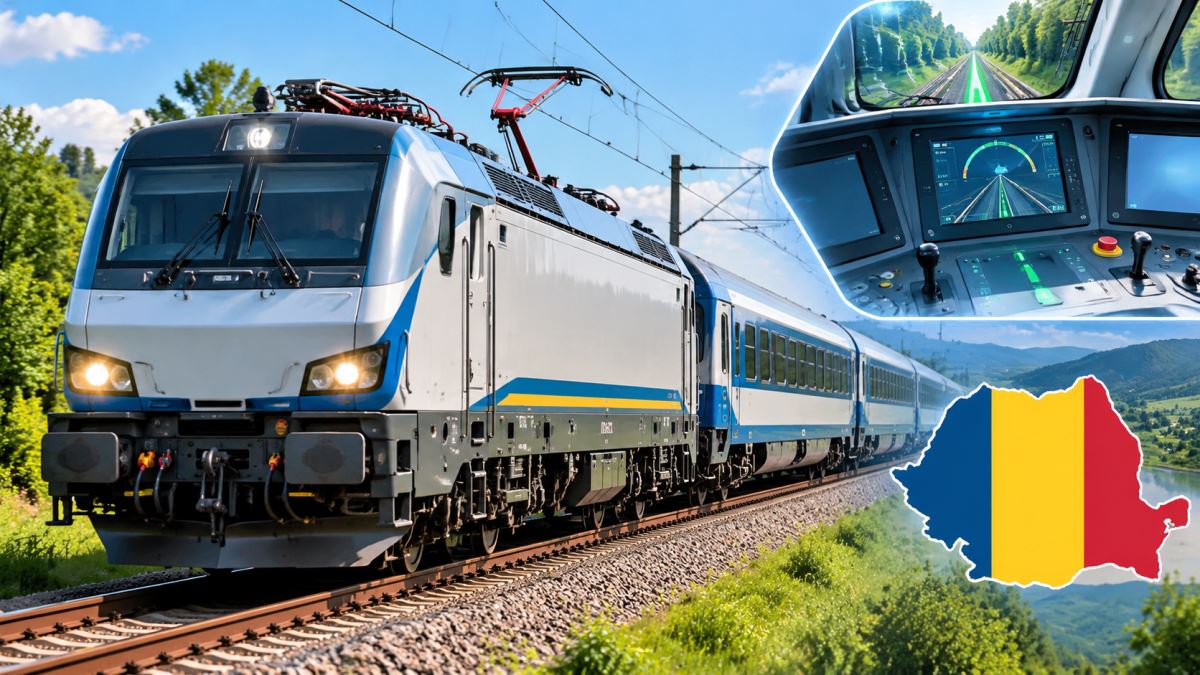
Romania takes delivery of all 16 Alstom Traxx electric locomotives: new fleet also brings ETCS Level 2
The Romanian railway sector has received a new group of electric locomotives after Alstom delivered the final vehicle from a series of 16 units ordered for Autoritatea pentru Reformă Feroviară (ARF), the Romanian agency responsible for railway reform. On 19 November, the manufacturer announced that delivery had been completed according to the agreed schedule, bringing to a close a multi-year procurement project for new locomotives intended for passenger services. The final unit was handed over to the customer and is being prepared for entry into service, while the remaining locomotives have already been progressively introduced into operation. The first production locomotive was delivered in April 2026, and passenger services using this type of vehicle began in September. According to Alstom, the new fleet is primarily intended to strengthen the reliability and efficiency of services on longer routes.
The contract also includes long-term maintenance
The procurement is part of a contract signed by Alstom and ARF in January 2024. It provides for the delivery of 16 Traxx electric locomotives, together with maintenance and repairs over a period of 20 years. The contract includes the possibility of extending this period by an additional 20 years, subject to the conclusion of a separate supplementary agreement. This model links vehicle delivery with long-term technical support, which is important for maintaining fleet availability after the start of regular operations. Alstom states that maintenance work will be carried out by its personnel at dedicated maintenance facilities that are currently being expanded. This means that the contractual obligation does not end with the handover of the final locomotive but also includes support throughout a substantial part of its planned operational lifespan.
The contract is part of broader cooperation between ARF and the manufacturer on renewing Romania’s railway rolling stock. The locomotives were delivered progressively throughout 2026, and completion of the series means that the customer and the national passenger operator now have access to all the contracted units. Alstom emphasises that the project’s objective is to improve the reliability and efficiency of long-distance railway services. The impact of the procurement will become apparent through locomotive availability, their regularity in service and their ability to meet the requirements of different passenger services. Delivery of the entire series does not mean that all units have been assigned to the same routes simultaneously, as they are being progressively introduced into operational service.
Designed speed of 200 km/h, Romanian approval limited to 160 km/h
The Traxx Passenger locomotives have four axles and are designed for a maximum speed of up to 200 kilometres per hour. However, they have been approved for a maximum speed of 160 kilometres per hour on the Romanian railway network, meaning that their design capability must not be confused with the speed permitted in regular operations in that country. According to the technical specifications published by the manufacturer, each locomotive can haul a train consisting of up to 16 passenger coaches. This capacity allows them to be used on trains with a larger number of coaches, including longer intercity and night services.
The locomotives’ multi-system configuration has been designed for operation on networks with different power supply systems, making them easier to use in international railway traffic. Alstom states that the Traxx platform supports cross-border operations and that its energy-efficient design and longer maintenance intervals are expected to contribute to greater vehicle availability. These are design characteristics, while their actual impact will also depend on infrastructure conditions, operating regulations and the organisation of the operator’s activities. Locomotive capacity and reliability are important for maintaining scheduled departures, but the overall journey time also depends on track permissions, stops, train composition and traffic conditions.
ETCS Level 2 enters commercial passenger service for the first time
The most important technological development associated with this fleet is the commercial use of the European Train Control System, ETCS Level 2, in Romanian passenger railway traffic. On 3 November, Alstom announced that the country’s first passenger service had begun operating with a locomotive equipped with this system working together with the corresponding trackside signalling and safety infrastructure. The service operates on the section between Buftea and Brazi on the Bucharest-Budapest route, which is operated by the passenger carrier CFR Călători. According to the manufacturer, this marks the first time in Romania that ETCS Level 2 equipment on a vehicle and the corresponding trackside infrastructure have been used simultaneously in commercial passenger operations. The locomotives are equipped with Alstom’s Onvia Cab in-cab signalling system.
ETCS is a common European standard designed to monitor train movements and improve the compatibility of railway traffic between countries. At Level 2, the system enables continuous information exchange between the train and trackside equipment, providing the driver and monitoring system with data about operating conditions. Alstom explains that ETCS monitors train movements in relation to permitted operating conditions and can automatically activate braking if safety limits are exceeded, for example if a train travels too fast or approaches another train too closely. This operating method complements traffic management procedures, while the common European standard reduces the need for different national solutions and facilitates interoperability on international corridors.
It is important, however, to distinguish the introduction of ETCS on a single section from the complete modernisation of the entire railway network. According to information published by Alstom, operational Level 2 implementation in this case is limited to the Buftea-Brazi section and does not cover all the lines used by the new locomotives. Passenger services using Traxx locomotives began in September 2026 with conventional signalling systems, before commercial operations using ETCS Level 2 were launched on the aforementioned section of the route. This demonstrates that new vehicles can be introduced into service even where signalling modernisation is being carried out progressively. At the same time, the full benefits of the digital system depend on infrastructure equipment being installed on the specific sections, as well as on compatibility between the vehicles and trackside equipment.
New vehicles are part of a broader railway infrastructure renewal programme
The introduction of modern locomotives is only one part of the technological changes taking place on Romanian railway lines. Alstom states that it is also involved in signalling, traffic management and electrification projects on several important railway routes in the country. Among the projects highlighted by the company are sections of the Rhine-Danube Corridor, the Cluj-Oradea railway line, the Caransebeș-Lugoj section and the modernisation of the Bucharest-Giurgiu route. The company states that it has been present in Romania for more than 30 years and employs more than 2,000 people, reflecting its role in signalling and electrification projects as well.
For railway operators and passengers, the connection between investment in vehicles and investment in tracks, power supply and signalling is important. A locomotive may have the technical capability to travel at high speeds, but this capability can only be used where permitted by the infrastructure and official approvals. Similarly, ETCS Level 2 can deliver its expected benefits only when both the train and the corresponding railway section are equipped. In the case of Romania’s Traxx fleet, the handover of all contracted units and the start of commercial operations using ETCS represent two related but separate stages of modernisation. The project’s success will be demonstrated by reliability in everyday operations, maintenance efficiency and the expansion of digital signalling.
Sources:
– Alstom – confirmation of the completion of delivery of all 16 locomotives and the fleet’s technical specifications
– Alstom – launch of commercial passenger operations using ETCS Level 2 and explanation of the system
– Alstom – contract with ARF for 16 locomotives and long-term maintenance
Note: This content was prepared with the assistance of artificial intelligence tools.
Tags
Romania
railways
Alstom
Traxx
electric locomotives
ETCS Level 2
passenger rail
rail modernization