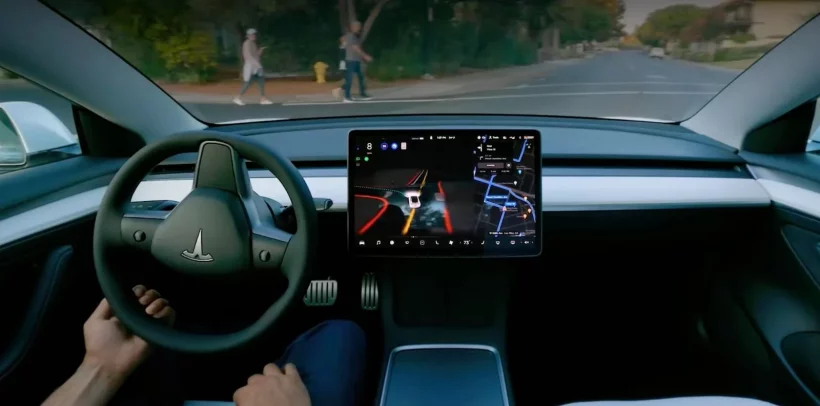

The Italian Ministry of Transport has granted temporary approval for the operation of Tesla Assisted Driving—the official name for the company’s Full Self-Driving (Supervised) suite in the European region. Italy is the twelfth European nation to legalize the technology and the first major EU market to reach such a decision.
Rome chose not to wait for an official verdict from Brussels. A vote by the relevant European committee regarding union-wide recognition of the technology is not expected until December.
Deputy Prime Minister and Minister of Transport Matteo Salvini announced the move on X. He stated that the ministry (MIT) gave the green light following a rigorous technical safety review, bypassing the broader European approval procedure, which he described as still in development.
Tesla’s European division responded quickly with the concise message: “Now approved in Italy, rollout coming soon,” accompanied by a video of an electric vehicle driving through Rome. No specific launch date has been announced yet.
What Is Assisted Driving in Italy
The system remains a Level 2 driver-assistance feature. The software can steer, brake, accelerate, navigate intersections, and perform lane changes, but the driver must remain fully alert and holds ultimate responsibility for operating the vehicle.
How Italy Reached This Decision
The Dutch RDW authority acted as the pioneer, approving FSD Supervised on April 10 under Article 39 of the EU’s vehicle type-approval regulation. Other nations can subsequently recognize this approval at the national level on an individual basis.
Before Italy, ten countries had already followed suit: Belgium, Croatia, the Czech Republic, Denmark, Estonia, Finland, Latvia, Lithuania, Slovakia, and Slovenia. These are primarily smaller markets. Together with the Netherlands, they cover roughly 70 million people, accounting for about 15% of the EU population.
With Italy’s population of nearly 59 million, the December decision effectively doubles the percentage of Europeans eligible to use the autopilot, bringing the total closer to 30%.
Rome’s stance shifted rapidly. Back in April, Senator Carlo Calenda urged Salvini’s ministry to fast-track the legalization. Later, on October 29, Salvini reported a constructive conversation with Elon Musk regarding support for EU-wide approval. However, three weeks later, Italy opted for national authorization.
Much has changed in the interim. Tesla dropped the “Full Self-Driving” branding in Europe following concerns from the German Ministry of Transport regarding misleading terminology, and reduced the maximum speed-limit offset from 50% to 10%. Additionally, on November 16, the RDW regulator mandated stricter driver-attention monitoring, including a requirement to keep hands on the steering wheel when traveling above 130 km/h. This is the version Italy has now legalized.
The Outlook for the December EU Vote
The EU Technical Committee on Motor Vehicles (TCMV) postponed the vote on Tesla to December after preliminary discussions in October. EU-wide approval requires a qualified majority: at least 15 of the 27 member states, representing at least 65% of the EU population.
In October, German authorities confirmed their willingness to support the initiative after Tesla agreed to rebranding and speed limits. If Berlin follows through, Germany, along with the 12 countries that have already approved it, would cover about 47% of the bloc’s population.
While a significant step forward for the manufacturer, it remains far from the 65% threshold. France refused to approve the technology at the national level in July, and Spain has yet to recognize the Dutch verdict. The automaker needs the vote of at least one of these countries, combined with the support of the remaining skeptics.
Editor’s Take
This is a clear win for the company and for Italian owners of HW4-equipped EVs, who have long been paying for a feature they couldn’t use at home. Italy is the first major European market to say “yes,” which strengthens the brand’s position ahead of the December discussions.
Nevertheless, it is somewhat unexpected that Europe will receive an even safer version of FSD than the one available in the US. Hopefully, these changes will be reflected in real-world safety statistics, should that data ever be released.
Don’t miss interesting news
Subscribe to our channels and read announcements of high-tech news, tes