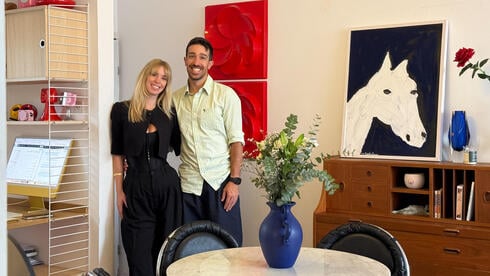
When Ronny Erdan moved from Ashdod to Tel Aviv at 21, her tight budget led her to furnish her apartment with curbside finds and secondhand purchases.
Nearly a decade later, what began as a way to save money has evolved into a field of expertise and two businesses. Her home in Tel Aviv’s Bavli neighborhood now serves as an ever-changing collection of distinctive vintage pieces.

Ronny and Roy in the entryway, between the secretary desk, dining area and workspace
(Photo: Noam Ron)

Even the concrete-look wall can be dismantled and taken to the next apartment
(Photo: Noam Ron)
Designer furniture sits alongside curbside finds and family heirlooms, while Erdan’s engineering background is reflected in her fascination with the materials and manufacturing techniques behind each piece.
The rented apartment she shares with her daughter, Tamar, and her partner, Roy, has become a colorful, eclectic home that evolves with every new acquisition and shift in mood.
Who lives here: Ronny Erdan, 29; her daughter, Tamar, 4; and her partner, Roy Sides, 29
Occupation: Doctoral student in environmental engineering, trained mechanical engineer and owner of two vintage businesses — one specializing in vintage furniture and decorative objects, the other an online vintage jewelry store called NUMERO 11
Location: Bavli neighborhood, Tel Aviv
Size: 678 square feet (63 square meters)
Time in residence: Two years

Works by Kadishman alongside an ever-changing collection of vintage pieces
(Photo: Noam Ron)
“I grew up in Ashdod in an ultra-modern, all-white home where everything was brand-new,” Erdan says. “My parents are still shocked that I bring secondhand items into my home or, worse yet, things I’ve picked up off the street. My love of vintage began nearly a decade ago, when I moved to Tel Aviv and couldn’t afford to furnish my apartment.
“I started collecting whatever I could find on the street or at markets. As an engineer, I was drawn to the quality of materials used in older furniture and the craftsmanship and technological innovations behind pieces from the 1950s, ’60s and ’70s. Over time, I learned to identify different styles, periods and designers. I’m a lifelong student, so vintage design became another subject I taught myself.”
“As a student, I worked three jobs, including one at the Bob Vintage store in Jaffa, to support a passion that eventually grew into a business. Today, I sell furniture and accessories through a WhatsApp group and on Facebook Marketplace. I also run an online vintage jewelry store that started with my own collection.
“I buy pieces from around the world, visit house clearances and have built relationships with many dealers. I keep lists of items I’m looking for, but ultimately, I buy whatever catches my eye. I consider vintage pieces an investment, much like art or gold, so I’m not afraid to spend substantial sums on them.

Chairs from New York and a sideboard once owned by a Holocaust survivor. The kitchen retains its original fittings, as the apartment is rented
(Photo: Noam Ron)
“My home is constantly changing. The rule is that whenever something new comes in, something else has to go. Sometimes I search for a particular piece for years, but once I’ve found it and enjoyed it, I have no problem letting it go.
“I believe the law of conservation of energy applies to objects, too. Someone loved them before me, I love them now and I believe that love stays with them, passing positive energy on to others.”
How did you find this apartment?
“I posted on Facebook that I was looking for a place to live. A woman reached out and told me she was moving out of an apartment that would be perfect for me, but it wouldn’t be available for another six months. At the time, I was living in a separate unit at my parents’ home and began collecting pieces for my new apartment.
“Since we moved in, the apartment has changed countless times. The sofa has faced every possible direction in the living room, and sometimes a single new find can prompt me to rethink the entire room.

Works by Israeli artist Menashe Kadishman appear in several rooms
(Photo: Noam Ron)
“Because it’s a rental, everything I’ve added can be dismantled and removed, even the concrete-look wall in the living room.
“I’m a single mother and work long hours, so I rarely have time to get away. My home has become my own vacation retreat. It’s where I choose to invest, my escape from the daily grind. Being at home feels like staying at a hotel.”
“I bought the Danish teak secretary desk in the entryway from a woman who owned a vintage store. For years, I would see her photographing the items she was selling on that desk, and every time, I’d ask her to sell it to me. She kept turning me down until she decided to move abroad and finally agreed to sell it to me.
“Above it hangs a work by Menashe Kadishman that I acquired through a trade on Facebook Marketplace. I acquired the large piece hanging next to it through a similar trade. I love Kadishman. To me, he represents the pinnacle of Israeli art.
“On the desk is a Murano glass vase that belonged to my grandmother, and on the wall are plastic relief decorations from IKEA dating back to 2007, which have now become vintage pieces themselves.”
“I bought the marble dining table at Items Gallery, and it’s been with me for years. Around it are chairs by Italian designer Gastone Rinaldi, which I bought from a lawyer who moved from New York to Israel and brought an extensive collection of vintage furniture with him in a shipping container. They’re in excellent condition and still have their original upholstery.

“Next to the dining area stands a signed rosewood sideboard that I bought from the grandson of a Holocaust survivor. He told me his grandfather had brought it from the Netherlands after the Holocaust and that it had remained in the family ever since.
“The moment I saw it, I knew I’d found a real treasure. I love learning the history of the pieces I buy. I feel it adds another layer of meaning to an object.
“Above the sideboard are mirrors I ordered from the United States, and on top of it are a mirror and a lamp by EDITION by.”
“In the living room, I created an accent wall with a concrete finish using removable drywall panels.
“The sofa and armchair by Brazilian designer Percival Lafer have rosewood frames and original leather upholstery, which was professionally preserved. I used to have a green fabric sofa here, but because of Tamar, I decided to switch to leather, which is easier to clean.

A mirror designed by Ronny, inspired by the work of Gustaf Westman
(Photo: Noam Ron)

“There are five marble tables in the living room, including a Castiel piece from the 1980s, one by EDITION by and others made of Carrara and Statuario marble. I love the natural veining of marble and how no two slabs are alike
“One table holds a 1970s Weltron radio next to a German Space Age-style vanity. Another features a telephone and a Toucan lamp from the same era, along with a Murano glass ashtray that belonged to my grandmother.
“The rug is vintage from the 1970s, and I designed the large mirror inspired by Gustav Westman and had it custom-made.”
“When Roy moved in with me, we created a workspace for him that was originally connected to mine.
“The shelves hold a collection of ceramics from the Ein Gedi series by Israeli manufacturer Lapid. I love how the designs capture the essence of the desert landscape, and I’ve always admired Lapid’s work.

Roy’s workspace showcases Ronny’s collection of Lapid’s Ein Gedi ceramics
(Photo: Noam Ron)
“The chair is one of the few pieces Roy brought with him. It’s an original Sides chair bearing the manufacturer’s signature. The prominent Israeli furniture company was once owned by his family.
“Later, we found three more chairs just like it on the street. It was a moving, full-circle moment.”
“My workspace is centered around a String shelving system I bought from IDANA. I called them almost every day asking for a discount until they finally agreed.
“I love how modular these units are, how you can take them apart, move them around and create new arrangements every time.
“The chair is a locally made version of the Tulip chair. On the shelves are a miniature 1970s Lipstick mirror and a vintage hat display called Twiggy, named after the British model. I’m particularly fond of it, although it scares Tamar a little”

Ronny’s workspace with its modular shelving system and Tulip chair
(Photo: Noam Ron)
“Tamar’s room is also filled with vintage pieces and curbside finds, including the curtain. The blanket dates to the 1970s, and the wardrobe came from a house clearance.
“Inside are Murano glassware, ceramics by Israeli manufacturer Beit Hayotzer, vintage Disney dolls and Japanese wooden figurines.

Almost everything in Tamar’s room was salvaged from the street, right down to the curtain
(Photo: Noam Ron)

The Zara Home play kitchen is secondhand, too
(Photo: Noam Ron)
“On the purple shelves is a sign I had custom-made, alongside an embroidered tapestry of a cat, because Tamar really loves cats.
“The chair, made from recycled materials, is from a brand carried by Tollman’s. Both it and the Zara Home play kitchen were bought secondhand.
“I give Tamar plenty of freedom at home, and she’s already started her own vintage collection.”
“Our bedroom features an oil painting from Hungary, a mirror and lamp from the 1970s, a Murano glass dog and an Australian wool rug I ordered from overseas.
“Roy and his father built the custom cabinetry, and the Hollandia bed is one of the few new pieces in the apartment. The bedding is by Rangoli, handmade in India.”

The couple’s bedroom: The bed is the only new addition
(Photo: Noam Ron)
“I love being surrounded by things that have a story, even if I don’t always know it. There’s an energy to them that you can feel.”
Noam Ron is an architect, designer, photographer and writer who explores the stories behind distinctive urban homes.