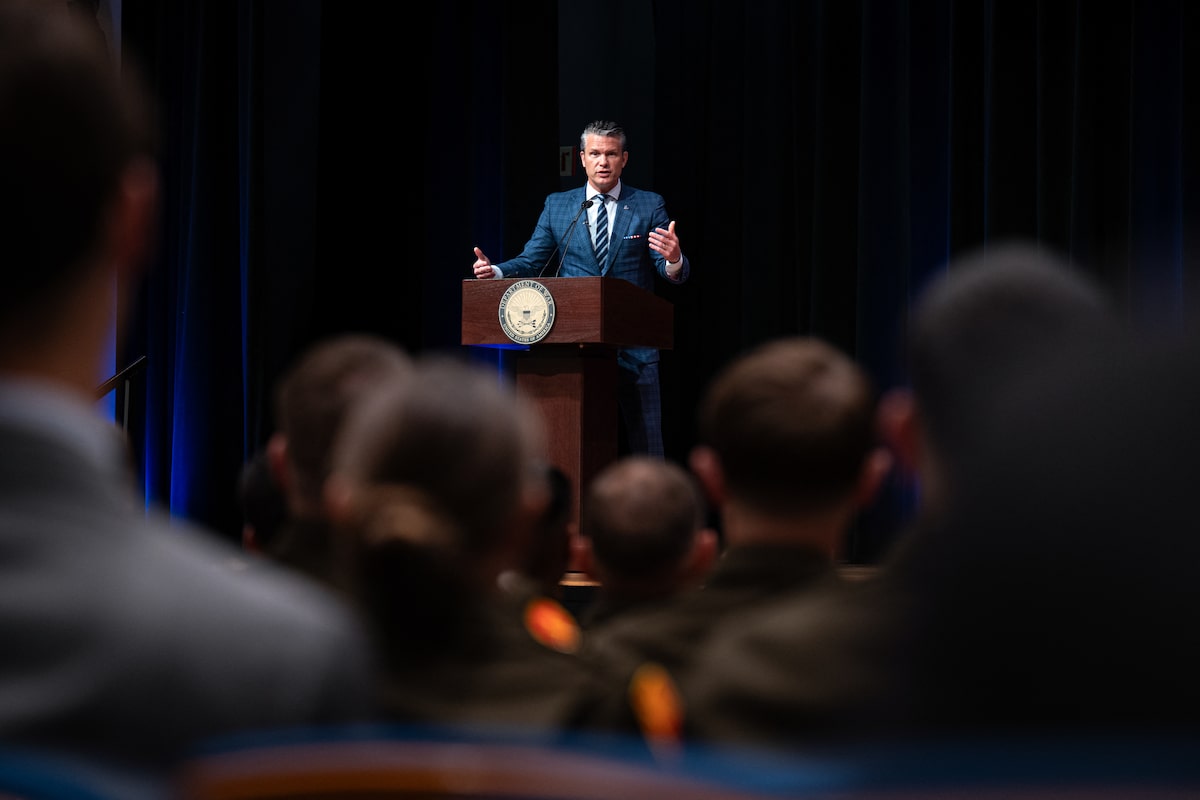
U.S. Defence Secretary Pete Hegseth speaks during a ceremony at the Pentagon. Senior leaders of the Canadian Armed Forces were not aware of the memo reportedly issued by Mr. Hegseth last week, sources say.ANNABELLE GORDON/AFP/Getty Images
U.S. Defence Secretary Pete Hegseth has reportedly issued a classified memo on “new restrictions” Washington is imposing on military co-operation with Ottawa – but the Canadian military and government are unaware of any such restrictions and it is not clear what they would be.
A Washington Post report on Friday, citing unnamed officials, said Mr. Hegseth wrote the memo last week. The Post said it had not seen the memo and did not provide any details about what those restrictions are.
The senior leaders of the Canadian Armed Forces were not aware of the memo, three military sources with direct knowledge of the situation told The Globe and Mail, and learned of it from the Post story.
The Canadian government and military have received no communication, formally or informally, from the U.S. government regarding the memo or any alleged plans to reduce defence co-operation, the three military sources and a senior government source said.
Two senior military sources said all military to military relationships are currently operating normally and Canada plans to stay the course.
The Globe is not identifying the sources as they were not authorized to speak publicly.
Neither the Prime Minister’s Office, the Defence Minister’s Office or the Minister of Canada-U.S. Trade’s office would comment on the situation.
In response to The Globe’s questions about the reported memo, the Pentagon’s chief spokesman said major elements of the Canada-U.S. defence relationship will not change.
“This guidance does not impact defence intelligence co-operation, our binational NORAD command, or our co-operation through NATO,” Sean Parnell said in a statement Friday evening.
Given that Mr. Parnell had ruled out restricting such broad areas of bilateral military co-ordination, the Canadian military sources said it was hard to tell what would actually be affected. They pointed to military-to-military exchange programs as one possibility.
Mr. Parnell said the Pentagon is “taking steps to ensure its engagements with Canada advance tangible U.S. defence objectives.”
He did not specify what these steps are, but added that Washington is “prioritizing opportunities for bilateral co-operation that strengthens the defence of our Homelands and shared hemisphere, while supporting Canada’s ability to meet NATO obligations.”
The development comes amid annoyance by Trump administration officials at Canada’s decision to hold off on buying U.S.-made F-35 fighter jets as well as the ongoing trade war launched by President Donald Trump against his northern neighbours.
In May of this year, the Trump administration suspended participation in a joint defence advisory board with Canada, complaining about Prime Minister Mark Carney’s January speech at the World Economic Forum.
Elbridge Colby, the U.S. undersecretary of defence for policy, announced the decision on X and linked it to Mr. Carney’s Davos speech, in which the Prime Minister called for the middle powers of the world to band together and resist mistreatment by global “hegemons,” in what was largely viewed as a repudiation of Mr. Trump.
“Unfortunately, Canada has failed to make credible progress on its defence commitments,” Mr. Colby wrote, admonishing Ottawa to prioritize “hard power over rhetoric.”
In a subsequent Pentagon briefing for Canadian reporters, a U.S. official criticized Ottawa’s decision last year to review its previous commitment to buy 88 F-35s from Lockheed Martin. Canada announced the review after Mr. Trump began threatening to annex the country as the U.S.’s “51st state” and imposed tariffs.
The official also said Canada had not laid out a concrete plan for spending five per cent of GDP on defence by 2035.
The Globe and Mail agreed not to name the official as a condition of taking part in the briefing.
The May move had little practical effect. The suspended body, the Permanent Joint Board on Defense, only met sporadically and was a forum for discussing major strategic issues in Canada-U.S. defence and making recommendations. Founded in 1940 and made up of military leaders and diplomats, it had seen its influence wane after the Cold War.
The Canadian government contended that the U.S.’s criticisms were unfair. Since taking office last year, Mr. Carney has stepped up Canadian military spending, reaching NATO’s two per cent of GDP benchmark and committing to Mr. Trump’s demanded five-per-cent-by-2035 level.
Canada has also pushed back against Mr. Trump’s global trade war significantly more than most other countries, imposing retaliatory tariffs and walking away from a tentative agreement in August.
The two sides are currently negotiating again. Mr. Trump on Friday said his administration is “working on making a deal” and Mr. Carney was “very nice” when the pair met in China this week. But he also repeated his usual complaints that Canada is “ripping us off” and a “difficult” country to deal with.
On Sept. 18, The New York Times reported that FBI Director Kash Patel had ordered the FBI to temporarily suspend intelligence sharing with the RCMP. The article came after a tweet from Mr. Patel in August detailing his outrage over a CBC policy that directed journalists not to refer to the events of 9/11 as terrorism.
National security sources told The Globe that the RCMP had started monitoring for any issues with intelligence sharing or co-operation after the tweet. The sources said the Force found no evidence intelligence sharing and co-operation had stopped. There was also no chilling of the relationship as had been alleged in the Times article, according to those sources.
Days after The Globe’s report RCMP Commissioner Michel Duheme told a Parliamentary Committee on Sept. 24 that the FBI-RCMP relationship remained robust and close.