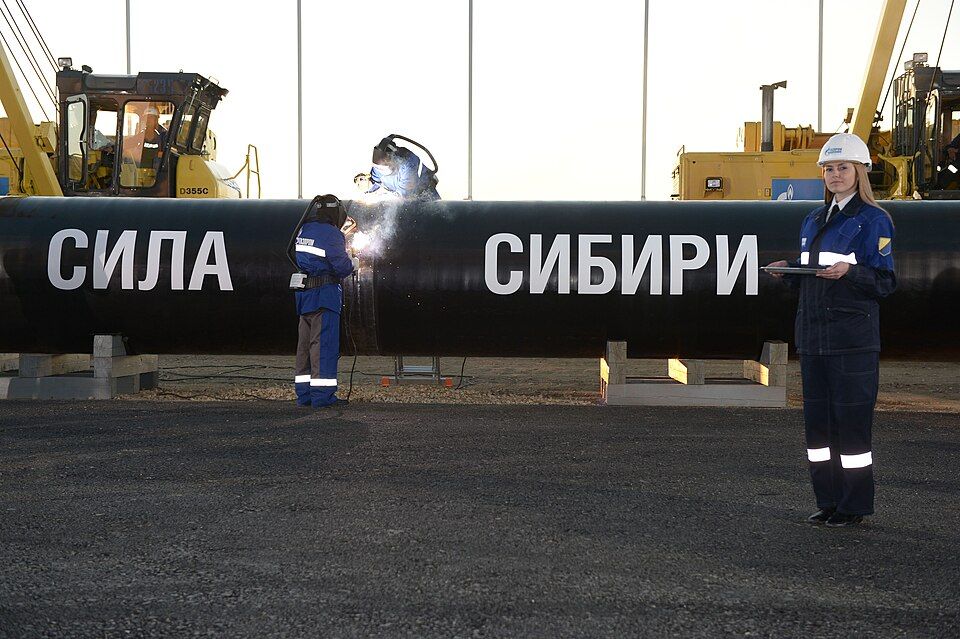
Since the start of the Russia-Ukraine conflict, the energy markets of Russia have been greatly impacted by the Western sanctions. China emerged as one of the largest importers of Russia’s energy, mainly oil and gas. China currently consumes 31% of Russia’s gas through the Power of Siberia 1 pipeline and both countries plan to increase the supply up to 50 billion cubic meters (bcm) by the end of this year. In this context, both countries are working to establish another gas pipeline, Power of Siberia 2 (PoS-2); a 2600km long pipeline originating from Western Siberia through Mongolia to China. The PoS-2 has emerged to be a critical test of Russia-China relations as it raises a fundamental question for Moscow: does the eastward energy pivot strengthen its strategic position, or risk deepening its dependence on Beijing? The recent reports on PoS-2 suggest a halt to the proposed timeline due to disagreement over pricing, where Beijing is using its upper hand in bargaining. This op-ed will examine the political economy of Power of Siberia 2 through the lens of asymmetric interdependence, assessing how market access, pricing, financing, and alternative energy options shape the bargaining power of both countries. It argues that Russia needs this deal more than China does, and that this imbalance tells us more about the Russia-China partnership than any joint communiqué.
What is PoS-2?
The planned gas pipeline is an extension of Power of Siberia-1 pipeline through which China bought 38bcm gas in year 2025. The PoS-2 is expected to increase the gas import to China by 50bcm passing through Mongolia from the Arctic gas fields of Yamal. Gazprom, which would build Power of Siberia 2, began studying the project’s feasibility back in 2020. Five years later, in September 2025, it announced a legally binding memorandum with China for a 30-year supply arrangement. Once completed, this pipeline would be nearly equal to Nord Stream 1, which is Russia’s largest and one of the most important former gas pipelines to Europe, with a capacity of 55bcm. At first glance, the PoS-2 appears to offer a mutually beneficial arrangement for both Russia and China. For China, it presents an opportunity to diversify its energy supply routes and mitigate potential energy vulnerabilities amid escalating instability in the Middle East. For Russia, it offers an alternative export route to compensate for the loss of access to traditional European energy markets following the Russia-Ukraine war and the subsequent Western sanctions. However, situation on the ground is different as the project faces significant hurdles to achieve the objectives it wants.
Why is China reluctant?
China’s reluctance stems from a combination of economic, environmental, and strategic considerations, particularly its broader objective of diversifying energy imports and avoiding excessive dependence on a single supplier. The primary concern is energy security, as the planned pipeline, together with existing gas imports from Russia, would account for around 98bcm to China. This would cover a quarter of China’s gas consumption, which is against China’s desired objective of diversifying gas imports. Over the past decades, China has strived to diversify its imports and has built pipelines from Turkmenistan, Uzbekistan, Kazakhstan, and Myanmar, along with LNG terminals that can receive cargoes from more than 20 countries. Adding two more Russian pipelines would make Russia the source of roughly a third of China’s gas, counting LNG.
The second issue is the economics, where even if Moscow offers discounted prices, China will need to build several hundred kilometers of new pipeline through the desert to reach the Bohai Economic Rim, which already has a dense and mature gas network. This is where Russian imports would compete with already present gas imports from the Bohai Sea, Shaanxi gas and other Russian pipelines, causing oversaturation. The problem is further compounded by seasonality, as half of northern China’s gas use is household heating, so if gas must travel farther south during low-demand months, costs rise further. Beijing’s hesitation, therefore, should not necessarily be interpreted as a lack of interest in Russian energy cooperation, but rather as a calculated effort to protect its strategic autonomy, energy security and economic interests.
This project also carries geopolitical implications. Russia’s growing dependence on the Chinese energy market following Western sanctions could gradually shift the balance of bargaining power in Beijing’s favor. Moscow, however, remains cautious about China’s expanding influence, particularly in its Far Eastern territories, and has resisted Chinese investment in parts of its pipeline infrastructure. Russia sees the pipeline very differently. Officially, it is a partnership of equals. Putin has described the deal as mutually beneficial, with gas prices to be “market-based.” Beneath the rhetoric, Moscow’s logic is strategic rather than commercial. For Russia, the project is less about profitability than about securing an export outlet to replace the European market it has lost. Russia also wants to keep control over its side of the project: Gazprom has financed and built the earlier pipelines to China on its own and financing for this one remains an open issue. Officials insist that talks are moving forward, with both sides agreeing to keep drafting a supply contract so companies can reach terms faster.
Both countries gain from Power of Siberia 2, but not equally. For China, it is one more option among many: a hedge against maritime chokepoints, but one it can afford to delay until the price is right. For Russia, it is closer to a lifeline, and every year without a deal makes the sale more urgent and the terms more favorable to the buyer. That imbalance matters beyond one pipeline. It shows how dependence works in practice. The weaker party announces, the stronger party waits, and “partnership” becomes a description of Moscow’s hopes rather than Beijing’s commitments. Until a price is signed, the “no limits” friendship has at least one limit: Beijing’s willingness to pay.
[Photo by Kremlin.ru, CC BY 3.0, via Wikimedia Commons]
Ayesha Sikandar is a Research Associate at the Strategic Vision Institute, Islamabad, Pakistan. The views and opinions expressed in this article are those of the author.