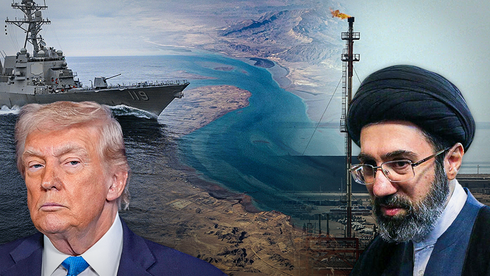
Western intelligence has gathered information in recent days indicating that Iran is preparing the vessels to leave the Persian Gulf for the Gulf of Oman, apparently en route to China. According to Euronews, more than 14 tankers have assembled near Iran’s main oil export terminal on Kharg Island, where they have been loaded with oil, assigned crews and placed under Iranian flags.

(Photo: AP/Alex Brandon, Atta KENARE/AFP, REUTERS/Stringer, Lance Davis/United States Navy/Huntington Ingalls Industries)
Iranian media, including the Fars news agency, have discussed a proposed operation dubbed “Operation Fereydoun,” named after a hero from Persian mythology. Under the plan, the tankers would sail openly under Iranian flags, potentially announcing their destination in China in advance.
Some proposals have called for keeping the vessels’ Automatic Identification System (AIS) transmitters switched on, rather than concealing their movements as Iran’s shadow fleet typically does to evade sanctions. Iranian television discussions have also raised the possibility of placing journalists, civilians and international antiwar activists aboard the ships to increase the diplomatic cost of American intervention.
Tehran is apparently considering another way around the blockade: transferring Iranian oil to foreign tankers that the U.S. Navy would not ordinarily intercept.
Such a maneuver may already have been tested. According to United Against Nuclear Iran (UANI), which monitors Iranian shipping, approximately 200,000 barrels of crude oil were transferred from the tanker OLYM to the HAO FAN south of Kharg Island on November 17. There is no evidence that the cargo subsequently escaped the blockade, and the purpose of the transfer remains uncertain.
The U.S. Central Command subsequently expanded enforcement of the blockade to include vessels receiving Iranian oil through transfers at sea. According to UANI, no tanker carrying Iranian crude has successfully departed the Gulf of Oman and evaded U.S. enforcement since the blockade was reinstated in July, although some smaller vessels carrying liquefied petroleum gas have passed through.
The proposed convoy appears to be part of a broader Iranian effort to break the military and diplomatic stalemate in the Gulf, which has placed growing pressure on the country’s economy. American sanctions and the naval blockade have severely restricted Iran’s oil revenues, compounding energy and electricity shortages that could worsen during the coming winter.
Iran is also losing its ability to use the Strait of Hormuz as its primary source of leverage over Washington and global energy markets.
Strait of Hormuz: oil tankers set ablaze in the strategic waterway last week


That pressure was reflected in remarks last week by Mohsen Rezaei, a former commander of the Islamic Revolutionary Guard Corps who now heads Iran’s Supreme National Security Council. Rezaei, regarded as particularly close to Supreme Leader Mojtaba Khamenei, said he had received instructions to bring the current state of “neither peace nor war” to a swift conclusion.
Foreign Minister Abbas Araghchi echoed that message and said Iran intended to break the naval blockade. On Saturday, Deputy Foreign Minister Kazem Gharibabadi went further, describing the American blockade as an act of war and declaring that Tehran would take whatever measures were necessary to end it.
At the same time, Gharibabadi emphasized that Iran remained willing to pursue negotiations through mediators, including Qatar.
The proposed escalation appears designed to achieve three objectives: restore oil revenues, deter further American pressure and force Washington into a decision over whether to risk another military confrontation.
The immediate economic goal is to restore at least some Iranian oil exports and replenish the country’s rapidly shrinking foreign currency reserves. According to international energy data company Kpler, revenues from Iranian crude oil and condensate exports could fall to zero by mid-December.
If the U.S. Navy allows the convoy to pass, Tehran could potentially earn several billion dollars from the cargoes, providing the government with urgently needed revenue and handing it a political victory over Washington.
The second objective is deterrence. Tehran’s message is that if Iran cannot export oil, its neighbors may also find their ability to export energy severely disrupted. Threatening Gulf oil and gas infrastructure would allow Iran to turn an economic crisis affecting its own population into a regional and potentially global problem.
The third objective is to force President Donald Trump into a difficult choice. Stopping the convoy could trigger attacks on Gulf energy facilities and a sharp rise in global oil and gas prices. Allowing it through, however, would weaken the credibility of the American blockade and provide Tehran with both an economic and symbolic victory.
Iranian planners appear to calculate that the threat of a regional energy crisis could deter a joint U.S.-Israeli military strike and improve Tehran’s bargaining position in future negotiations.
U.S. Central Command, led by Admiral Brad Cooper, has several military options for intercepting the vessels, but each carries significant risks.
One possibility would be to disable or destroy some of the tankers through direct strikes. Such action could send a powerful deterrent message, but it could also cause a major oil spill in the Persian Gulf, drive up energy prices and give Tehran a pretext to attack oil facilities in neighboring Arab states.
A more limited option would involve precision strikes against the tankers’ engine rooms to prevent them from continuing their journey. But such an operation would still carry the danger of civilian casualties, particularly if Iran places journalists and other noncombatants aboard the vessels as proposed in Iranian media discussions.

Admiral Brad Cooper: The head of US Central Command faces difficult choices if Iran attempts to break the naval blockade
(Photo: CENTCOM)
The U.S. military could also attempt to seize the tankers using Marines deployed aboard naval vessels south of the Persian Gulf, supported by helicopters and boarding craft. Thousands of Marines are reportedly available for such an operation.
However, if Tehran places armed Revolutionary Guard personnel aboard the tankers, the American forces could face a violent confrontation during the boarding attempts. Such a scenario would recall the Israeli Navy’s 2010 interception of the Turkish Mavi Marmara, which attempted to breach Israel’s naval blockade of Gaza.
Any clash at sea could leave Trump facing pressure to launch a broader military operation against Iran, potentially in coordination with Israel.
There is also another possibility: Iran may be engaging in brinkmanship, bringing the situation to the edge of confrontation to extract concessions without necessarily seeking a full-scale war.
Israel’s intelligence community and the IDF are closely monitoring the Iranian preparations, particularly the possibility that the convoy could begin moving toward the Strait of Hormuz in the coming days.
Based on experience from recent months, the prevailing Israeli assessment is that if the Americans move to stop the ships and a military confrontation develops, Iran would not necessarily retaliate against Israel immediately. Instead, Tehran could initially concentrate its attacks on oil and gas infrastructure in neighboring Gulf states.
However, an American counterattack against Iran could change that calculation, potentially drawing Israel into a renewed joint military campaign.
For now, the critical question is whether Tehran intends to carry out the operation or is using the preparations primarily to increase pressure on Washington.
The departure of the tankers from Kharg Island toward the Strait of Hormuz, particularly if accompanied by official Iranian announcements, would be a strong indication that Tehran had decided to put its threat to the test.
According to the information currently available from public sources, however, there is still no confirmation that Iran’s leadership has issued a final order for the convoy to sail.