Back to Article List
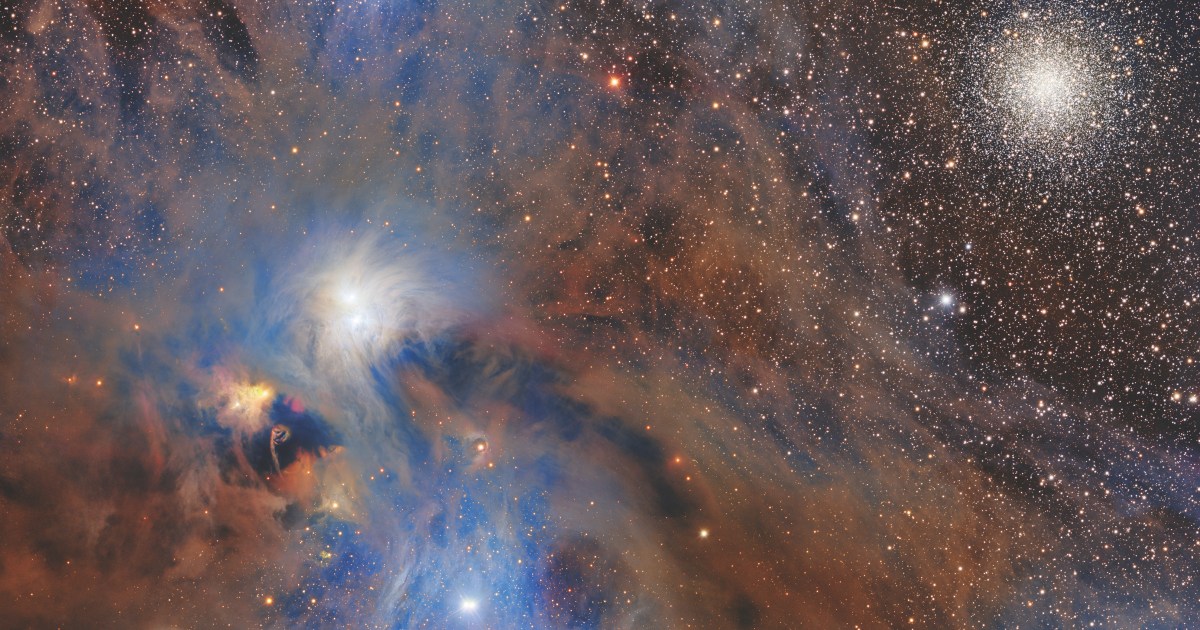
The young, star-forming Corona Australis Molecular Cloud shares this scene with the aged Chandelier globular cluster.

Credit: Dark Energy Survey/DOE/FNAL/DECam/CTIO/NOIRLab/NSF/AURA
Credit: Dark Energy Survey/DOE/FNAL/DECam/CTIO/NOIRLab/NSF/AURA
A stunning stellar nursery lurks at the northern border of Corona Australis. The Corona Australis Molecular Cloud fills the left side of this image with glowing gas and dark dust. Although most of the newly forming stars remain hidden within this web, the variable R Coronae Australis just shines through. It dwells in the orange cloud to the lower left of the bright emission nebula that dominates just left of center. Several bluish reflection nebulae also populate this area. The molecular cloud lies 430 light-years away, among the closest star-forming regions to Earth, and holds enough material to create thousands of stars. Contrast that with the Chandelier Cluster (NGC 6723) at upper right. This globular contains hundreds of thousands of stars and resides about 28,000 light-years from us. It inhabits far southern Sagittarius.
Richard Talcott is a former senior editor and current contributing editor of Astronomy.