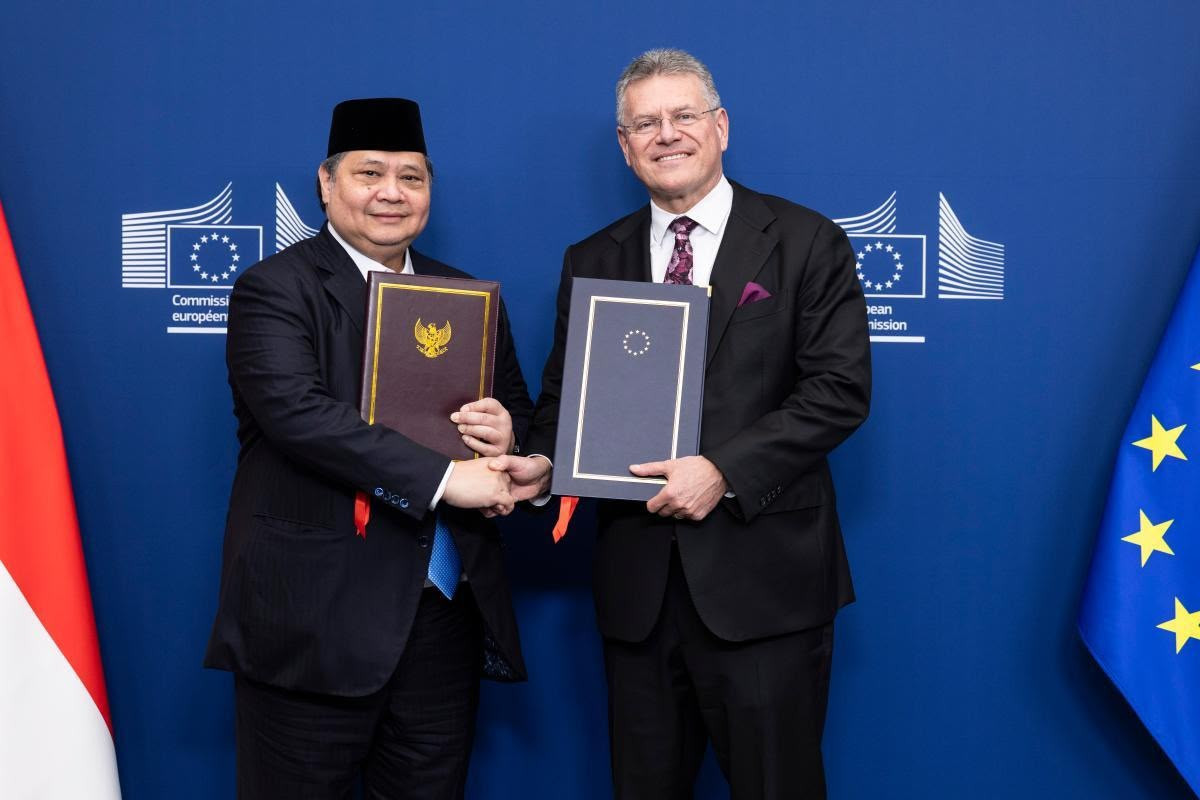
he government expects the Indonesia-European Union Comprehensive Economic Partnership Agreement (IEU-CEPA), which was signed on Saturday, to boost the country’s exports to the EU by 14.4 percent, or around 2.6 billion euros (US$2.85 billion). However, analysts noted that the benefits will depend on the timely implementation of the deal.
Coordinating Economy Minister Airlangga Hartarto claimed that businesses on both sides should begin feeling the benefits by Jan. 1, 2027, at the latest.
In Indonesia, garments are expected to record the largest export gains at 779 million euro, followed by leather and footwear at 652 million euro and vegetable oils at 512 million euro. The deal is also hoped to add 26.8 billion euro to the country’s gross domestic product by 2042.
“[The signing] is an important milestone, not an end goal. Today, we enter the implementation stage, which demands harder work than the negotiation process itself,” Coordinating Economy Minister Airlangga Hartarto said after the signing on Saturday.
Trade Minister Budi Santoso said the agreement will immediately eliminate import duties on 90.4 percent, or 8,820, of the EU’s 9,754 tariff lines for Indonesian products, with a further 7.92 percent to be phased out over three to 15 years, bringing total coverage to 98.35 percent.
“More than 98 percent of EU tariff lines will provide preferential market access for Indonesia’s leading export products, such as palm oil and its derivatives, footwear, textiles, fisheries products, rubber, furniture and various other manufactured goods,” Budi said on the same event.

Every Monday
The agreement will immediately eliminate duties on 1,143 tariff lines for Indonesian textiles and garments, 78 for footwear and all 14 for palm oil and palm kernel oil, alongside selected downstream products such as oleochemicals, margarine and glycerol.