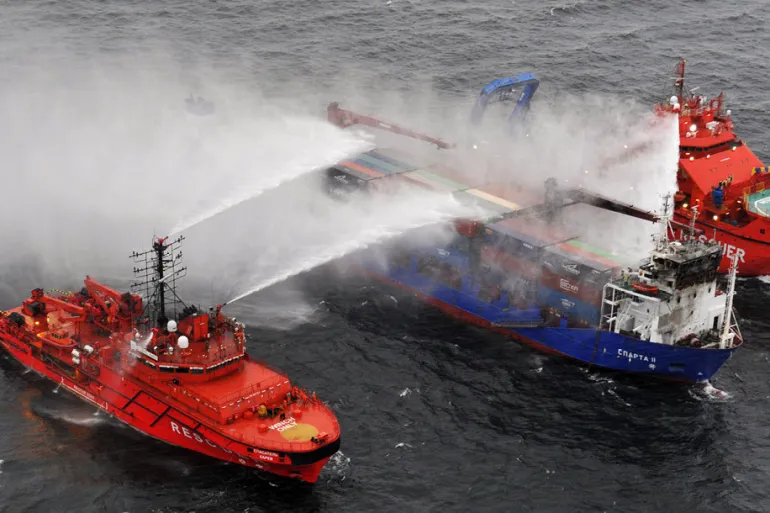
The FINANCIAL– The damaged Russian cargo ship Sparta II was towed out of Finland’s economic zone on Sunday, November 22, ending the Finnish Border Guard’s rescue mission, the Finnish public broadcaster Yle reported, citing the coast guard.
The departure followed a drone strike on Saturday and a fire that brought Finnish, Estonian and Russian vessels into a joint rescue effort in the Gulf of Finland. All sixteen crew members were evacuated; one suffered a slight injury, Reuters reported.
Yle said maritime and aviation restrictions imposed around the operation had been lifted. Its evening update reported that the ship had left both Finland’s economic zone and the area for which Finland was responsible for preventing environmental damage.
Finnish Interior Minister Mari Rantanen said the authorities had stabilized the situation and avoided environmental damage, according to Yle. Prime Minister Petteri Orpo thanked the personnel involved and Estonia for the participation of its vessel Kindral Kurvits.
A stable tow followed a prolonged fire
The Russian rescue vessel Murman began towing Sparta II on Sunday afternoon. In its announcement of the tow, the Finnish Border Guard said the damaged ship was listing slightly but remained stable enough to move.
Thermal cameras showed that some containers were still warm, although no flames were visible from outside. The announcement described an operation that would first take the ship beyond Finnish territorial waters and then beyond Finland’s maritime rescue responsibility area.
The Finnish patrol vessel Uisko, Estonia’s Kindral Kurvits and rescue tugs operated by Alfons Håkans supported the tow within the Finnish responsibility area. A Border Guard helicopter monitored the condition of the cargo ship and possible threats to the marine environment.
The Border Guard said it had not detected fuel or hazardous-substance leaks. Its plan provided for a transfer of responsibility once the vessel left the Finnish area, at which point the Finnish rescue mission would end.
Reuters reported that seven vessels had helped fight the fire: two Russian, two Estonian and three Finnish. The response brought Russian crews together with personnel from Finland and Estonia, both NATO members, while Finnish officials coordinated the operation inside their area of responsibility.
The evacuation began before the tow
The Border Guard’s Saturday evening account placed Sparta II at anchor off Loviisa, with a fire still burning aboard. It said the crew had left in lifeboats before being transferred to a nearby cargo vessel.
A restricted area had been established around the site. The Finnish resources named in that account included Uisko, patrol boats, a surveillance aircraft and helicopters. The agency also identified the rescue tugs Ajax and H. Kanter as participants in firefighting and cooling.
Murman had joined the operation at the Finnish Border Guard’s request. The agency said it was preparing for marine-pollution response together with rescue departments, while the plan was to make it possible to tow the disabled ship into the Russian area of responsibility. It described environmental protection as part of that towing plan.
The Saturday statement said authorities were not aware of danger to surrounding maritime traffic. It also recorded a separate investigation into an aircraft’s suspected violation of Finnish territorial airspace, which continued while the maritime rescue was under way.
Firefighting also required controlling the ship’s stability
In its Sunday morning update, the Border Guard said firefighting and cooling were continuing with several units, including Estonian and Russian resources. Uisko coordinated the work at the scene under Finnish leadership.
The agency described a constraint on the use of water: crews had to prevent it accumulating inside the hull in quantities that could cause the ship to lose stability or sink. The task therefore involved managing the condition of the vessel as well as suppressing the fire.
That morning’s statement again said officials were not aware of danger to surrounding traffic. It also said the suspected airspace-violation investigation remained active. The later towing announcement followed those earlier efforts to keep the damaged ship sufficiently stable to move.
Weather was another concern at Sunday’s briefing. Yle reported maritime operations director Jukka-Pekka Lumilahti’s account of winds of seven to ten meters per second and waves of one to two meters. He said conditions were expected to worsen the following day, a forecast made while authorities were working to move the disabled vessel.
The cargo remained unidentified
Earlier Sunday, Yle quoted coast guard commander Joni Sjöberg as saying firefighting had continued through the night and was still in progress that morning. At that stage, the intention was to move the ship out of Finnish territorial waters after the fire was extinguished.
Sjöberg said the crew’s evacuation had been completed and that its members had been transferred to a Russian rescue vessel. The operation also involved cooling containers aboard Sparta II. Their contents were unknown, Yle reported.
Professor Katarzyna Zysk of the Norwegian Defence University College told NRK, in remarks cited by Yle, that confirmed Ukrainian involvement would fit a strategy of limiting Russia’s ability to sustain the war and attack Ukrainian civilians.
A military-linked vessel on a Baltic route
Euronews identified Sparta II as a 121-meter, Russian-flagged cargo vessel operated by Oboronlogistika, a logistics company associated with Russia’s Defense Ministry. The ship was traveling from St. Petersburg toward Kaliningrad when it was attacked.
Kaliningrad is Russia’s Baltic exclave between Poland and Lithuania. Euronews reported that the ship was struck by two drones in the eastern Gulf of Finland, west of Gogland Island, on November 21. It caught fire, lost the ability to maneuver and drifted into Finnish territorial waters.
The Finnish military assessed that Ukraine was likely responsible. Ukrainian authorities had not publicly confirmed responsibility in the reporting available on Sunday. That assessment did not establish the attacker’s identity or the purpose of the strike, and no confirmed account identified military equipment aboard.
The U.S. sanctions record predates the attack
The U.S. Treasury’s Office of Foreign Assets Control listed Sparta II in a May 8, 2022 sanctions update. That entry identifies it as a Russian-flagged roll-on, roll-off vessel with International Maritime Organization number 9160994.
The entry links the vessel to Oboronlogistika and records gross tonnage of 7,260. It appears among vessels added to the Specially Designated Nationals list under the Russia-related Executive Order 14024 program. The record is a historical designation from 2022, predating the November 2026 fire and rescue.
Finnish officials weighed rescue and seizure
Yle reported that Finnish authorities considered seizing the ship but judged towing the burning vessel toward shore to be highly risky for maritime and environmental safety. Border Guard maritime-safety director Mikko Hirvi said Russia towing it away was the best solution for Finland.
Henrik Ringbom, a maritime-law professor at Åbo Akademi University, told Yle that inviting Russian vessels to help was a normal response to a maritime emergency. He said the vessel was in distress and its crew needed rescuing, despite Russia’s war against Ukraine.
Joel Linnainmäki, a researcher at the Finnish Institute of International Affairs, welcomed the technical dialogue between Finnish and Russian authorities. He said it mattered for the Gulf’s environment and for avoiding the costs of keeping the ship and its cargo in Finland.
Linnainmäki also said boarding the vessel would have created further questions about the legal basis for taking custody of its cargo and what Finland would then do with it. His assessment concerned the options facing Finnish authorities during the emergency.
FAQ
Did Finland’s rescue mission end?
Yle’s Sunday evening update, citing the coast guard, said the ship had left Finland’s responsibility area and the mission had ended.
Was Ukraine’s responsibility confirmed?
No. Finnish military officials assessed Ukrainian involvement as likely; Kyiv had not publicly confirmed it in Sunday’s reporting.