
“Infiltrators”, “Bangladeshis”, “illegals”. These words have defined most of 26-year-old Noorul Amin’s life. A Rohingya refugee who arrived in India in 2007 at the age of eight, Amin and his family made their way from Kolkata to Jammu and then Delhi, surviving by collecting garbage and selling scrap.
On November 19, Amin, like other Rohingya refugees in Bangladesh and around the world, watched as the International Court of Justice delivered its verdict finding Myanmar guilty of committing genocide against the country’s minority Rohingya population.
“The truth has been brought forward,” Amin told Scroll from Delhi, where he lives with his wife, also a refugee from Rohingya, and three children. “The whole world has came to know about the genocide that happened to us.”
Though the ICJ ruling was on charges brought by The Gambia on Myanmar’s military operations in 2016 and 2017 in the western Rakhine state, the court observed that Muslim minority ethnic group had, for decades, faced persecution in Buddhist-majority Myanmar.
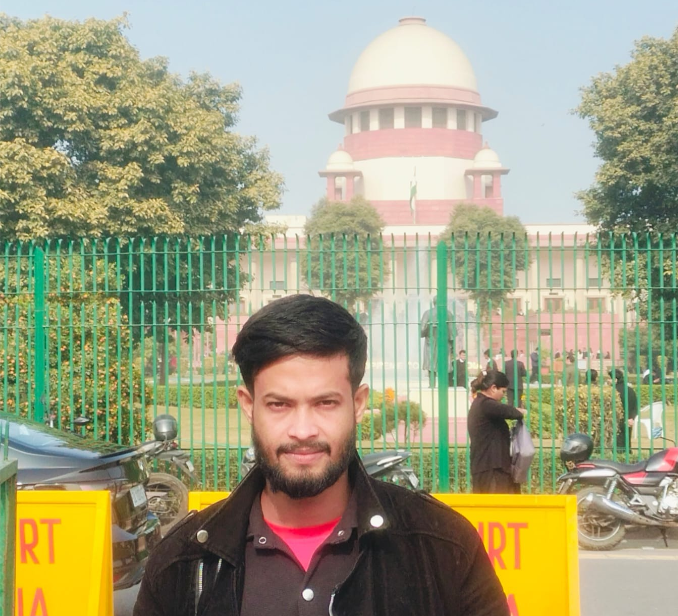 Noorul Amin outside the Supreme Court of India in New Delhi. Credit: Special arrangement.
The verdict notes that Myanmar instituted discriminatory legal and administrative measures that progressively eroded the “political and civil rights of the Rohingya in Rakhine State in the decades leading up to the 2017 clearance operations, leaving the group marginalized and particularly vulnerable”.
Amin’s early life and that of his wife’s family is witness to this long history of the persecution of the Rohingya in Myanmar. While Amin and his family fled Myanmar in 2007, his wife, Zahida, left in 2020, as an 18-year-old, after the military excesses of 2017.
The ICJ ruling said that the 2017 operations by the Myanmar army in Rakhine killed an estimated 10,000 Rohingya and prompted at least seven lakh of them to flee to Bangladesh.
Zahida’s eldest brother was shot dead in 2017. Her other brother was arrested and has been in detention since 2023. “There is still no word on whether he is alive or dead,” she said. Her father died of a heart attack soon after that.
For the Rohingya who made their way to India, life has been hard here as well. Political and communal rhetoric in India has vilified Bangladeshi migrants as “infiltrators”. India is not a signatory to the UN refugee law or protocols, maintaining that “existing laws for dealing with foreigners are sufficient to deal with refugees”. Rohingya refugees, like Amin and his family, have also been swept up in India’s crackdown on “Bangladeshi migrants”.
In May 2025, Amin’s five family members were among the 40 Rohingya refugees who were flown to the Andaman and Nicobar Islands and then thrown into the Andaman Sea. Indian authorities forced them off a navy vessel and left them to swim into Myanmarese territory with nothing but life jackets.
Amin said he hopes that at least now, after the ICJ verdict, the Indian government will think more kindly of the Rohingya refugees. “We shouldn’t be subjected to atrocities,” said Amin. Finding work is a struggle, making it difficult to pay rent, which can cost up to Rs 5,000- Rs 6,000 a month, plus money for food and electricity. “If we eat food for two days, we don’t eat for four days,” said Amin.
He said refugees like him want to return to their homeland. “We will leave India once we get our rights, our land and property, citizenship and security,” he said.
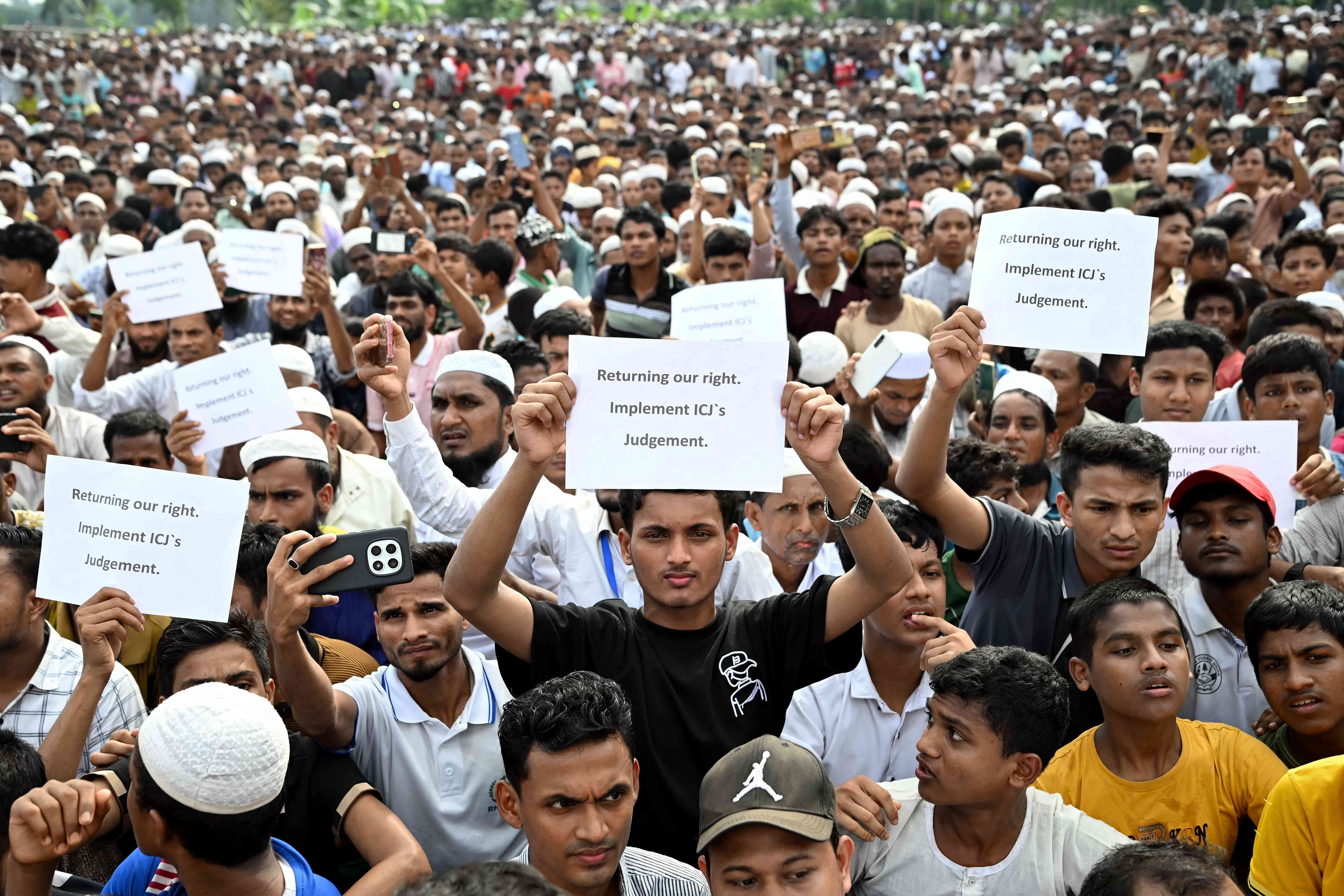 Rohingya refugees wait for the arrival of UN General Assembly President Khalilur Rahman in at a camp in Bangladesh’s Cox’s Bazar on November 20. Credit: AFP.A journey by boat, a gold jhumka
Amin remembers his long journey to India, a country he grew up hearing about. “When we were young in our country, we used to watch many Indian films and listen to songs and see Indian people,” said Amin.
In 2007, when he was around eight years old, his parents and other refugees put together a boat using bamboo and banana trees to escape a “bloodbath” in Myanmar. They climbed onto the boat, which floated down the river, and made their way to Bangladesh.
According to the Human Rights Watch, the Myanmar military had been carrying out abuses against the Rohingya in late 2006, including forced evictions and forced labour.
After two months in an overcrowded refugee camp, with food and education becoming a struggle, Amin and his family decided to travel to India. “We thought India is a big democracy where there is humanity,” he said.
Amin studied up to Class 9 at a government school in Jammu. He claims he was not allowed to continue his education after that. In 2020, got married to Zahida who had reached India that year.
Zahida told Scroll that she left Myanmar in 2020 on foot. She recalled her community being targeted since 2012. “The military would eye girls and take them,” she said. “My friends, who were in Class 5, 6, were taken away in front of my eyes…horrible things were done to them.”
The ICJ verdict said that “brutal acts of sexual violence” and the targeting of children of Rohingya communities were among the evidence supporting the conclusion Myanmar acted with “genocidal intent”.
In 2020, Zahida, who was then nearly 18, and three other children “started walking along whatever path we could find. “It led us to the Bangladesh border where we took a boat and crossed over,” she told Scroll.
In Bangladesh, they travelled by a rickshaw. “In my ear, there was one gold jhumka. I gave that to those people to get money to buy food and pay for our transport,” said Zahida. They made their way to Kolkata and then Delhi. Amin’s parents got her married to him as she had no one else.
For two years, Zahida never knew what happened to her family. Zahida’s mother and third brother have since returned to their home in Rakhine where they live in makeshift huts, still fearing for their lives.
“They asked us to help save them,” said Amin. But he doesn’t have the money for that. “We need at least Rs 30,000 to bring them to Bangladesh and eventually India,” he said.
Two detentions in India
Sabber Kyaw Min, founder and director of Rohingya Human Rights Initiative, told Scroll that as per the latest figures, that there are an estimated 22,000 Rohingya refugees in India.
Since 2011, the UN has been issuing refugee cards to those in India, including the Rohingya. These cards are proof of identification and aimed at preventing harassment and arrest of refugees.
Human rights and legal experts have often criticised India’s treatment of refugees. Some say India needs a separate law to deal with refugees in the country in a humane manner and enable them to contribute economically to the country.
Amin told Scroll that he and his family held UN refugee cards but were still detained while his parents were forcibly pushed out of India in 2025.
In 2020, after getting married, Amin, Zahida and his parents were detained from their jhuggi in the Rohingya camp in Shaheen Bagh in Delhi. “When I was going to work, the police stopped me on the road saying that ‘You are illegal’,” he said.
They were taken to the Kalindi Kunj Police Station at Madanpur Khader. Zahida was three months pregnant then while his mother was 45 years old and his father was 55. “We asked the police why they brought us there. We told them that we suffered genocide and had come to India as guests,” Amin said.
Amin said the police refused to listen to them. He alleged that a police official lied about taking them to the office of the UN High Commissioner for Refugees and instead put them in a detention centre. “My wife and I were detained for five months,” he said, after which they were handed over to the UN refugee agency. “But my parents spent three years in a detention centre.”
Dragged out of a hospital
In 2024, Amin said his family got American visas as part of resettlement policy through the UN refugee agency. “But we got stopped because of Trump,” said Amin. Donald Trump was sworn in as US president in January 2025 and imposed various travel restrictions and immigration curbs soon after taking charge.
Then, in May that year, soon after the Pahalgam terror attack, the police in several Indian states began a crackdown on “Bangladeshis” and “infiltrators”, forcibly expelling them at the India-Bangladesh border. On May 2, 2025, India issued directives laying the process to deport “illegal Bangladeshi nationals/Rohingyas”.
Scroll has reported on how working-class, Bengali-speaking Muslims were forced out of India in the wave of ethnoreligious profiling and detentions after the terror attacks.
In May, the police detained Amin’s father and brothers and dropped them in the middle of the Andaman sea.
Days later, when the Supreme Court heard a writ petition about the deportation of the Rohingya refugees, the bench said it was a “beautifully crafted story”.
“That court said that India is not a dharamshala or shelter,” said Amin, referring to the Supreme Court’s remarks on a separate petition about the detention of a Sri Lankan Tamil man. “Our parents were never brought back either.”
Amin hopes that the verdict by the International Court of Justice will change how India deals with the junta regime in Myanmar. “If they [Myanmar government officials] come to India, they should be arrested,” he said. “We should get justice.”