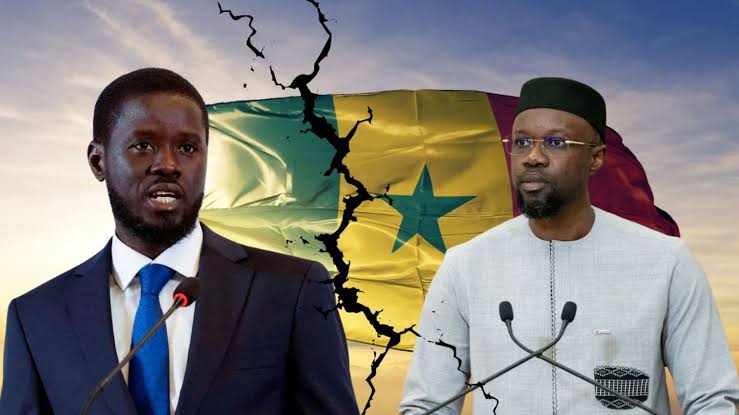
Senegal’s president and the speaker of its parliament won power together barely two years ago. They now disagree over a budget the IMF wants passed before it releases $2.2 billion in financing.
How they settle, or fail to settle, their quarrel will shape whether Dakar secures the money.
Parliament has already shown its hand. On 3 November, 126 of 165 lawmakers voted down the government’s revised 2026 budget.
The result gave the first hard evidence of how much trouble President Bassirou Diomaye Faye faces at home.
From political allies to adversaries
Faye and Ousmane Sonko came to power together in 2024. Sonko led the PASTEF party and backed Faye as its presidential candidate after a defamation conviction barred him from the race.
Once Faye won, he made Sonko prime minister.
Policy disagreements now drove them apart. Faye’s government opened talks with the IMF and moved towards reworking the country’s obligations. Sonko opposed conventional restructuring, calling it a “disgrace,” and argued Senegal should rely more on domestic revenue.
Faye dismissed Sonko as prime minister on 22 May 2026. Four days later, Senegal lawmakers elected him Speaker of the National Assembly. He kept the leadership of PASTEF, which holds 130 of the 165 seats, so losing the premiership cost him little legislative power.
Sonko described the split as “definitive” at a meeting in Dakar last week. The remark left little room for a quiet reconciliation.
Both men now hold positions from which they can obstruct each other.
A budget in limbo
PASTEF opposed the revised 2026 budget on the grounds that the government’s debt and deficit figures lacked credibility. The party also questioned spending priorities and said it had not received important documents.
The Finance Ministry rejected the complaint and said it had supplied further explanations and supporting papers.
The ministry added that the parliamentary committee had put forward no amendments or alternative measures. Lawmakers voted the bill down regardless. The episode suggested that the objection ran deeper than the technical detail of the text.
The fight has since moved on to the 2027 budget. The finance committee asked the government to withdraw its spending plan, and the Finance Ministry refused. The committee then rejected several parts of the draft, including the revenue and public debt plans.
The IMF has kept its distance. Its spokeswoman Julie Kozack said on 12 November that the Fund was not a party to discussions between the government and parliament. Staff reached agreement with Senegal in September on a three-year programme, but the Executive Board must still approve it.
The Board wants a budget framework that supports the agreed policies, corrective action on previously misreported debt and assurances of backing from Senegal’s financial partners.
The budget is the first of those conditions and the one now stuck.
What delay would cost Senegal
The Fund’s caution has a history. An audit found that the government under former President Macky Sall had understated public debt and budget deficits between 2019 and 2023. The discovery led the IMF to suspend its previous lending programme in 2024. A parliament-approved budget is part of how Senegal is expected to rebuild its credibility.
The programme matters beyond its headline sum. It could help Senegal manage its debt and draw further support from other lenders, including the World Bank and the African Development Bank. Until the Board signs off, none of that financing is available.
Pressure is building at home.
The new Prime Minister, Ahmadou Al Aminou Lo, said in September that government payment arrears had reached CFA1.956 trillion ($3.5 billion) by March 2025. He warned that the delays could slow economic activity and cost jobs.
 Senegal’s public external debt as the country seeks IMF funding
Seydou Ndiaye, a financial economist based in Dakar, told Businessfront that the damage would extend well past the loan.
“If this fight continues, Senegal will lose more than just the IMF money. Without a budget that parliament will pass, Senegal cannot prove to the IMF that it can manage its money.
“In the end, it is ordinary people who will suffer. Because the government will be forced to cut spending, and the Senegalese people will feel it first through higher prices, delayed projects, and fewer jobs,” Ndiaye said.
Can Faye go around Sonko?
The IMF has not said Sonko must personally back the programme. It requires Senegal to commit to the agreed policies and to carry them out through its own legal and institutional framework. In theory, this gives Faye room to proceed without his old ally.
In practice however, the arithmetic is unforgiving. PASTEF controls the Assembly and has already rejected the 2026 revision while challenging the 2027 proposals. Sonko’s twin roles as party leader and Speaker give him a firm hand over how legislation moves.
Faye could try to strike a deal with individual lawmakers. The dispute, however, sits between him and Sonko, and until they resolve it, the necessary budget measures may keep stalling.
Senegal’s constitution also requires the government to follow proper parliamentary procedure, which closes off any shortcut.
A staff-level agreement commits no funds until the Executive Board votes. Faye’s task has therefore widened beyond satisfying the Fund.
He must now find a route through a parliament run by the party of his former ally.