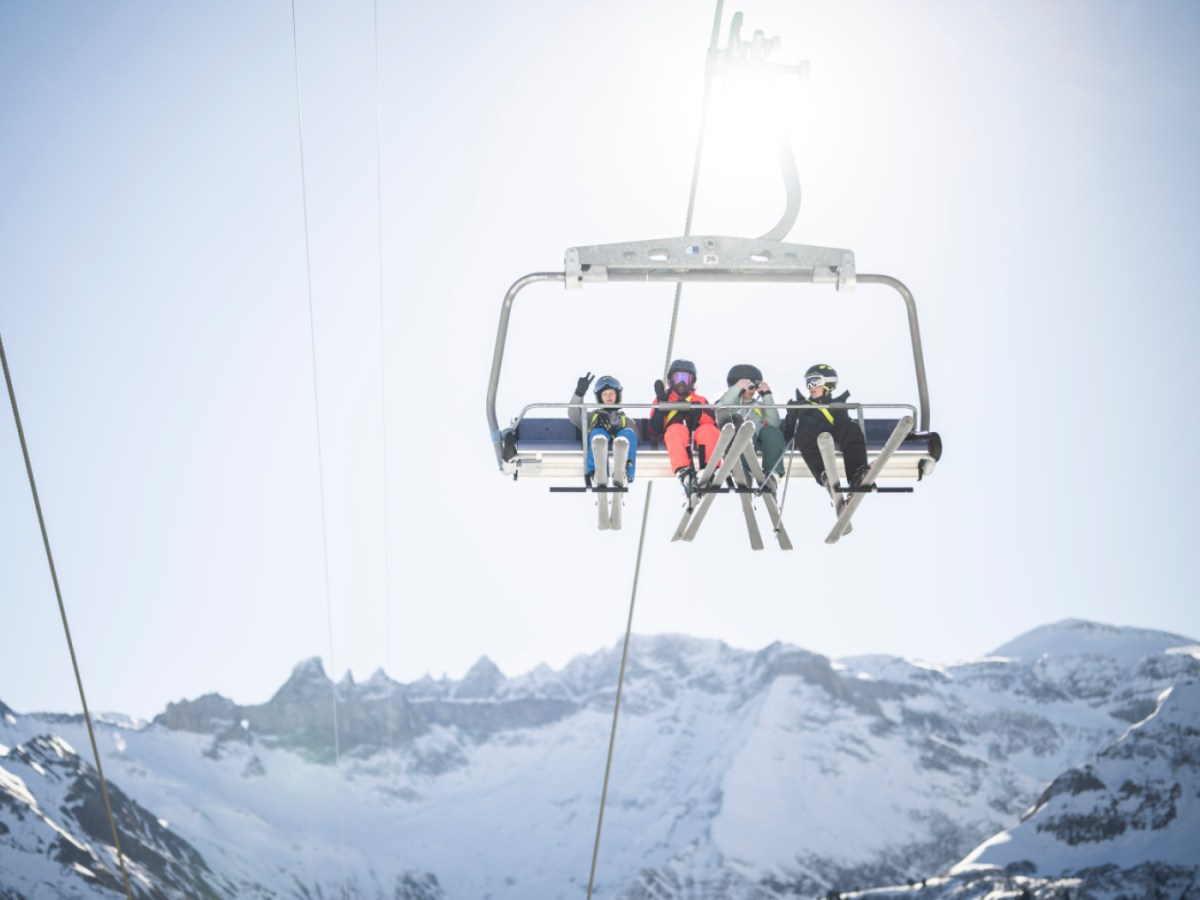

Drought does not slow down the start of the season for Swiss ski resorts
Keystone-SDA
Despite the dry and hot summer, the ski season can get underway on schedule: contrary to fears, the water shortage in the ski resorts has not affected the reserves needed for artificial snowmaking on the slopes.

The major mountain railways and ski resorts unanimously reported that their reservoirs were well filled, according to a survey by the Swiss News Agency Keystone-SDA. Furthermore, there have been more frequent thunderstorms in the mountains than in the lowlands, and there has recently been rainfall, said Kathrin Naegeli, head of corporate communications at the Jungfrau Ski Region.
Due to the many fog-free, clear and cold nights, the ground is currently even cooler than in other years. Furthermore, the altitude of between 1,800 and 2,500 metres ensures reliable snow cover, says Naegeli. In any case, the weather, wind and humidity are the key factors for producing artificial snow from November onwards.
Other regions in the Bernese Oberland are also taking a relaxed view of the start of the winter season. In the Meiringen-Hasliberg ski area, the snowmaking reservoir is full, explained Simon Schmid, head of marketing and sales. As things stand, there is nothing to prevent operations from running continuously from December 19. The ground is no warmer than usual, and prioritising individual slopes is standard practice anyway.
More

More
Climate adaptation
Drought conditions in Switzerland persist despite rainfall
This content was published on
Oct 12, 2026
The autumn rains that fell up until the weekend have only temporarily eased the drought, which remains severe in Switzerland.
Read more: Drought conditions in Switzerland persist despite rainfall
Graubünden ready
In the Graubünden ski resorts in eastern Switzerland, too, the summer drought appears to have left hardly any traces. On the Corviglia near St Moritz, the required water is stored at an altitude of 2,500 metres or higher in two natural reservoirs, said a media spokesperson.
As only meltwater and rainwater are used, groundwater and drinking water are not affected. Moreover, rainfall in the Upper Engadine was in line with the average.
In the Lower Engadine, Andri Poo, director of the Scuol Mountain Railway, is looking forward with confidence to the opening on December 12; the reservoirs are full and no groundwater is being used, Poo said. In San Bernardino, too, there is enough water available for Pian Cales, the only slope with artificial snow, said Nicolò Meroni, spokesperson for San Bernardino Swiss Alps.
More

More
Tourism Trends
Climate change in the Alps: five ways Swiss ski resorts are fighting for survival
This content was published on
Feb 15, 2026
Not all Swiss ski resorts have a future. How mountain destinations are coping with less snow and cost pressures.
Read more: Climate change in the Alps: five ways Swiss ski resorts are fighting for survival
No concerns in Central Switzerland
The situation is similar in Central Switzerland. In Hoch-Ybrig, the reservoir is completely full, said managing director Urs Keller. This means there is sufficient water available for snowmaking and drinking water. There are no signs that the start of the season will be delayed.
Stefan Ryser, director of Sörenberg – Lucerne’s largest ski resort – also does not anticipate either a shorter winter or an early end to the season. The resort relies on three interconnected water sources: the Eisee, the Schwand reservoir and the Waldemme. Although the Eisee is slightly below its usual level, Ryser expects operations over the festive period to go ahead as planned.
For their part, the Titlis Mountain Railways are considered a ski resort with very reliable snow conditions thanks to their altitude of over 3,000 metres and north-facing aspect. The Trübsee, from which they draw a contractually agreed volume of water, is well filled, said Fabian Appenzeller, head of communications at Titlis Mountain Railways. Additional snowfall is not currently required.
More

More
Climate adaptation
Drought in Switzerland: Europe’s ‘water tower’ runs dry
This content was published on
Aug 21, 2026
Rivers reduced to trickles, scorched landscapes and forests taking on autumn colours weeks ahead of schedule: such scenes highlight the severity of a drought unmatched in Switzerland for decades.
Read more: Drought in Switzerland: Europe’s ‘water tower’ runs dry
Confidence in French-speaking Switzerland
The same confidence prevails in Western Switzerland: At Télé-Villars-Gryon-Diablerets (TVGD), the water comes from a 45,000 cubic metre reservoir that was already filled with meltwater in the spring, said TVGD sales manager Félicien Rey-Bellet.
The flow from the spring that feeds the reservoir has fallen by only 10%. Furthermore, the dry ground offers an advantage: in frosty conditions, it cools down more quickly than waterlogged soil, which tends to favour snowmaking.
In Valais, too, the cable car operators have given the all-clear. While the dry spell has reduced reserves and necessitated “careful water management”, said Alain Michellod, marketing manager at Téléverbier, earlier precautionary water restrictions imposed by individual municipalities in the 4 Vallées ski area have long since been lifted.
There is therefore no need to fear any restrictions on snowmaking. As soon as temperatures drop, base snowmaking can begin without delay.
+ How we produce news in English
Translated from German, reviewed by an English Department journalist.

Articles in this story