Key Takeaways:
With COP 31 underway and the EU targeting a full phase-out of Russian gas by late 2027, Eastern Mediterranean gas from Israel’s Leviathan, Tamar, and Karish fields has become a regional shock absorber, supplying Jordan and Egypt and freeing LNG capacity for Europe.
The basin’s medium-term export potential of 30–40 bcm cannot replace lost Russian volumes or fully offset Hormuz disruptions, while infrastructure remains vulnerable to conflict, maritime disputes, and Turkish opposition.
Strengthening the Israel–East Med corridor, including Italian energy ties in Libya, reduces Moscow’s hybrid leverage and Beijing’s supply-chain dominance by diversifying both fuel sources and infrastructure partnerships.
While in Antalya the COP 31 is underway with a record attendance, ministers remain divided mostly over climate finance and phasing out fossil fuels. Phasing out fossil fuels is the fundamental step but for energy security, as for all securities, you always need the same 4 elements, the ‘Four As’: availability, affordability, accessibility, and acceptability (meaning mostly sustainability) and phasing out fossil fuels require time to keep those four guarantees.
Therefore, to reach energy security with those four elements, diversification of fossil fuel resources remains the main strategy to be applied. For the European continent in particular, some East Med actors are increasingly important. Turkey was traditionally an important hub, as a vital energy transit corridor between resource-rich regions—first of all the Caspian Basin and Russia, and energy-importing markets in Europe. But Europe’s push to insulate its energy system from geopolitical coercion has entered a decisive phase since Russia’s full-scale invasion of Ukraine, that pushed the EU to unwound its dependence on Russian gas, targeting a complete phase-out by late 2027. Yet 2026 demonstrated that escaping one vulnerability can expose others. Shipping disruptions in the Strait of Hormuz—which previously carried nearly a fifth of global liquefied natural gas (LNG) trade—sent benchmark European gas prices surging toward four-year highs and underscored how fragile global supply chains remain. Against this backdrop, Israel and other countries in the Eastern Mediterranean have emerged not as a silver bullet for Europe’s energy needs, but as an indispensable regional shock absorber against the Russian dependency and hybrid pressure and also in some way the Chinese supply-chain dominance.
Israel’s Offshore Engine and Regional Integration
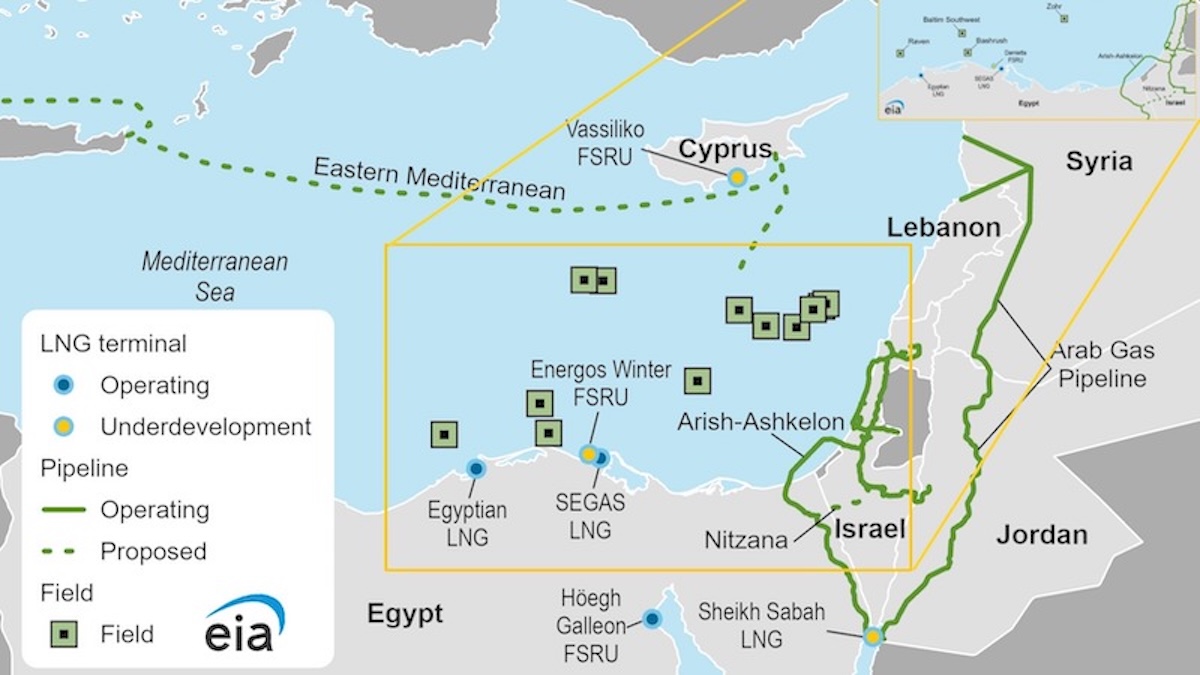
At the center of the Eastern Mediterranean energy architecture are Israel’s offshore natural gas fields—primarily Leviathan, Tamar, and Karish. With Leviathan alone holding roughly 600 billion cubic meters (bcm) of reserves, Israel has transformed from an energy importer into a vital regional supplier. Rather than relying on speculative, multi-billion-dollar subsea pipelines directly to continental Europe, Israel has anchored its exports in practical regional integration.
Through the Eastern Mediterranean Gas (EMG) pipeline and the Arab Gas Pipeline, Israel supplies steady volumes of gas to Jordan and Egypt, reinforced by a landmark 15-year, $35 billion supply expansion agreement with Cairo running through 2040. This flow serves a dual purpose for Europe. First, it stabilizes power grids in neighboring states facing domestic production declines and surging electricity demand. Second, when regional demand allows, Israeli pipeline gas frees up capacity at Egypt’s Idku and Damietta liquefaction terminals—alongside developing Cypriot fields like Cronos—to ship LNG cargoes north to European regasification hubs in Greece and Italy.
Diplomatically, the Eastern Mediterranean Gas Forum (EMGF)—bringing together Israel, Egypt, Greece, Cyprus, Italy, Jordan, France, and the Palestinian Authority, with the EU and the United States as observers—has institutionalized this cooperation. Beyond natural gas, Israel, Cyprus, and Greece are advancing subsea electricity interconnections, such as the Great Sea Interconnector, designed to link isolated grids into continental Europe and pave the way for cross-border solar power trade.
Realistic Constraints in a Contested Sea
Any serious assessment of the Eastern Mediterranean must balance its strategic promise against hard physical and political limits. In total, the basin’s medium-term export potential of 30 to 40 bcm annually cannot fully replace lost Russian volumes or absorb a prolonged closure of the Strait of Hormuz.
Infrastructure bottlenecks and security threats also weigh heavily on the region. Offshore platforms, coastal liquefaction plants, and subsea cables operate in an active conflict environment. During the regional escalations of 2025 and 2026, Israeli gas fields experienced temporary precautionary shut-ins, while drone strikes on port infrastructure near Damietta highlighted how quickly critical export nodes become targets once they gain strategic value. Furthermore, unresolved maritime boundary disputes and sharp opposition from Türkiye—which contests exclusive economic zones and opposes energy corridors that bypass Turkish territory—continue to complicate route planning and raise diplomatic friction. Recently Libya actually ratified a maritime agreement for new Exclusive Economic Zones (EEZs) with Türkiye to supports offshore oil and gas exploration claims and bolsters Ankara’s maritime arguments in the Eastern Med against Greece and Cyprus.
Countering Russian Hybrid Warfare and Chinese Leverage
Even with modest export volumes, strengthening the Israel–East Med corridor directly undermines the strategic leverage of both Moscow and Beijing in Europe’s energy sector.
For Russia, energy has long functioned as a primary instrument of hybrid warfare, paired with cyberattacks, disinformation, and covert surveillance of European subsea cables and pipelines. Every cubic meter of Eastern Mediterranean gas that reaches Europe—or displaces LNG demand in the Middle East so Atlantic cargoes can pivot toward European ports—erodes Moscow’s pricing power and ability to exploit winter storage deficits. Moreover, deepening maritime security coordination among Israel, Greece, Cyprus, and European naval forces creates shared intelligence and defense frameworks that harden critical undersea infrastructure against sabotage.
At the same time, Europe faces a subtler form of vulnerability from China. While Beijing does not weaponize gas pipelines, it dominates global clean-technology manufacturing and refines 19 out of 20 strategic energy minerals, many subject to export controls. Simultaneously, state-backed Chinese firms have spent years acquiring stakes in Mediterranean ports and European power grids. By co-investing in Eastern Mediterranean gas, grid interconnectors, and regional renewable hubs under EU-backed frameworks, European governments diversify both their fuel mix and their infrastructure partnerships—reducing reliance on concentrated Asian supply chains and keeping strategic Mediterranean corridors aligned with transatlantic partners.
Italian possible role
In today’s Mediterranean geopolitics the role played by Italian nation is also increasingly important, in particular in a crucial country of the North Africa as energy provider, Libya. Libya’s largest international energy operator remains the Italian Oil National Company (ENI, which translates to National Hydrocarbons Authority), serving as the primary supplier of domestic power generation fuel and a critical link in European energy security. Operating in the country since 1959, the Italian energy major produced roughly 162,000 barrels of oil equivalent per day in equity output in 2025 and is currently spearheading an investment wave exceeding $8 billion to expand offshore gas output.
I recently participated to the annual conference in Washington DC, by the Association for the Study of the Middle East and Africa (ASMEA), in which many academic papers were presented by scholars from all over the world but in particular Mediterranean countries and Africa. One paper was presented by an Italian scholar, professor at the Niccolo Cusano University in Rome, on “Eni’s Energy Diplomacy and the Consolidation of Algerian Sovereignty (1962–1978)”, showing how the Italian multinational energy company helped build Algerian sovereignty through institutional advice, training, and engineering, but also became the counterpart against which Algiers asserted it. Italian ENI could play a similar role today, given the needs of European energy security diversification. In that direction goes for example the recent contract worth over €400 million awarded to Italian contractor Rosetti Marino by Mellitah Oil & Gas—the joint venture between Libya’s National Oil Corporation (NOC) and Eni North Africa, playing a role also in reducing Russian footprint in Libyan energy.
In this new era where energy corridors are frontlines of hybrid competition, Israel, Italy and its Eastern Mediterranean partners offer Europe proximity, shared security interests, and vital flexibility—helping ensure that neither Moscow’s coercion nor Beijing’s supply-chain leverage can dictate Europe’s energy future.
