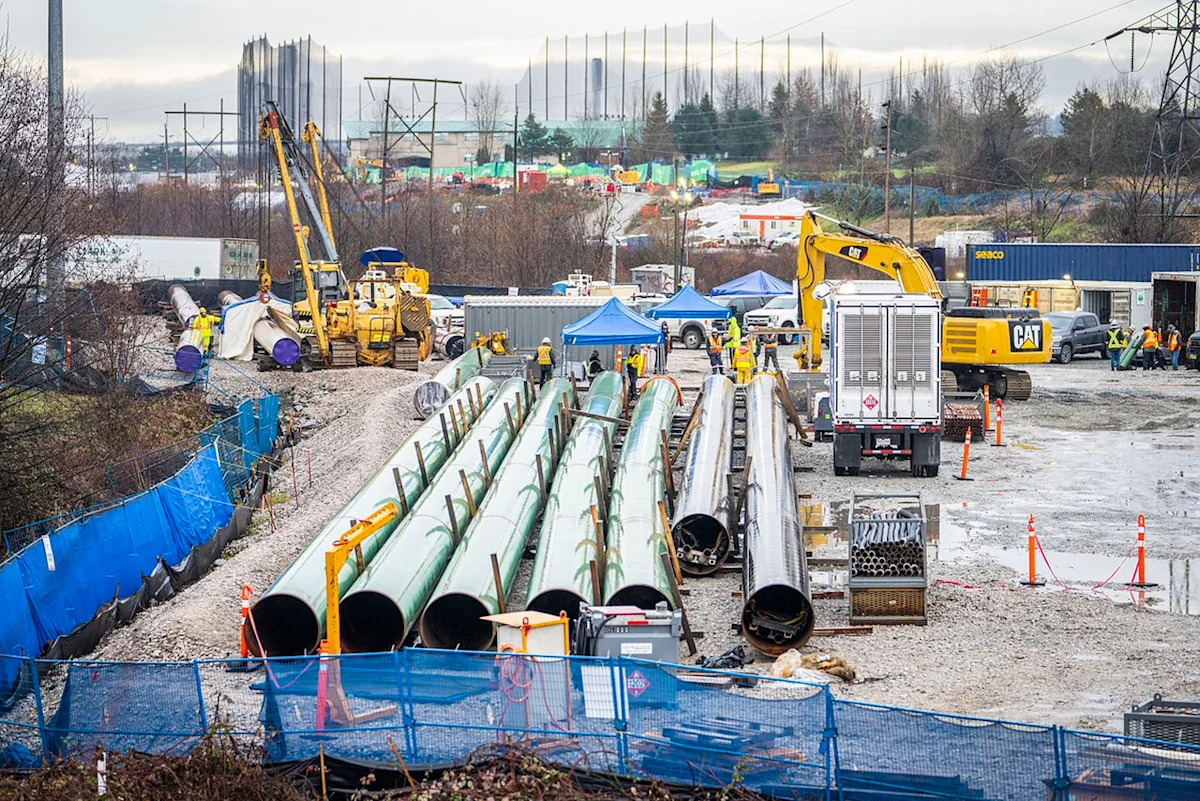

The Trans Mountain pipeline extension along the Burnaby-New Westminster border in 2024. (Handout/Trans Mountain Corp.)
When the expanded Trans Mountain pipeline began pumping crude to the British Columbia coast, the conventional wisdom among oil market analysts was that most of it would go to California.
That expectation made sense, despite years of political talk about opening Asian markets to Alberta oil. The original Trans Mountain line had always mostly served California.
Still, of the 30 oil tankers that left the B.C. coast during a record-breaking October, nearly all pointed west toward China — a clear signal of where Canada’s crude and its trade policy appear to be headed.
And it marks a big shift from less than a decade ago.
In 2018, nearly three-quarters of crude oil exports from Canada’s West Coast went south to California, according to analysts. That’s because the state’s refineries are built to process grades of heavy crude such as what comes from Alberta‘s oilsands.
With Latin American supply declining and Middle Eastern grades getting pricier, some experts thought California could take as much as half of the expanded line’s new capacity.
“That most of our Pacific-bound oil was going to California is a function of geography,” said Daniel Lincoln, a researcher at the University of Alberta’s China Institute.
Asia was a harder sell, especially after Russia invaded Ukraine in 2022. Western sanctions pushed Moscow to flood Asian markets with discounted crude that featured a similar chemical composition to Canadian oil.
In 2023, a year before the expansion opened, Wood Mackenzie was among the firms expecting more Canadian barrels to head to the U.S. rather than Asia. At the time, Chinese and Indian imports of discounted Russian oil were hitting record highs, creating fierce competition that analysts believed Canadian crude would struggle to match.
Shipping economics suggested a similar outcome. A tanker leaving the Westridge Marine Terminal in Burnaby can reach California in as few as two days. The trip to China takes closer to 18. What’s more, Westridge can only load mid-sized tankers, making long voyages costly.
In mid-2024, Argus estimated it cost triple the amount per barrel to ship a mid-size tanker straight to China, compared to the cost of the run to the U.S. West Coast. To make Asia work, many cargoes had to be transferred to supertankers off the California coast, adding another step.
Cut to today. Of the 30 tankers that sailed from Burnaby, RBC analyst Greg Pardy’s team counted 22 port calls in China and only two loadings bound for California.
By RBC’s estimate, Asia-Pacific buyers took roughly half of the nearly 16 million barrels that left Vancouver that month. The United States took less than a fifth.