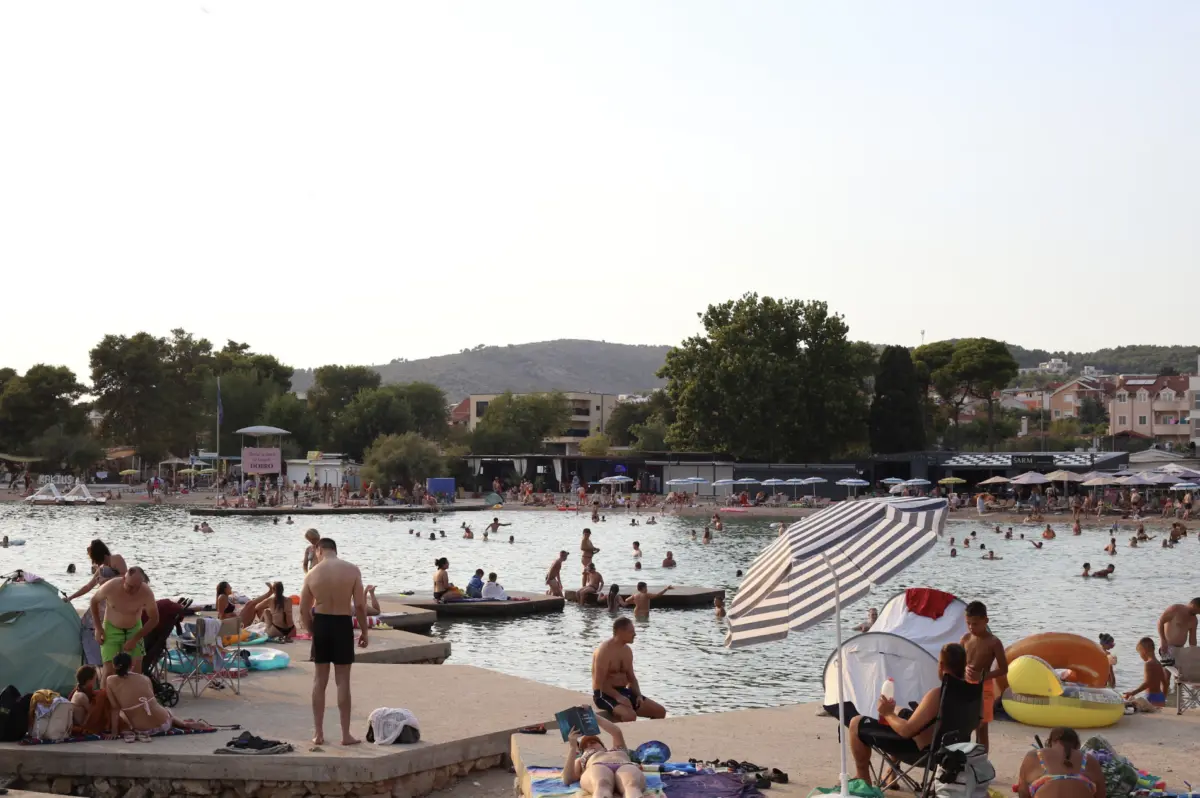
Croatia’s coastal economy rests on tourism. In 2026, the country saw record arrivals, with tourists drawn to the historic cities and, above all, the crystal-clear waters of the Adriatic.
On paper, the Adriatic sea in Croatia is almost spotless. In a nationwide bathing water monitoring study, 91.3% of the 10,989 samples analysed in 2025 were classified as excellent, and only 8% as poor.
Routine checks prove the water is suitable for swimming, and tourist boards use images of clean sea water to promote the coast. The Blue Flag offers an apparent guarantee of environmental responsibility.
However, wastewater treatment data reflect a very different reality. Every summer, we read news reports about sewage reaching the sea due to leaks in pipes, septic tanks and boats. Biologists and local organisations raise the alarm, pointing out that much of the wastewater that ends up in the sea is not analysed.
Our research shows that the Blue Flag is more about economic benefits than environmental protection.

A Blue Flag flying in Croatia. Photo: Jelena Prtorić
An inadequate sewerage system
After joining the EU in 2013, Croatia was granted a transition period, until 2023, to comply with the Urban Waste Water Treatment Directive.
In 2025, the Commission’s Environmental Implementation Review found that Croatia was not treating urban wastewater as required by European legislation: in 2020, compliance was 7%. Furthermore, according to a 2024 report the Croatian Audit Office, only 54.6% of Croatia’s population is connected to the public sewer system. Another study estimates that only 43% of the population is served by a wastewater treatment network. Many households rely on individual systems such as septic tanks.
So how can the bathing water be excellent? Partly due to geomorphology, says Slaven Jozić, a microbiologist at the Institute of Oceanography and Fisheries in Split. The eastern Adriatic coast is steep, and the sewage outfalls are engineered to lie below the thermocline, the boundary between warmer surface water and the colder layer beneath. Such stratification limits vertical mixing.
“It is like hunging a curtain in the sea”, explains Jozić. Wastewater, treated or untreated, at any level spreads sideways along the bottom instead of rising. Faecal bacteria, well adapted to the human gut, quickly decline in cold, dark, salty water. “That is why we have excellent beaches, even with a few high-quality sewage treatment plants”.
When bathing tests reveal contamination, experts say it is usually from local failures, such as a broken pump, an overflow, or a leaking septic tank, not outfalls. In small coastal and island communities, sewage often ends up in “black pits”, septic tanks that can be simple holes in the ground. Connecting every village to a sewer would be a big undertaking in a country of more than a thousand islands and islets, and many coastal towns that empty during the winter.
New construction catering to tourists exacerbates the problem, as it has spread faster than the sewers meant to serve it. Split’s water company estimates that there are 20,000 septic tanks in the urban area, 90% of which are leaking. Around 2,000 tankers reach the treatment plant each month, so only one in ten is emptied. The city’s main plant at Stupe still provides only coarse treatment, though it is due to be upgraded for 275,000 people by April 2028. “We can build [treatment plants], but the new houses are springing up too fast”, explains a water compant engineer.
The same pattern is seen in other areas of the country, such as Istria. “The problem arises when new tourism capacity is planned faster than the proper infrastructure is put in place, and when nobody looks at the overall burden that such development brings”, says Irena Burba of the NGO Zelena Istra.

A Blue Flag beach in Croatia. Photo: Jelena Prtorić
What the tests do not measure
The EU Bathing Water Directive, unchanged since 2006, analyses only two fecal indicators – Escherichia coli and intestinal enterococci – to assess the risk to bathers. These tests do not reveal much about the ecosystem’s overall health. “The sea was always considered a big pool capable of containing anything. This theory is completely wrong”, says Jozić.
The sea’s ability to purify itself “is not absolute”, agrees marine microbiologist Paolo Paliaga. Fecal bacteria survive much longer in sediments than in open water, and storms can dislodge them. Persistent pollutants, such as heavy metals, remain in the sediments, so the seabed can become “a sort of archive of past pollution, even when the surface water appears clean”. In Istria, the NGO Zelena Istra has collected similar accounts from fishermen and divers: fewer fish, a depleted seabed and the loss of habitat for aquatic plants like Posidonia oceanica.
In Croatia, during the bathing season, between June and mid-September, sampling is conducted every two weeks, more frequently than the minimum of four samplings per season required by the Directive. However, in areas exposed to pollution, “more frequent measurements would allow for more effective identification of short-term contamination”, argues Jozić.
Apri la mappa a schermo intero
In its 2025 report on the application of the Directive, the European Commission stressed that additional parameters and a risk-based approach should be taken into account.
Short-lived pollution is difficult to measure or prove. “Each year, we receive two or three reports of water pollution”, says Luka Bunčuga, director of the Hvar water utility. “By the time our water warden reaches the site, the pollution is no longer visible”. Citizens often report vessels discharging waste close to the coast, but by the time inspectors arrive, the evidence is gone. Such reports are not automatically forwarded to public health authorities for water sampling. Every summer, complaints are raised about boats emptying their tanks, faulty sewer systems and inadequate septic tanks. Yet, every summer, the coast becomes increasingly commercialised.
A flag you pay for
In 2026, 111 Blue Flags flew on Croatian beaches and marinas. For many visitors, this blue sign suggests clean water and an environmentally responsible beach. In reality, it is a voluntary private label owned by the Copenhagen-based Foundation for Environmental Education (FEE), administered in Croatia by the NGO Lijepa naša.
Water quality requirements are based on the same state bathing water monitoring system used for all monitored Croatian beaches. No independent assessment of the sewer system, the seabed, or the coastal ecosystem in general is performed.
Some Blue Flags fly on beaches in parts of the coast that EU data identify as non-compliant with urban wastewater rules. Croatia is not an isolated case. In Italy, the newspaper Domani found that at least 47 Blue Flag municipalities, nearly one in five, included urban areas named in EU Court of Justice rulings over sewage collection and treatment. Water quality and wastewater treatment, taken together, do not exceed 20 points out of 100 according to Italian criteria.
Most other criteria concern services like lifeguards, toilets, separate bins, signage and accessibility. This summer, we visited several Blue Flag beaches and marinas. All displayed the flag and offered its visible amenities, but information on environmental education was harder to find.
The contracts, which OBCT has reviewed, list education on responsible marine behavior as one of the program’s objectives. However, it is unclear how this criterion is assessed. We asked the NGO Lijepa naša for information on its educational activities related to environmental protection. As of this publication, we have not received a response.
Furthermore, the criteria we reviewed do not appear to consider visitor numbers or prevent beach artificialisation, which can further damage coastal habitats. “Natural, pristine beaches will never receive a Blue Flag”, says Guillem Xavier Pons Buades of the University of the Balearic Islands, who studied Blue Flag beaches in Spain. “The Blue Flag system has become a business. You have to pay to receive the flag, and it has turned into a competition between beaches”.
“With similar labels, it is always hard to measure their [environmental] claims because there are just too many stakeholders involved”, says Kristina Bučar of Zagreb’s Faculty of Economics and Business, who has researched tourism eco-labels, which – in her words – are considered “exclusively as a form of promotion”.
A marketing tool
The flag is a marketing tool and it costs money. A price list for Croatia we compiled from different documents obtained via FOI requests shows that a single beach in 2026 paid 2,586 euros per year. This fee declines with volume, with quotes of 529 euros for operators with more than 20.
The Blue Flag label is now being discussed as part of a broader EU crackdown on so-called “greenwashing”. Under rules aimed at empowering consumers in the context of the green transition, “sustainability labels used commercially must meet transparency and verification requirements”. The Commission has clarified that Blue Flag awards to public beaches managed by local authorities “do not themselves constitute commercial practices”, although the assessment may be different for commercial operators.
In September, FEE introduced the idea of an optional third-party audit for private and commercial sites and a temporary two-year flag for 2026–27 for others. For another year, the flags will allow Croatia to publicise the excellent quality of its bathing waters and its environmental responsibility. However, they will not address the critical issues related to the ability of the sewer system, seabed, and coastline to withstand another record-breaking season.
In the meantime, on 19 November, the European Commission opened an infringement procedure against Croatia, after finding 60 non-compliant agglomerations in the 2024 data (six fewer than the 66 identified in the map above). The authorities have two months to reply before the procedure may advance.