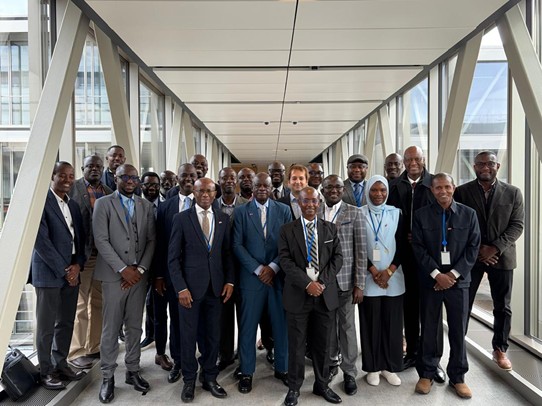
A high-level delegation from the Gambia Revenue Authority (GRA) and key government institutions has concluded a week-long study tour of SICPA’s facilities in Switzerland, exploring advanced technologies to strengthen revenue mobilisation, improve compliance and address leakages.
The delegation, which visited from 16 to 20 November 2026, comprised representatives from the Ministry of Finance and Economic Affairs, the Central Bank of The Gambia, the Public Utilities Regulatory Authority and The Gambia ICT Agency, among others.
The visit forms part of government’s broader efforts to modernise revenue administration through digital transformation and strategic partnerships.
In February 2023, The Gambia signed a concession agreement with SICPA, a Swiss-based technology and security company, for Digital Tax Stamps, a Telecommunication Service Monitoring System and a Refined Fuel Marking Solution. The interventions are designed to strengthen revenue collection, improve regulatory oversight, combat illicit trade and minimise leakages.
One major area of engagement was FinTech integration, particularly the onboarding of major mobile-money operators in collaboration with the Central Bank. Discussions explored how digital financial transactions could be better integrated into the revenue monitoring framework.
The delegation also examined proposals for customised digital dashboards to support executive decision-making and technical monitoring within the GRA. The systems are expected to facilitate near-real-time revenue monitoring and strengthen accountability through secure data management and role-based access.
The delegation was also introduced to advanced forensic authentication techniques to distinguish genuine tax stamps from counterfeit ones, including colour-shifting inks, micro-printing, polarisation filters and digital identification codes. Experts stressed that preliminary indicators alone are insufficient to establish counterfeiting.
Another component was a visit to a fuel testing laboratory, where the delegation examined infrastructure, equipment and safety standards. Particular attention was given to fire protection, ventilation, chemical storage and waste management, to ensure the proposed laboratory at the Gambia Standards Bureau meets technical and safety requirements before commissioning.
The delegation also received a presentation on SICPA’s Digital Market Intelligence (DMI) platform, an AI-assisted system designed to enhance fuel monitoring and regulatory enforcement. The platform integrates data from fuel marking, laboratory testing, field inspections and location data to identify unusual patterns and support targeted inspections.
SICPA clarified that its alerts serve as risk-assessment tools to guide further investigation and do not constitute proof of wrongdoing. The DMI platform has not yet been deployed in The Gambia.
SICPA, which has a 99-year history and employs more than 3,000 people worldwide, reaffirmed its commitment to the partnership. The GRA has already hosted regional counterparts seeking to learn from The Gambia’s experience in applying technology to improve revenue administration.