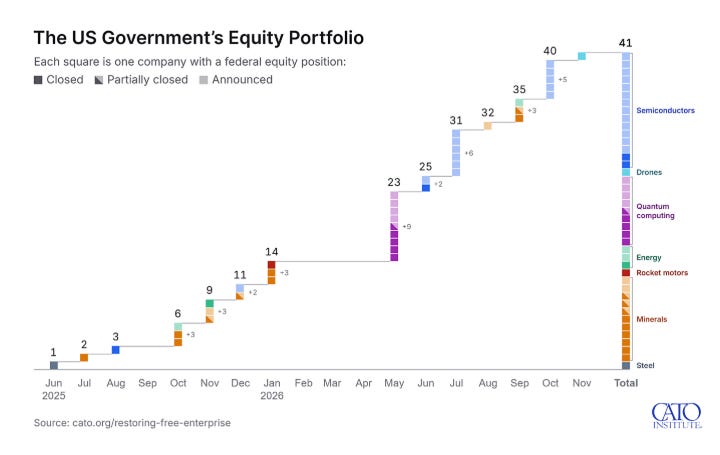
The Senate’s defense bill would write the Trump administration’s corporate equity spree into law. “President Trump wanted his own sovereign wealth fund,” Cato’s Tad DeHaven writes, and the administration “started building an ad hoc portfolio anyway, one deal at a time.” Section 1051 of the Senate’s fiscal year 2027 National Defense Authorization Act “would reward the administration for its opaque and legally dubious equity operation,” giving the Pentagon’s Office of Strategic Capital “a dedicated account and express authority through 2037 to buy stakes in suppliers of critical minerals, materials, chemicals, and batteries.” DeHaven notes that “[t]he Senate Armed Services Committee’s own report acknowledges a ‘high possibility for distorting markets or corruption.’” DeHaven urges lawmakers to strike the provision granting the Pentagon its new equity authority.
Universal Health Accounts would put $1.2 trillion into workers’ paychecks without increasing deficits. “Rising health insurance premiums are crowding out wages,” Cato’s Michael Cannon writes, and with Democrats taking control of Congress, “expanding Medicare would be fiscally irresponsible.” In a new paper, Cannon proposes Universal Health Accounts (UHAs), which “would consolidate all federal health-related tax preferences into a single, capped exclusion for tax-free deposits into worker-owned ‘universal health accounts.’” The current tax exclusion for employer-sponsored insurance “reserves its biggest benefits for the highest earners, imposes its greatest burdens on the lowest earners, and lets employers control everyone’s health dollars.” Under UHAs, “100 million workers would receive increases in cash wages totaling $1.2 trillion, or 4 percent of gross domestic product,” with family-coverage workers seeing raises “on the order of $20,000.” Workers could keep their employer plans or choose other coverage, and UHAs “can do all this without increasing or reducing federal tax revenues, spending, or deficits.”
Expanding Social Security would deepen the program’s hidden cost: displaced saving and forgone investment. As Sen. Bernie Sanders (I-VT) pushes to expand benefits, Geert Ensing of the Mercatus Center warns that “[b]y displacing saving without building a corresponding stock of productive assets […], Social Security weakens the investment on which future incomes depend.” When payroll taxes are paid straight out to retirees, Ensing explains, “[t]he worker is promised future income, but the transaction has not created an asset capable of producing it.” He cites economist David Blau’s estimate “that each dollar of expected Social Security wealth crowds out approximately 56 cents of private wealth accumulation.” That matters because “retirement incomes ultimately depend on what the economy can produce,” and “[d]isplacing investment leaves future workers with fewer productive resources than they would otherwise have inherited.” Boccia and Nachkebia also explain that Social Security is “a pay-as-you-go scheme, not a savings program,” and that “[t]he trust fund holds no real economic assets, only IOUs that increase government borrowing.”
Democrats want to open Medicare to Americans as young as 50, but Congress should be raising the eligibility age instead. Sen. Tammy Baldwin (D-WI) introduced the Medicare at 50 Act, which would let people ages 50 to 64 buy into the program, and House Democrats have made lowering the eligibility age a priority. James Capretta of the American Enterprise Institute has long argued for the opposite course, noting that “Social Security’s normal retirement age is already moving up from age 65 to 67 […] but Medicare’s eligibility remains at 65 (where it has been since the program was enacted in 1965).” Capretta explains that “Retirement programs such as Social Security and Medicare must be adjusted periodically to reflect changing demographic reality.” In its most recent score of the option, the Congressional Budget Office finds that phasing the age up to 67 would cut deficits by $15 billion over its first six years, and that “Over the longer term, deficits would continue to be lower under this option than they would be under current law.”
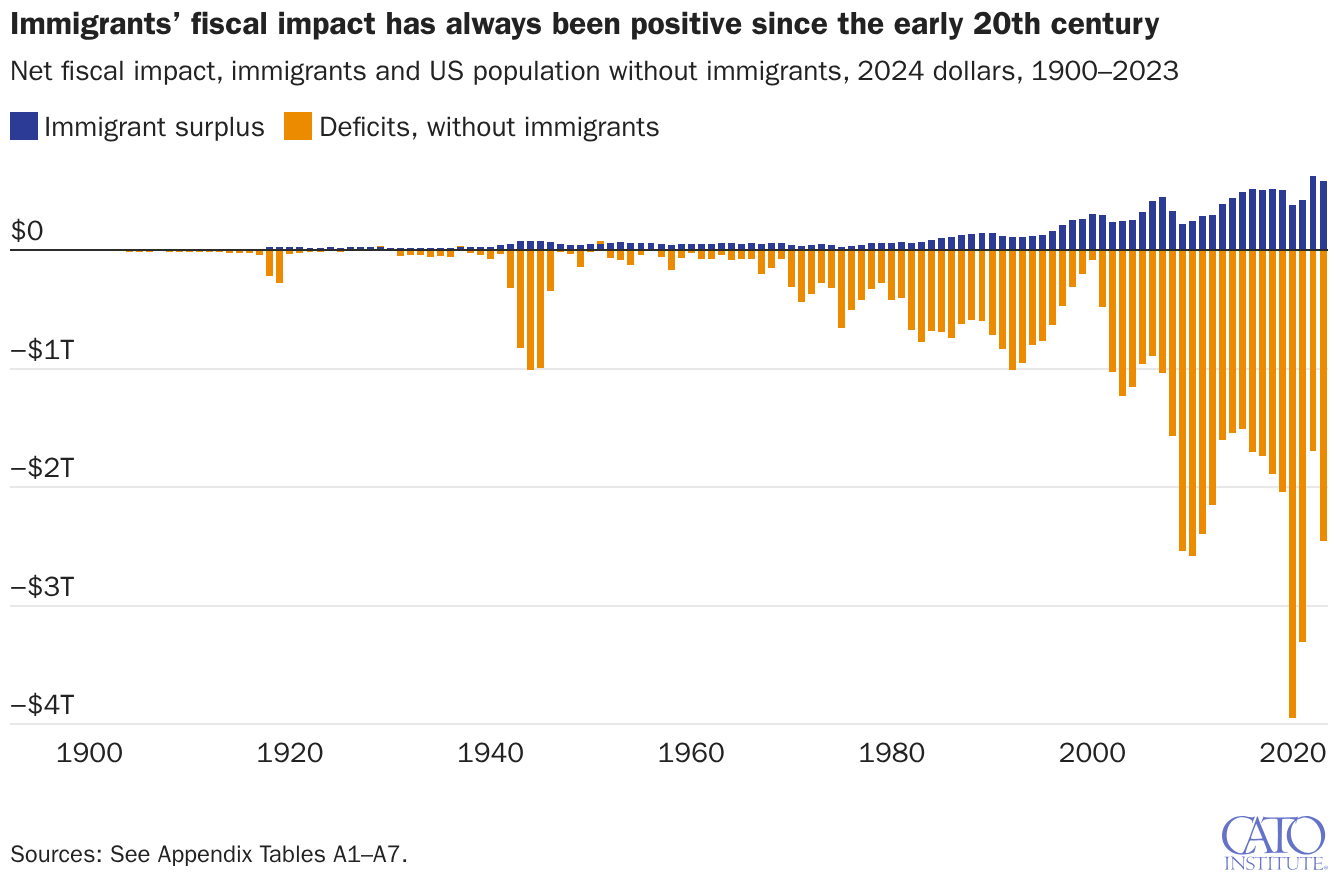
Immigrants have reduced government deficits every year since 1900. Cato’s David Bier and Julián Salazar find in a new study that “immigrants have reduced federal, state, and local government deficits every year for the last 124 years by a cumulative $14.6 trillion, not counting savings on interest payments on a smaller debt.” As the figure below shows, “[i]mmigrants paid more in taxes to every level of government than they received in benefits from government every year since 1900.” Bier explains that “the immigrant surplus was more than twice as fiscally beneficial in 2023 as in 1913, before the modern welfare state and individual federal income tax,” and that 86 percent of the cumulative surplus “has accrued since 1965 and the creation of the modern Great Society welfare state.” As for Milton Friedman’s famous claim that the welfare state ended immigration’s fiscal upside, “Friedman failed to consider that the worse the United States’ fiscal situation, the more beneficial new immigrants become.”