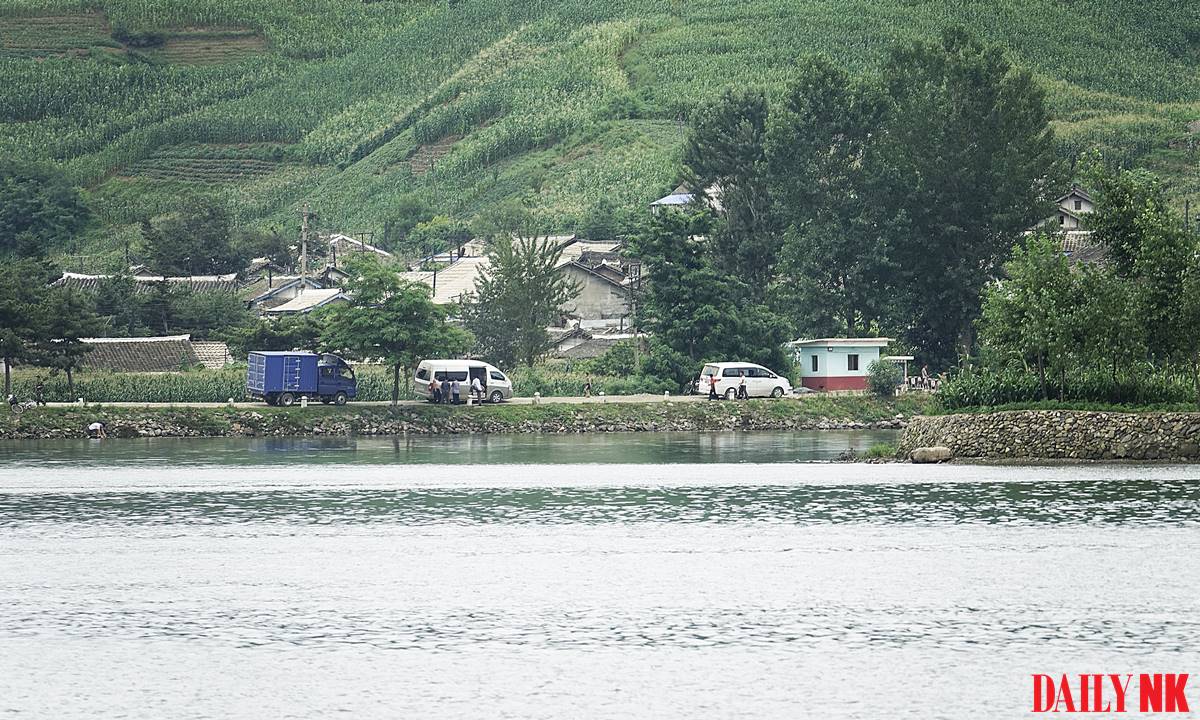
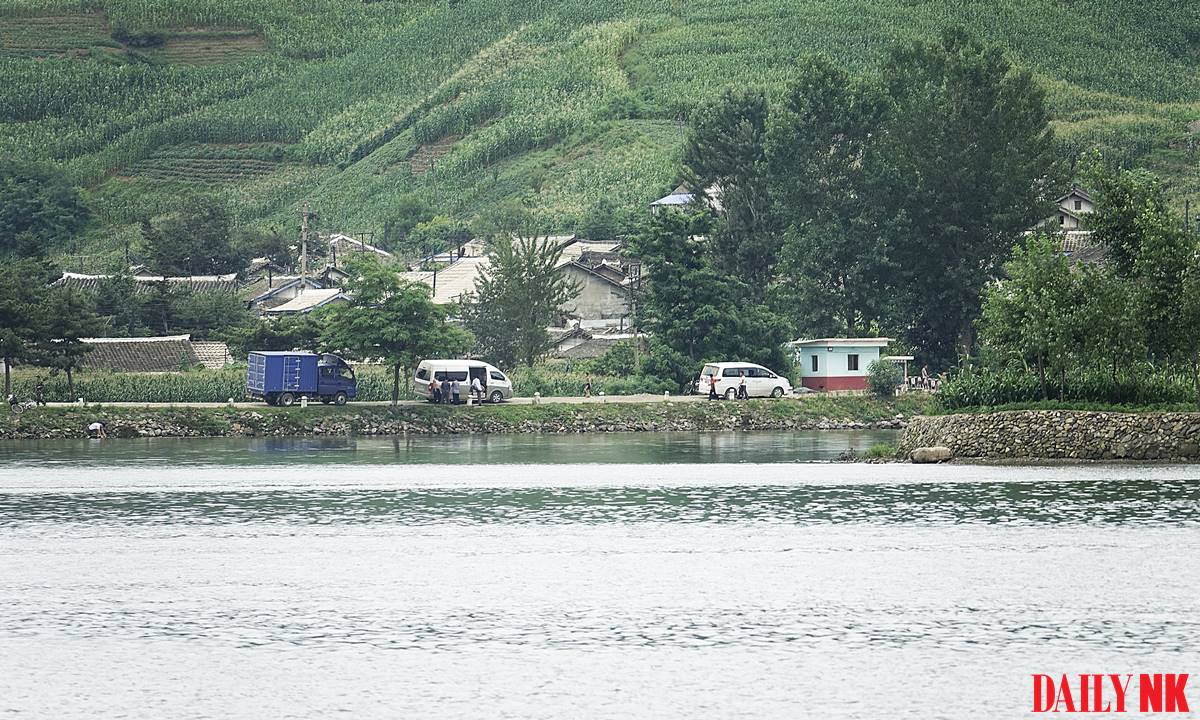
 FILE PHOTO: Vehicles parked in an area of North Pyongan province near the Sino-North Korean border. (Daily NK)
Several used cars that entered North Korea through China’s Changbai customs in October 2026 have been sent back at Beijing’s request. Chinese investigators tied the vehicles to a loan and insurance fraud scheme, a rare reversal for the used car trade with North Korea. That trade has grown with the return of Chinese used cars through Hyesan and the wider revival of North Korea-China trade.
Changbai is a Korean autonomous county in China’s Jilin province, across the Yalu River from Hyesan. Its customs office is a main gateway for Chinese goods bound for Ryanggang province, and it reopened after China’s National Day holiday in October.
A source in China told Daily NK recently that several of those cars have now been shipped back to China. People in the area do not see this as a routine return or a canceled sale. They view it as direct intervention by Chinese authorities against illegal used car exports.
“Cars that go into North Korea sometimes come back out, so at first people thought the deal had simply gone wrong,” the source said. “It turned out investigators were looking into people who took out loans on their cars, faked thefts and sent the cars to North Korea. In the end, Chinese authorities stepped in directly, tracing the cars and how they were sold, and even getting them back.”
According to the source, Chinese car owners would borrow money using their vehicle as collateral and then report it stolen. The car would then be sold cheaply to a trader dealing with North Korea as an off-the-books vehicle. Losses piled up for the lenders and for insurers that had to pay out theft claims.
Murky prices make the used car trade ripe for fraud
For traders, the scheme meant buying problem vehicles at rock-bottom prices and reselling them in North Korea at a steep markup. The source said the opaque pricing of used cars helped the practice spread. New cars carry clear factory prices based on model and specifications, so their cost is hard to fake. Used car prices, however, swing so widely with age, mileage and condition that sellers can practically name their price.
Traders dealing with North Korea tend to demand high margins to cover the many risks of cross-border business. Because a fair market price is hard to pin down, they can inflate the cost of cheap vehicles and pocket large profits.
“Everyone trades to make money, but with North Korea, a lot of people won’t settle for a normal profit,” the source said. “They add in the price of the risk and any losses that might come up, so they especially like used cars. That gap is what made it possible to buy cheap and sell high like this.”
China was already uneasy about cars reported stolen at home turning up in North Korea. With loan fraud now hitting banks and insurers, investigators appear to be widening their probe to all North Korea trade.
U.N. Security Council sanctions adopted in late 2017 ban vehicle exports to North Korea. Chinese cars have kept crossing the border anyway, and a new customs route for cars opened this year. Luxury used cars even went on display in Pyongyang ahead of sales to buyers with foreign currency.
Trade insiders in the region call the return of cars already inside North Korea highly unusual. “A lot of people thought that once a car went into North Korea, it would never come back out,” the source said. “Now that several have come back, people figure China must have pushed this quite hard.”
Local observers expect tougher checks on ownership, outstanding loans and how each vehicle was acquired. Hyesan route customs already showed its strict side when South Korean goods were shut out of Hyesan customs trade earlier this month.
“People who’ve made big money in the used car trade are saying the good days are over,” the source said. “Now that the state itself is looking into the problem, some expect the used car trade with North Korea to shrink considerably.”
About This Translation
This article was originally written in Korean and translated with the help of generative AI tools. It was then edited by a native English-speaking editor. All AI-assisted translations are reviewed and refined by our newsroom.
Reporting from Inside North Korea
Daily NK operates networks of sources inside North Korea who document events in real-time and transmit information through secure channels. Unlike reporting based on state media, satellite imagery, or defector accounts from years past, our journalism comes directly from people currently living under the regime. We verify reports through multiple independent sources and cross-reference details before publication.
Our sources remain anonymous because contact with foreign media is treated as a capital offense in North Korea — discovery means imprisonment or execution. This network-based approach allows Daily NK to report on developments other outlets cannot access: market trends, policy implementation, public sentiment, and daily realities that never appear in official narratives.
Maintaining these secure communication channels and protecting source identities requires specialized protocols and constant vigilance. Daily NK serves as a bridge between North Koreans and the outside world, documenting what’s happening inside one of the world’s most closed societies.