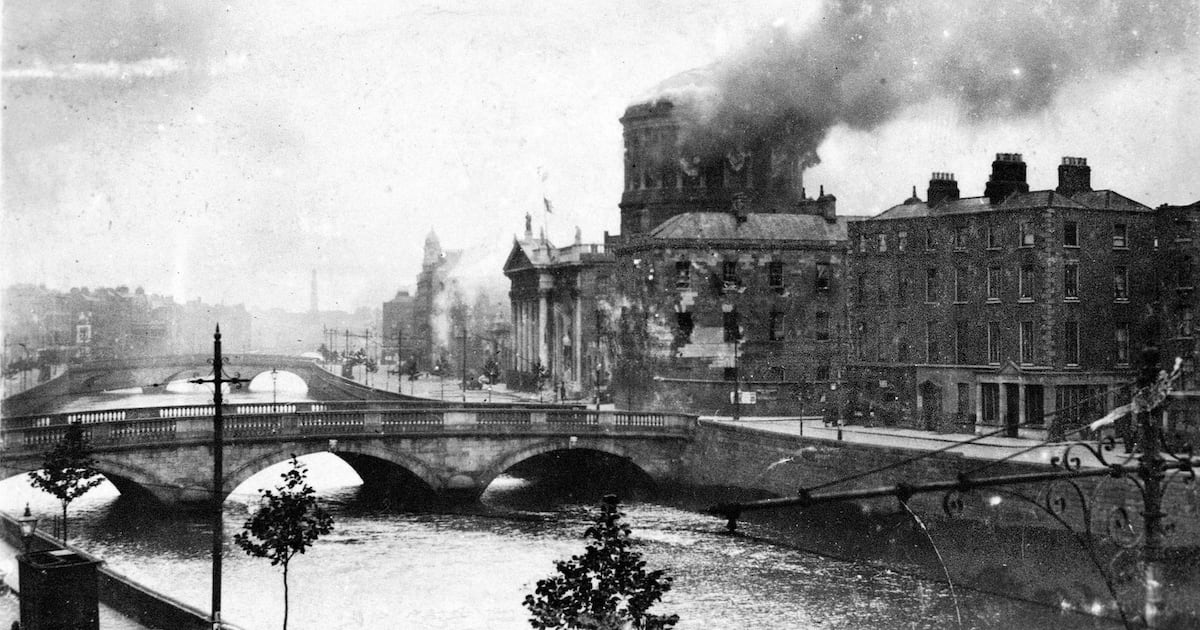
An original 1841 census form that was badly burned in the destruction of the Public Record Office (PRO) in the Four Courts in Dublin 104 years ago has been deposited in the National Archives following a fortuitous find.
The form was among the fragments of paper that fell on the streets of Dublin on the last day of June, 1922, when the census records from 1831, 1841 and 1851 were among tens of thousands of centuries-old documents that were almost entirely destroyed in the basement explosions and fire that followed the Four Courts bombardment at the beginning of the Civil War.
The form in question was the census return of the McCarthy family of Curranashingane townland in Drinagh civil parish, Co Cork. It was completed by the head of the household, Florence McCarthy, a farmer.
The form had been recovered from the back garden of the minister of the Presbyterian Church in Sandymount, south Dublin, into which it had flown in July 1922, days after the Four Courts fire. It was placed among the pages of the church baptismal register for safekeeping, according to Steven Smyrl, who discovered it while examining the baptismal register.
His discovery was fortuitous because Smyrl is a professional genealogist and a fellow of Accredited Genealogists Ireland. He returned the form to the National Archives of Ireland, the successor of the PRO. It can be viewed on the website of the Virtual Record Treasury of Ireland, the all-island body that is tracing and cataloguing as many salvaged historical records as possible.
Smyrl is a member of the panel of the Virtual Record Treasury, based at Trinity College Dublin, and he is chairman of the Irish Genealogical Research Society (IGRS), which was founded in London 90 years ago by people who were interested in Irish genealogy and alarmed about the destruction of the PRO in Dublin.
The relationship between the society and the National Archives and Virtual Record Treasury “is particularly appropriate”, Smyrl says, “given that the IGRS was itself founded in response to the destruction of the PRO, with one of its original purposes being to locate and preserve copies, transcripts and abstracts of material that had been lost”.
Based for many years in the now-defunct Irish Club in Eaton Square, in London’s Belgravia, the society was founded in September 1936 by Fr Wallace Clare (1895-1963), a Catholic priest, academic and author of the first book about Irish genealogy.
It is a registered charity, run by volunteers who are guardians of what is claimed to be the world’s largest and most important collection of Irish genealogical material in private hands, mostly held in secure storage in Kent. It has provided abstracts to the Virtual Treasury of 19th-century census records whose originals were destroyed in the 1922 fire.
About half of the society’s membership is based in Ireland, with the remainder in Britain, Canada, the USA, South Africa, Australia, New Zealand and Argentina.
Notable members have included David Goodall, a former British high commissioner in India and senior civil servant in the 1985 Anglo-Irish Agreement negotiations. Michael Leader was also a member. He spent decades locating and transcribing extant Church of Ireland parish registers in 145 parishes, principally in Co Cork.
The society describes itself as “the world’s first and oldest society dedicated to the pursuit of Irish genealogy”. Its library and archive includes rare manuscripts, privately printed books and pamphlets, transcripts and abstracts, some of which were compiled before 1922 and preserve information from records that were subsequently destroyed.
“Much of what the society collected in those early years is now irreplaceable”, says Smyrl. “The destruction of the PRO in 1922 created an enormous gap in Ireland’s documentary heritage. The founders of the IGRS realised that material which survived in private hands, or in copies and transcripts made before the fire, was going to be crucial to future generations of researchers.”
The society is marking its 90th anniversary with a year-long programme of events – online and in person – in Canada, the USA, England, Scotland, Republic of Ireland and Northern Ireland. Hybrid events in Ireland and abroad have heard about Irish War of Independence records held in Kew, London; Irish immigration in Canada; Irish contributions to the American Revolution; US military pensions; 17th-century Scots’ immigration to Ireland; Irish merchant communities in pre-revolutionary France and Cumann na mBan after Ireland’s revolutionary decade.
Smyrl spoke at the Consulate General of Ireland in Edinburgh earlier this month. He discussed the society’s collections and its digitisation for databases, which is being developed.
“The society’s work is increasingly about making those collections accessible digitally, while continuing to acquire and preserve material that might otherwise disappear,” he says. “The 90th anniversary has been an opportunity not just to celebrate the society’s history, but to draw attention to the fact that a surprising amount of Irish genealogical material did survive 1922 – if you know where to look.”