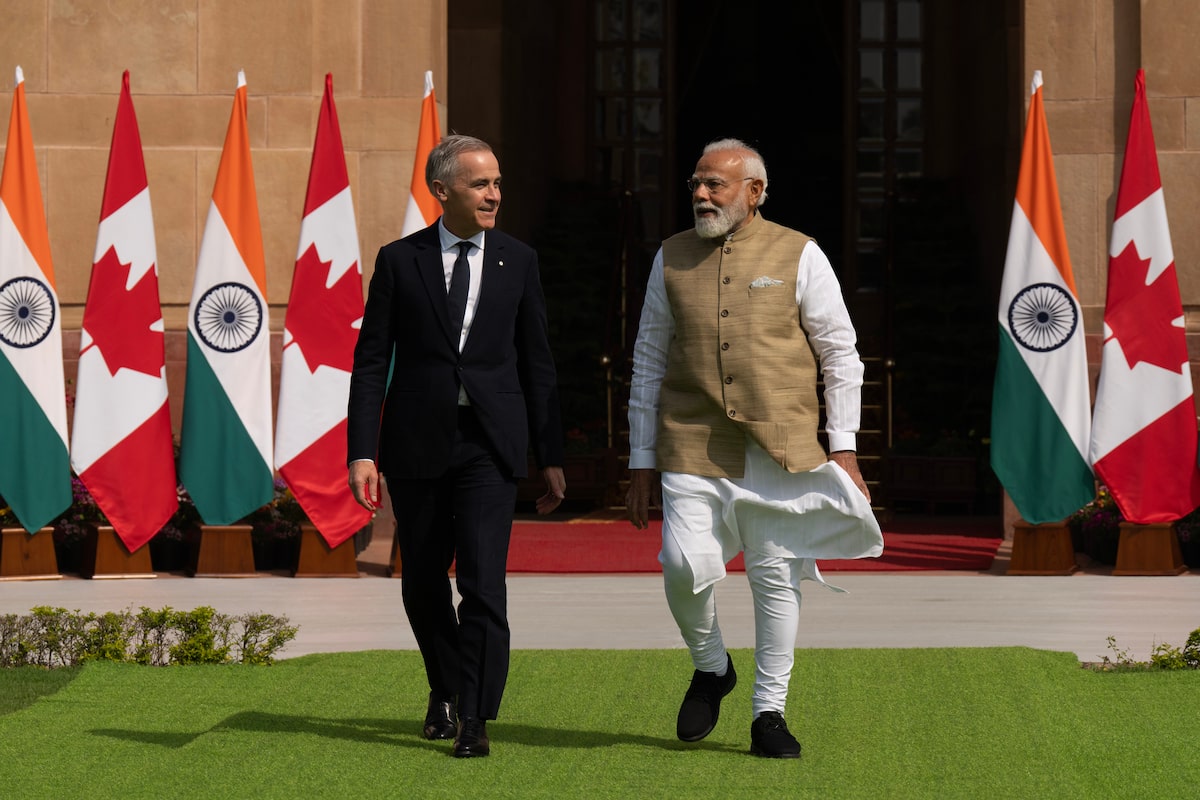
Prime Minister Mark Carney walks with Indian counterpart Narendra Modi in New Delhi earlier this year. They are expected to announce the conclusion of talks on a free-trade deal during the Indian leader’s December visit.Adrian Wyld/The Canadian Press
Canada and India are negotiating deals on deepening security and defence relations to coincide with Indian Prime Minister Narendra Modi’s December visit, including a pact on military co-operation and another on sharing classified information, New Delhi’s envoy says.
Prime Minister Mark Carney and Mr. Modi are already expected to announce the conclusion of talks on a free-trade deal during the Indian leader’s Dec. 11-12 visit to Canada, but the other agreements under negotiation indicate a new level of trust between Ottawa and New Delhi after a 2023 diplomatic rupture that sidelined relations for years.
India’s High Commissioner to Canada Dinesh Patnaik said in an interview that the two countries are also working on a more permanent mechanism for co-operation on security and intelligence matters. Right now, the countries’ national security advisers and intelligence agencies exchange information from time to time, but the goal is a “platform” for this interaction, he said.
Canada-India relations entered a deep freeze in 2023 when then-prime minister Justin Trudeau publicly accused New Delhi of a role in the B.C. slaying of Hardeep Singh Nijjar, a Canadian who campaigned for a separate Sikh homeland to be carved out of India. New Delhi has repeatedly rejected the accusation.
Mr. Carney’s government, eager to rekindle ties with India as part of its effort to shift trade away from an increasingly unpredictable and protectionist United States, has repeatedly tried to wall off Canada-India relations from the Nijjar probe by saying the investigation and legal process are handled independently. Four Indian men, who entered Canada on student visas, are awaiting trial in the B.C. Supreme Court on charges of killing Mr. Nijjar.
Mr. Patnaik, the envoy, said increased security co-operation between Canada and India has led to New Delhi’s co-operation on the deportation of Indian citizens who have overstayed their visas in Canada or entered fraudulently. He said that in 2026 alone, he’s provided emergency travel documents to assist in nearly 5,000 removals. “That’s co-operation. Earlier it used to get stuck in non-co-operation between both sides.”
Carney’s Southeast Asian deals only a first step to expanding trade
The two countries are in talks on a defence agreement that Mr. Patnaik said will range from strategic co-operation, including warship visits, to joint training capacity building, including exchanges, and finally, military goods production in aerospace, naval and space.
“We’re looking at early warning and surveillance aircraft, and Canada’s Bombardier is the best platform for it,” the envoy said. “We’re looking at seaplanes from De Havilland. We’re looking at space co-operation.”
He said a defence co-operation deal will set up a framework under which governments can work together and with private-sector companies.
“You need a lot of ammunition. You need a lot of explosives. There are Indian companies who are one of the top producers in the world who are willing to come and set up factory here to produce those things: 155-mm shells, shell casings, missile guidance systems, control systems.”
He said India has private-sector space-launch capability in Skyroot Aerospace, which could help Canada.
Mr. Modi’s trip will include a reception with the Indo-Canadian community in Toronto on Dec. 11 and meetings in Ottawa on Dec. 12. “The diaspora wants to meet him. All of them want to meet him,” Mr. Patnaik said of Indo-Canadians. “He’s a rock star.”
Indian envoy Dinesh Patnaik, shown in Ottawa last week, said the increased frequency of talks between the countries has changed New Delhi’s perceptions of Canada.Justin Tang/The Canadian Press
The envoy said New Delhi and Ottawa are also negotiating an agreement for sharing “sensitive, classified and deep-tech information” with each other and keeping it protected. Such a pact is necessary for trading, or jointly developing, weapons and sensitive technology.
He said the increased frequency of talks between India’s and Canada’s national security advisers and intelligence agencies has changed New Delhi’s perceptions of Canada.
India has long complained that Canada provides a haven for people who advocate for the creation of Khalistan, a separate Sikh homeland in India’s Punjab region. Ottawa has frequently responded to India’s complaints by pointing to the Charter of Rights and Freedoms and noting that freedom of expression is protected in Canada.
“There was this whole perception in India among the security agencies that the security agencies in Canada were directly or indirectly supporting separatist elements here,” Mr. Patnaik said. Now, he said, the Indian side “realizes that the Canadians are actually not supporting the separatists. They’re just caught in laws which allow for freedom of expression in a manner which may not be palatable to the Indian side.”
Mr. Patnaik said the hundreds of thousands of Indians studying in this country bring billions of dollars to Canada and that a reduction in their numbers would hurt the economy.
Dubai’s trade with Canada could double over next five years under new deal, official says
He said that Immigration, Refugees and Citizenship Canada is working on a “fast track” system with Canadian universities for Indian students who undertake legitimate degree programs at credentialed institutions in this country. This is not part of the trade deal but is being negotiated separately, Mr. Patnaik said.
“They want to put in a robust system where trusted institutions can get students without having a problem,” he said.
He said negotiations on the trade deal are almost complete aside from some “politically sensitive” matters such as tariff-rate quotas, which allow a set quantity of a good to be imported at a lower, or zero, tariff rate, with anything above that quantity charged a higher tariff. These would include Canadian shipments of pulses such as yellow peas and lentils, the envoy said.
Mr. Patnaik said India is hungry for critical minerals and nuclear know-how from Canada. “We’re already discussing how can we buy more uranium from you.” India now has about 8.8 gigawatts of nuclear capacity across dozens of reactors, and the government plans to more than double that to roughly 22.5 GW by 2031–32 and to reach 100 GW by 2047.
“You are very good at blue hydrogen, which is made from gas. How do we learn from you? On critical minerals, already we are signing up for magnets, for rare earths, for nickel, cadmium and copper.”