NEW ORLEANS (WVUE) – The explosion in AI’s capabilities has revolutionized the cyber landscape, enabling computers to simulate human learning, decision-making, problem-solving and more.
Amid AI’s growing capabilities, higher education institutions are readying computer science students to compete in the changing job market.
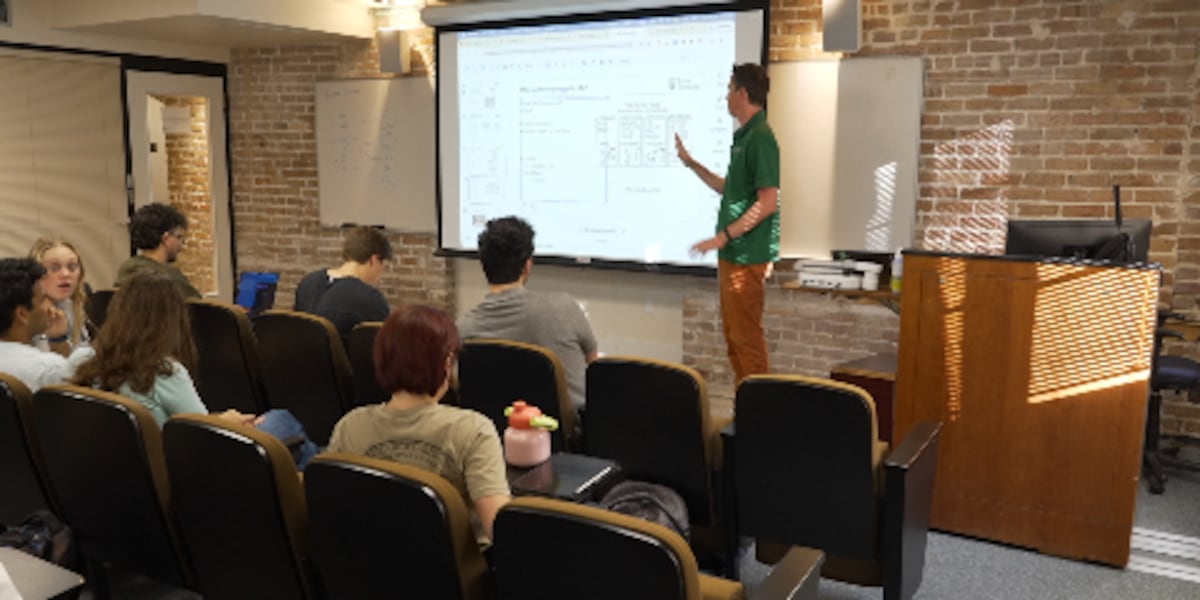
At Xavier University of Louisiana, Austin Orgah, Ph.D., instructed students on how to program using the computer language Java.
Jaelen Johnson is in Orgah’s class.
“I’m a dual-degree computer engineering/computer science major. So, I wanted to focus on broadening my major for computers,” Johnson said.
To be sure, higher educational institutions are embracing artificial intelligence.
On Tulane University’s campus, Nicholas Mattei, Ph.D., taught a class called MultiAgent Systems.
“We have an undergraduate minor in artificial intelligence, and there’s also an artificial intelligence sort of concentration within our computer science majors,” said Mattei. “We have online and on-ground master’s programs that are in computer science, but have large sort of AI components as a part of them.”
And just days ago, Tulane approved a master’s certificate in artificial intelligence.
Ninety miles west of New Orleans, computer science and AI are part of LSU Baton Rouge’s curricula.
“We have a bachelor’s degree in AI,” said provost Joseph Messina, Ph.D. “So if a student knows for sure that they would like to work in developing and building large language models, we have the opportunity for them to be trained very well to pursue those kinds of careers.”
AI has been a game-changer.
“It used to be you had to study how to speak the language of the computer. And now you can kind of talk to the computer in English, and that is the language the computer speaks,” Mattei said.
Still, as AI advances, computer science degree enrollment is falling around the country.
“There’s been a decline. We have not been immune from the influences that have been hitting everybody across the country,” said Ray Lang, Ph.D., who chairs Xavier’s computer science department.
In terms of enrollment changes, Messina describes it differently for LSU Baton Rouge.
“AI jobs didn’t exist five years ago. So we’re seeing just the normal change, I think, in the market for computer science as a degree. Here at LSU, we’re flat. So we haven’t seen the decline in enrollment that we’ve seen that other universities have seen. But it hasn’t grown either,” said Messina.
At Tulane, the situation is similar.
“We’ve seen a bit of flattening in our total computer science enrollment, but growing in the AI and data science spaces,” Mattei said.
The National Student Clearinghouse’s preliminary fall enrollment trends report said Enrollment in Computer and Information Science programs continues to drop sharply, with a 12.4% decrease at four-year institutions, 12.3% decline at two-year schools and10.4% at graduate institutions.
FOX 8 asked Lang to what he attributes the decline in computer science enrollment.
“Computer science attracts different kinds of students. Some are really passionate about the theory,” said Lang. “But others are really trying to come in and prepare for a good career, a good, solid career. And with all the layoffs that have been happening in the past few years and the negative news, those sort of students have shifted to other areas.”
Northeastern University’s Center for Inclusive Computing in Boston tracks AI-focused undergraduate degree programs offered by universities’ computer science departments.
Its graph shows an upward trend.
“I think that it’s being driven both by student interest and by universities’ upper administration both, and by faculty motivation,” said Carla Brodley, Ph.D., founding executive director of CIC.
Brodley broke down their findings.
“The fastest growing, however, is not AI majors or minors. It’s actually AI concentrations. What that means is a student comes in, they’re going to do a computing, a computer science degree. And typically you may have different concentrations like cybersecurity, AI theory, systems,” she said.
Like many universities, Messina said LSU is looking to increase the number of AI courses it offers.
“I envision adding more AI courses to the institution. I think it’s fundamental for our students to be exposed and to learn how to effectively use these tools,” said Messina.
AI has impressive skills, with Brodley adding that it writes code very well.
“You see these terms like Vibe Coding, where you sort of talk to the AI, be it Claude or ChatGPT, and you ask it to write code for you,” Mattei said,
Lang agrees.
“AI can already produce output that’s very, very good and really equivalent to what entry-level programmers produce. So, we have to prepare our students with skills to jump, really, to the second or third rung right off the bat,” Lang said.
With the rapidly improving sophistication of AI agents, the computer science academicians were asked if will become obsolete.
“I don’t think that will be the case. I think we will expect more from our computer programmers, our computer science graduates,” said Messina. “And I think what we as educators have to teach them will change over time.”
Mattei said he does not see a future where there is less computing being used.
“But maybe sitting in a dark room, like writing code by yourself, those jobs might be a little bit of trouble,” he said.
Lang said Xavier is adding computer science courses.
“We’ve just instituted three new courses that will come online next year,” he said.
Even as AI rapidly advances, there are university students who have made it clear they do not want to use AI.
“Surprisingly to me, I’ve heard this quite often. There are actually a lot of students who would like not to use it,” Messina said.
AI needs huge data centers, and Brodley said students refuse to use AI because they do not approve of what it is doing to the environment.
Lang has also seen his students be reluctant to use AI.
“And the very first day I did an example, and the students were like, ‘Oh, no, we don’t want to use that,’” he said.
Big tech layoffs made headlines. Current computer science majors weighed in on whether they are concerned that there may not be good jobs available once they graduate.
At Tulane University, computer science student Leonardo Matone said he started coding before the AI boom.
“I am kind of generally afraid, not really so much because of the AI boom but more because of the current state of the economy,” said Matone.
Johnson is confident he will be ready for the job market upon graduation.
“I do believe I will be at the very least ready when I am out. Because even though it’s growing at an exponential rate [so] that it’s hard for humans to keep up with, I think because I’m growing with it, I can understand it as I grow and as it grows,” he said.
Tulane University senior computer science major Darian Tocci is also counting on success in the work world.
“I think there’s a lot of opportunity that comes with it. I also think that it is quite scary about how fast it really all is moving,” she said.
The impact on computer science enrollment aside, many computer science majors at the undergraduate and graduate level remain confident their chosen major will lead to the careers they envision.
See a spelling or grammar error in our story? Click Here to report it. Please include the headline.
Subscribe to the Fox 8 YouTube channel.
Copyright 2026 WVUE. All rights reserved.