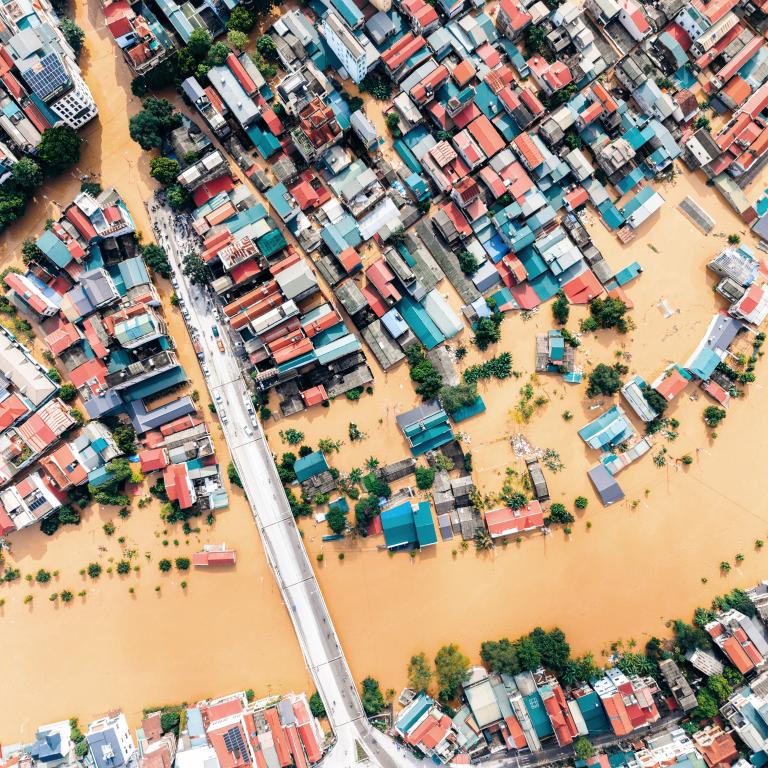
The survey indicates that 73% of respondents affected by extreme weather have experienced disruption from multiple perils. In Europe, flooding, heat stress, and water stress each affected 45% of respondents, making these the leading hazards identified in the survey. Tropical storms and wildfire affected smaller shares of respondents. Still, their lower frequency should not be mistaken for lower strategic importance: localised severity, concentration of assets, and limited recovery capacity can turn less common events into material business interruptions.
The more significant shift is in where the consequences appear. Physical assets are most commonly affected (82%), followed by operations and people (55%), suppliers (45%), and critical infrastructure (27%). A site may remain undamaged while business operations stall because employees cannot travel, utilities are constrained, logistics corridors are disrupted, or key suppliers suspend production.
For European risk managers, this creates a challenge that conventional property-led assessments can miss. Flood maps identify exposed facilities but may miss simultaneous risks to regional transport, water, energy, or supplier networks. Heat assessments quantify site conditions but may overlook reduced productivity, safety constraints, and the cumulative effects of repeated heat exposure on equipment and maintenance.
Forward-looking climate risk analysis is improving but remains uneven
The case for this analysis is clear, but only just over half of respondents conduct it. Among those who do, quality and scope are improving: 75% assess multiple perils, most commonly heat stress (81%), followed by water stress (75%) and flooding (50%).
Quantitative and qualitative methods help organisations translate rising climate risk into decision-useful insights under different conditions, supporting choices on capital spending, maintenance, continuity, supply chains, and insurance.
The lens is also widening beyond physical assets. 94% of respondents who conduct forward-looking assessments consider physical assets, while 81% consider operations and people. 50% assess critical infrastructure, suppliers, customers, resources, and ecosystem services, or requirements from governments and regulators. 44% assess emergency response.
This broader scope is one of the less visible yet most consequential developments in the findings. It recognises that dependencies beyond an organisation’s control can undermine resilience. Even with major flood defences, a business remains vulnerable if a substation, road, port, data connection, or water source fails. Assessments must identify hazards and dependencies that determine whether the organisation can continue delivering products and services.
Adaptation is progressing from protection to system resilience
Our survey shows a mixed but active picture of adaptation. 23% of organisations have integrated adaptation into a broader climate or sustainability strategy; 10% have a standalone adaptation strategy; 17% are developing one; and 27% are considering one. Yet maturity varies: 20% report no formal adaptation strategy and no plans to develop one, while 3% do not know.
The measures being implemented suggest a gradual shift towards system resilience. Improving business continuity planning and investing in asset engineering are both cited by 52% of respondents. 42% are building greater redundancy into supply chains, while 29% are investing in nature-based solutions and 29% in better early-warning technology.
These actions distinguish adaptation activity from effectiveness. A plan may list projects without showing whether they reduce downtime, protect services, or improve recovery. Strong strategies link measures to outcomes: interruption limits, recovery-time objectives, minimum service levels, supplier alternatives, workforce safeguards, and reduced expected losses.
Insurability and board attention are accelerating the case for action
Concern about insurance availability is growing: 28% worry about their next renewal, rising to 55% over the next five years. This longer-term outlook suggests insurance reflects not only current losses but also how changing hazards, concentrated exposure, and uncertainty may shape future risk transfer.
At the same time, only 26% say adaptation measures are recognised in insurance negotiations. This highlights a persistent translation gap: resilience investments may go unrecognised by insurers or capital providers unless organisations show what changed, how it was tested, and how it affects potential losses.
Documentation should therefore be treated as part of the adaptation programme, not as an administrative afterthought. Useful evidence includes specifications, maintenance records, test results, scenario analyses, incident metrics, continuity exercises, supplier assessments, and pre- and post-exposure data.
Risk management and sustainability are the primary drivers of climate adaptation for 53% of respondents, reinforcing the move from operational concern to boardroom priority. Government and regulatory pressure, cited by 31%, and investor pressure, cited by 25%, add further momentum. For boards and executive teams, the question is no longer whether climate risk belongs on the agenda. It is whether the organisation can show that its decisions are based on forward-looking evidence and that adaptation is improving resilience in ways that matter to the business.