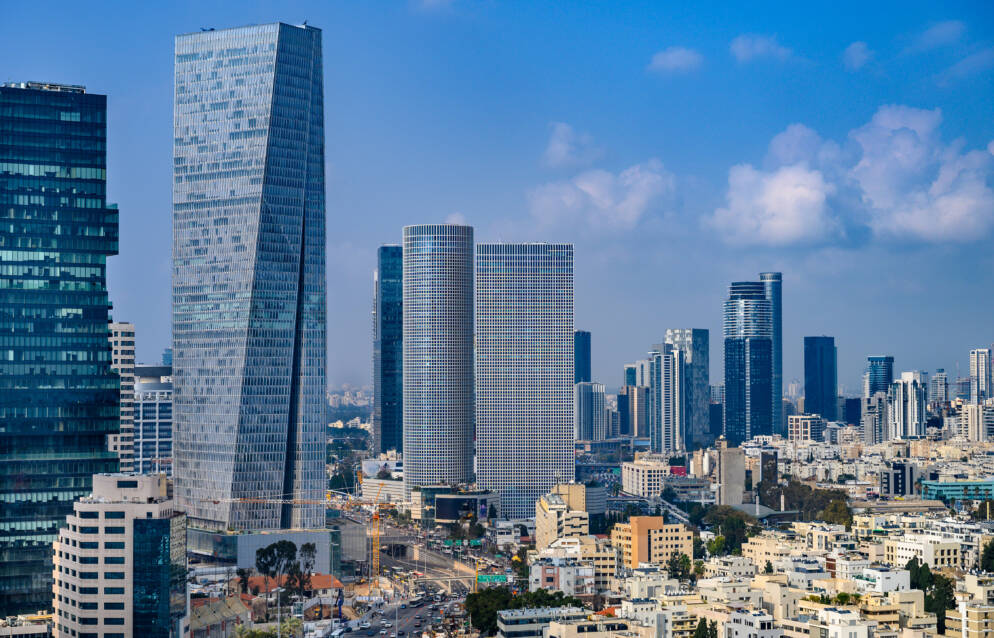
 Aerial cityscape of Tel Aviv skyscrapers (Adobe Stock / borisbelenky)
David J. Butler
There is an extraordinary energy to Israel that never fails to move me. Spending much of the month of November in Tel Aviv, I feel it everywhere: crowded streets, bustling restaurants, thriving businesses and construction cranes reaching skyward.
Towers of glass and steel rise alongside older neighborhoods, transforming the city. Across Israel, people open businesses, raise families and pursue ambitious dreams despite the dangers surrounding them.
I feel admiration and pride. Israel knows the price of war yet refuses to organize its future around the expectation of destruction. Through the ordinary business of living, Israelis insist that their aspirations, not their enemies, will determine what comes next. Yet looking at Tel Aviv’s magnificent skyline, I confront an unsettling thought: Every one of those buildings is a potential target.
Iran has demonstrated its ability to strike Israeli cities with ballistic missiles. Israel’s multilayered defenses have saved countless lives, but they are not impenetrable. What happens when a missile destroys an office tower worth hundreds of millions? Who insures it? Who rebuilds it? And what becomes of those whose livelihoods disappear with the building? The answers reveal a remarkable national commitment — and a troubling weakness in fulfilling it.
Under Israel’s Property Tax and Compensation Fund Law, the state compensates owners for qualifying physical damage caused by war and terrorism. Homes, offices and factories are protected. Rather than relying primarily on private insurance against catastrophic missile damage, owners turn to their government.
It is an extraordinary bargain. Israel effectively tells its people: Keep building, working and investing here. If war destroys your property, the nation will share the burden. Security is a collective responsibility; so is recovery. That assurance helps sustain confidence in Israel’s future.
But rebuilding walls is not the same as restoring lives. Consider Tel Aviv’s Da Vinci Towers, damaged by an Iranian missile in June 2025. Months later, the more severely damaged tower remained uninhabitable; in the adjoining tower, owners reportedly struggled to attract tenants at pre-attack rents. Compensation can repair windows and concrete. It cannot necessarily restore lost customers, a property’s reputation or a family’s sense of security.
Behind every claim are displaced families, anxious employees and business owners whose expenses continue even as revenues vanish. Nor is such anguish confined to Israel. In Gaza, devastated neighborhoods have left families facing immense losses; Iranian civilians, too, have endured death and destruction. The circumstances and responsibilities differ, but compassion for their suffering does not diminish Israel’s right to defend itself. The human cost of destruction crosses borders, even when the obligations to address it differ.
Israel compensates some indirect losses, including qualifying business interruption and lost rent. But here the law becomes less dependable. Businesses in designated border areas have standing protections; elsewhere, the government has often had to create temporary compensation rules after fighting begins. Only then can affected owners know which losses qualify, what formula applies and when they can file.
That is not a hypothetical concern. After the 2026 fighting with Iran, the Knesset enacted another special assistance program. In January, Israel’s state comptroller criticized the absence of permanent rules for many indirect losses: the need to establish fresh arrangements delayed some claims by as much as 92 days. Appeals against compensation decisions took an average of 851 days.
These delays have consequences beyond frustration. A business can be damaged overnight, but its owner may spend months uncertain about assistance and years contesting an award. Employees depart, customers move on and bills keep arriving. A payment made after a business closes cannot bring it back.
Israel has nevertheless paid billions in compensation since Oct. 7, 2023, reflecting national solidarity on an extraordinary scale. The task is not to dismiss that achievement but to make its protection more reliable.
The government should enact standing rules defining who qualifies for wartime business assistance and how losses are measured, while retaining flexibility for unusual conflicts. Qualifying businesses facing immediate hardship need prompt provisional payments, subject to later reconciliation; appeals need an independent, adequately staffed process with meaningful deadlines. No government can cover every consequence of war, and insurers and investors must carry appropriate risks. But people should understand the terms of their protection before missiles fall.
Israel applies extraordinary ingenuity to stopping missiles. It should apply comparable determination to helping people recover when they get through. And that brings me back to the extraordinary life unfolding around me.
The Zionist dream was never simply about establishing a state. It was about building a homeland, creating a society and securing a future in which the Jewish people could determine their own destiny. What I see across Israel today is the 21st-century continuation of that dream, expressed in neighborhoods, businesses, schools, families and skylines that continue to grow.
The destruction elsewhere in this troubled region reminds us that rebuilding is a profoundly human aspiration. But here, amid persistent danger, Israelis continue to build with extraordinary confidence in their country, in one another and in themselves. That confidence deserves a government prepared to stand behind it.
I look at Israel’s growing skyline with pride in what has been accomplished, optimism about what remains possible and hope for the generations who will inherit it. The Zionist dream is not simply something we remember or celebrate. It is something Israelis are building, every day, before our eyes.
David J. Butler is an attorney. He is president of Dvash Consulting, LLC and a member of the ownership group of Mid-Atlantic Media, which owns and publishes Philadelphia Jewish Exponent.