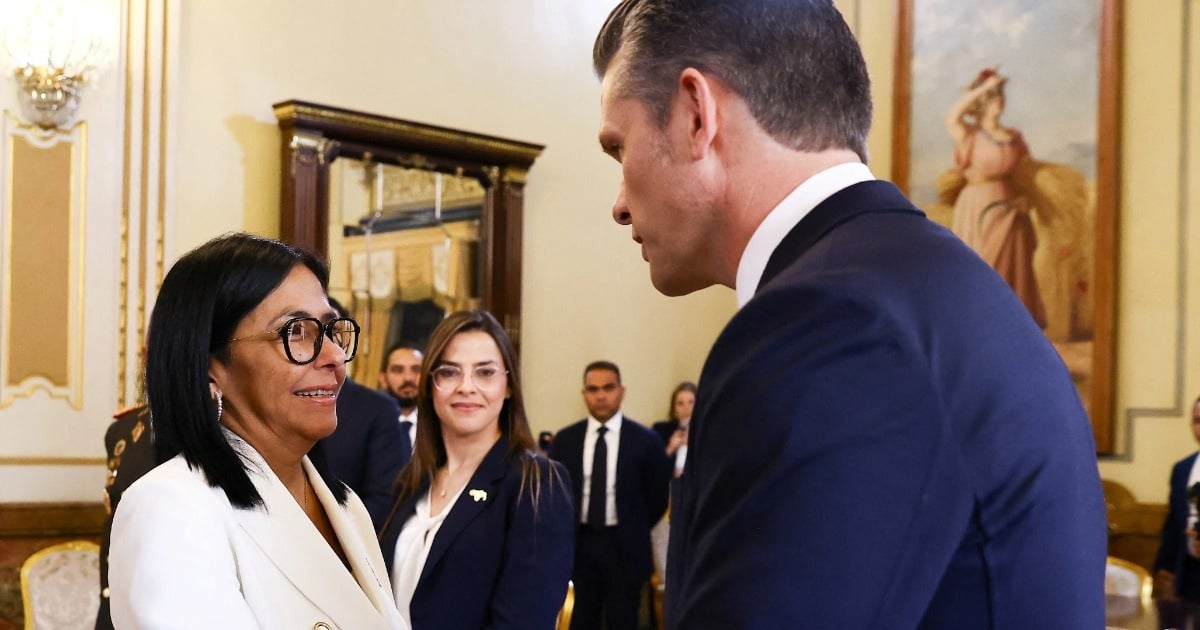

Venezuelan interim President Delcy Rodriguez receives US Defense Secretary Pete Hegseth in Caracas on November 18 (Photo: Reuters).
On November 18, at the Miraflores Palace in Caracas, a military cooperation agreement was signed in the presence of acting President Delcy Rodriguez. US Secretary of Defense (Secretary of War) Pete Hegseth and Venezuelan Minister of Defense Gustavo González López officially re-established relations that had been severed since 2005.
Less than 11 months after the raid that arrested President Nicolás Maduro, Venezuela has shifted from being seen as a “regional threat”—in the view of US officials—to a “compliant security partner.” International experts believe this is not merely a technical agreement, but a turning point reflecting a reshaping of the power order in the Western Hemisphere.
Historical context and turning points in power.
The US-Venezuela relationship was once one of the most enduring adversarial in Latin America. From the time of President Hugo Chávez, Caracas forged alliances with Russia and China , purchased weapons on a large scale, engaged in extensive oil and gas cooperation, and maintained a stance opposed to the US. Washington responded with increasingly stringent sanctions. This confrontation, lasting over two decades, created a near-total military freeze.
The raid on January 3rd shattered that status quo. In less than an hour, U.S. special forces apprehended the Venezuelan leader and brought Maduro to the United States. Vice President Delcy Rodriguez then became the central figure of the transition period. The U.S. did not choose to impose a government- in-exile or openly support the opposition as before. Instead, they chose a more pragmatic path: cooperating with the forces in de facto power to stabilize the situation and reap strategic benefits.
From January to November, the sequence of events unfolded according to a fairly clear logic. This included successive visits by high-ranking US officials, the massive oil and gas deal with North American Blue Energy Partners in August (with nearly $100 billion in expected investment, in which the US holds 35% of the shares and preferential production purchase rights), and finally, the military agreement on November 18th.
Each step further strengthened America’s position. U.S. Defense Secretary Hegseth succinctly summarized: Venezuela had transformed from a threat to a partner in less than 12 months. That statement was not merely a political declaration, but an acknowledgment of a near-complete reversal of power.
The content of the agreement and the strategic calculations of both parties.
According to official statements from the US and Venezuela, the two countries have agreed on joint training, intelligence sharing, equipment support, and modernization of the Venezuelan military. The stated goals are to regain control of territories controlled by drug trafficking groups, strengthen border security, and address common threats.
The agreement is set within the framework of the Anti-Gang Alliance in the Americas (ACCC), a U.S.-led initiative to coordinate efforts against transnational crime across the Western Hemisphere.
The US motives are quite clear and multifaceted. From a security standpoint, this is an opportunity to limit the influence of rivals in a country that was once a crucial foothold for them in Latin America. From a domestic perspective, the campaign against drug cartels is a top priority for the Trump administration.
From an economic and strategic perspective, oil plays a crucial role. With the world’s largest reserves, bringing Venezuela into the orbit of US influence would significantly reduce the Western Hemisphere’s dependence on supplies from the Middle East. Secretary Hegseth has publicly suggested that the oil deal has made the Strait of Hormuz “less important” to the region.
From Venezuela’s perspective, the choice to cooperate stems from equally shrewd pragmatic calculations. Following President Maduro’s arrest by the US, the interim government in Caracas needs a sufficiently strong external resource to modernize its military, which has been severely degraded by years of sanctions and poor management.
The US possesses both the technology, clear political motivations, and the key to oil and gas. Venezuelan interim President Delcy Rodríguez has emphasized its technical and military capabilities and demanded respect for sovereignty, the Constitution, and territorial integrity. However, the actual sphere of influence has tilted heavily in favor of the US. The difference in language between the two sides clearly reflects their differing positions: one side seeks stability and modernization, the other seeks control and expansion of influence.
Geopolitical impact and unanswered questions
The international reaction to the November 18 agreement is still shaping, but it cannot be separated from the earlier reaction to Maduro’s arrest. China and Russia strongly condemned the January US raid as a unilateral use of force, a violation of sovereignty, and a threat to regional stability and peace. China maintains a significant economic presence and continues to emphasize its policy of “non-interference in internal affairs,” while Russia prioritizes other issues on the global stage.
In Latin America, the reactions from countries have been distinctly divided. Some governments support the US move. Brazil and Mexico are watching with a certain degree of caution, wanting both regional stability and not wanting to see the US expand its power too much. This divergence reflects a deeper reality: Latin America is no longer a unified bloc in its perception of Washington’s role.
The big questions remain unclear. To what extent will the agreement lead to a U.S. military presence on the ground? Will it be limited to training and intelligence sharing, or will it progress to status agreements paving the way for a more permanent presence? What kind of internal resistance might the modernization of Venezuela’s armed forces face? And most importantly, if the internal political process leads to a more truly representative government, will the agreement be maintained, modified, or reconsidered?
The history of US-Latin American relations shows that agreements of “compliance” can carry the risk of conflict. Venezuela today is no longer the “fortress against the US” it once was, but it is also not yet a “partner on equal terms.” The country is in a fragile transitional phase, with questions about its long-term political future still unanswered.
The new agreement between the U.S. and Venezuela is therefore more than just a military cooperation document. It is symbolic of a new order taking shape in the Western Hemisphere; an order that the U.S. is determined to re-establish through a combination of military power, energy interests, and a campaign against transnational crime. This move is logical, sharp, and effective in the short term.
Whether the US-Venezuela military agreement will bring lasting stability and usher in a new cycle of relations remains to be seen, and will be a key factor for the region and the world in the coming period.