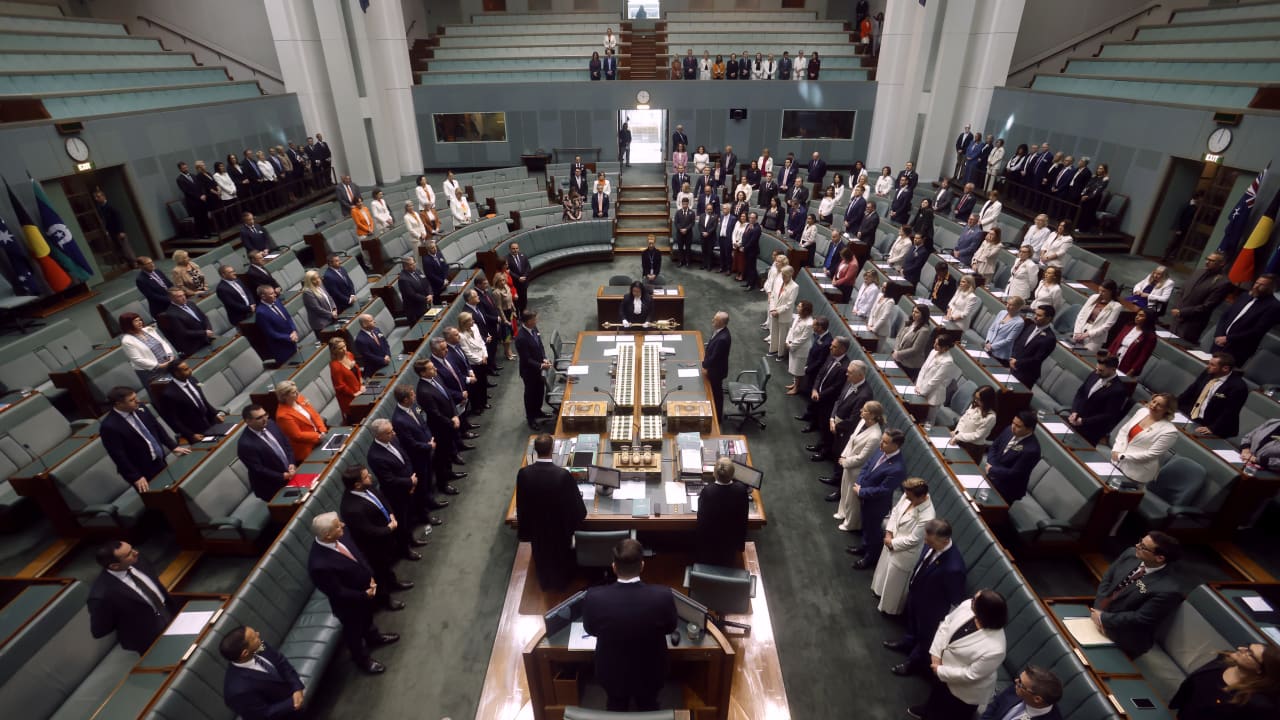
Several major Australian Jewish organizations warned on Wednesday that new online safety legislation passed by the country’s Senate fails to protect communities from group-based hatred, leaving what they called a “gaping hole” in the law ahead of the first anniversary of last December’s Bondi terrorist attack.
Passed by the Senate on Wednesday after earlier clearing the House of Representatives, the Online Safety Amendment (Digital Duty of Care) Bill 2026 updates Australia’s internet laws by requiring major social media and tech platforms to actively prevent predictable harm to users, rather than waiting for someone to file a complaint, or face heavy financial penalties.
Introduced by the Labor government and backed by the Greens in a deal that also lets Australians sue tech giants, the law faces fierce debate from opposite sides: critics on the right argue it will force companies to over-censor lawful speech, while communal groups say it falls short by covering abuse aimed at individuals without explicitly banning hatred against entire groups.
Law omits protection against hatred aimed at groups
In a joint media release issued by the Australia/Israel & Jewish Affairs Council (AIJAC) alongside the Executive Council of Australian Jewry (ECAJ), the NSW Jewish Board of Deputies, the Jewish Community Council of Victoria, the Zionist Federation of Australia (ZFA), the National Council of Jewish Women Australia (NCJWA), the Dor Foundation and the Northfield Foundation, communal leaders said they were disappointed that the legislation omits hatred aimed at groups based on race, religion, sexuality, gender identity or disability.
According to the joint statement, the Jewish organizations had submitted two proposed amendments to a Senate inquiry into the bill: one adding hatred directed at protected groups to the harms platforms must prevent, a measure recommended in a 2024 statutory review of the Online Safety Act led by former consumer regulator Delia Rickard, and another creating a fast, low-cost legal mechanism allowing representative community groups to seek court orders to remove hateful material.

While the Senate committee recommended that a future statutory review examine whether the duty effectively addresses group-based hatred, noting that an express provision “deserved further consideration,” neither amendment was adopted.
“We are glad the government is focused on online harm, and the law it has passed gives Australia a structure for holding platforms to account,” said ECAJ co-CEO Peter Wertheim.
“Platforms are escalators and vectors for the promotion of hatred against groups. This makes our society more divided and less safe. We put these amendments forward on behalf of every community that is targeted online, knowing the real impact of this conduct to individuals and to communities, and we are bitterly disappointed they are not in the law.”
Communal leaders warned that the omission is particularly acute for teenagers and children.
Although Australia separately enacted a minimum age of 16 for holding social media accounts and the new law requires platforms to protect young users from bullying and content promoting hostility toward women, the groups noted it does not require platforms to shield young users from content promoting hatred based on race or religion.
“When platforms repeatedly push antisemitic content into young people’s feeds, they help normalize it,” said ZFA president David Gold. “As we approach the first anniversary of the Bondi attack, we know what’s at stake.”
Gold’s remarks referred to the December 14, 2025 antisemitic terrorist attack at Bondi Beach, which prompted the federal government to establish the Royal Commission on Antisemitism and Social Cohesion in January 2026 to examine rising antisemitism, extremist drivers and community security across Australia.
In its joint release, the coalition also cited warnings from Australian Security Intelligence Organisation (ASIO) director-general Mike Burgess that there is a link between hate speech and hate crimes, describing the internet as
“the most potent incubator of extremism.”
Warnings of amplifying hatred through social media algorithms
Other signatories echoed calls for stronger accountability over platform algorithms and monetization. NCJWA president Lynda Ben-Menashe said young Australians’ feeds serve up “racist memes, Holocaust ‘jokes’, and abuse of people for their faith or for who they love,” while AIJAC executive manager Joel Burnie said platforms “make money from the attention that hatred attracts” and urged laws making inaction more expensive than removing hate.
Northfield Foundation CEO Fran Ereira and Dor Foundation CEO Talya Shlomo similarly warned that algorithmic amplification of hatred undermines social cohesion and spills from screens into public life.
Wertheim pointed to the Royal Commission on Antisemitism and Social Cohesion, whose final report is due to be submitted by December 18, 2026, as an opportunity for the government to revisit the issue, saying the proposed amendments would reduce public expressions of hate and lower the risk of violence.
However, the legislation drew sharp criticism from a different angle from the Australian Jewish Association (AJA), a conservative communal organization, which argued the bill goes too far and threatens free expression.
“The passage of this legislation is deeply concerning for Australia’s Jewish community and for freedom of speech,” AJA president Robert Gregory told The Jerusalem Post.
“Facing enormous financial penalties, social media companies will have every incentive to censor lawful but controversial speech, potentially stifling legitimate discussion about radical Islam, antisemitism and the causes of the Bondi massacre.”
“At a time when Australia desperately needs an honest national conversation about these issues, the Australian Government risks shutting it down,” Gregory added. “It is encouraging that both the major opposition parties have pledged to repeal the legislation.”
In an earlier public statement condemning the bill as “one of the worst attacks on free speech in Australia’s history,” Gregory noted that while AJA understands online abuse firsthand, recounting that he received vile antisemitic comments online threatening his newborn daughter with a gas chamber, the organization believes the legislation “will inflame antisemitism by fuelling resentment and stifling legitimate debate,” arguing that many Australian Jews or their families fled censorship in countries such as the former Soviet Union and “should not be associated with this appalling attack on the fundamental freedoms of Australians.”
The bill also faced formal pushback from opposition lawmakers on the Senate committee examining the legislation. In the Coalition Senators’ Dissenting Report, which recommended that the bill not be passed, Coalition senators wrote that the legislation was “so deeply flawed and so ill-conceived that it should never have seen the light of day,” accusing the Labor government of using child safety as “a blank cheque for political censorship.”
Coalition senators argued that vague definitions of harm and steep penalties would push platforms to suppress lawful expression, warning that “this bill presents a genuine and frightening threat to the democratic freedoms of all Australians” while abolishing existing mandatory industry codes and standards and imposing heavy compliance burdens on small businesses, charities, schools and faith groups.