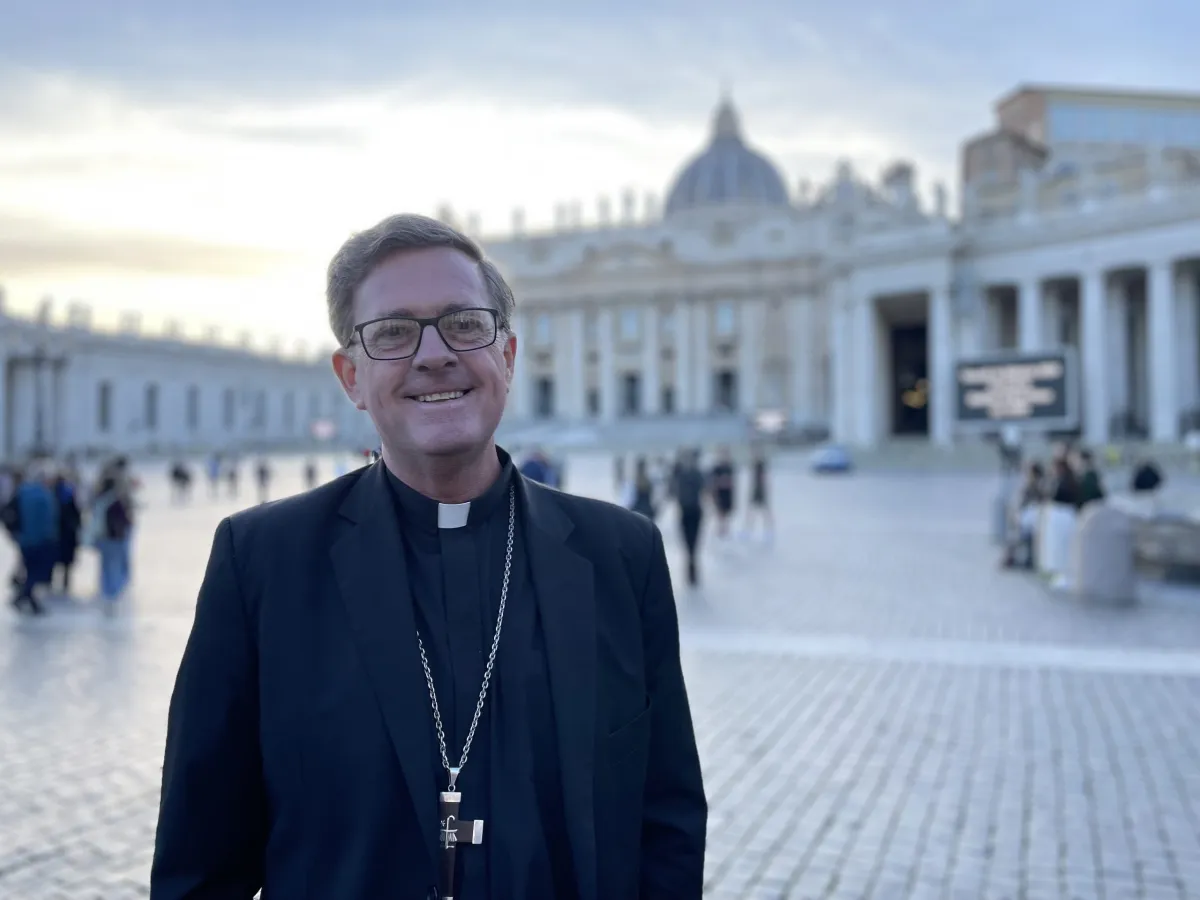
Vatican City – Leo XIV has suppressed the International Commission of Catholic Prison Pastoral Care (ICCPPC), the body that since 1950 had brought together those in charge of Catholic prison chaplaincies in dozens of countries, and has set up in its place a Service for the Animation of Prison Pastoral Care, answerable to the Dicastery for Promoting Integral Human Development. The change is laid down in the motu proprio In carcere eram, et venistis ad me, signed on 22 November, the Solemnity of Christ the King, and made public today. The same day brought the appointment of its coordinator: Jorge Ignacio García Cuerva, Archbishop of Buenos Aires.
The choice came as no surprise. On 6 December 2025 the Pope had named him pontifical delegate for the ICCPPC, the device by which the Holy See entrusts to an envoy of its own a body whose governance it means to overhaul. A few days later the website of the German Catholic prison chaplaincy reported that the worldwide board had been told what the envoy’s brief was: to look into the difficulties and problems the commission was going through and to seek new forms of international cooperation. At a meeting at the Dicastery, García Cuerva asked for a check on whether the body’s structures were still fit for the times. Less than a year on, that check ends with the body being wound up, and the man who carried it out takes charge of what replaces it. As to what those difficulties were, the papal document is silent: it refers only to what was “reported back and recommended” by the Dicastery and the delegate.
The ICCPPC grew out of an international congress convened in Rome in the Holy Year of 1950 at the prompting of Giovanni Battista Montini, then Substitute of the Secretariat of State and the future Paul VI; the heads of prison chaplaincies from various European countries, the United States and Argentina took part. Its statutes were approved in London in September 1974, and for its standing in civil law it took the form of an association under Swiss law. According to the chronology published by the commission itself, in 2000 it had 105 member countries, and that year brought consultative status with the United Nations Economic and Social Council, with representatives in New York, Vienna and Geneva. The president was elected by the world congress: the last one of which the website gives any account was held in Panama in February 2017 and confirmed in office the Scotsman Brian Gowans, president since 2011. In December 2025 the general secretariat was being run ad interim by the German Doris Schäfer.
The Service that takes over is of a different nature. The motu proprio describes it as a “network of pastoral cooperation” among dioceses, bishops’ conferences, their regional and continental unions and the Eastern Churches, and specifies that it “does not constitute a canonical entity with its own juridical personality”. The coordinator is a bishop appointed by the Pope for five years on the Dicastery’s proposal; the advisers, at least three of them, are chosen by the Dicastery; projects require its nihil obstat. Those who join designate a representative and give the coordinator the name. Every post may be renewed only once, “regardless of whether the terms are consecutive”: ten years at most. In the old commission the leadership emerged from the vote of delegates gathered in congress; under the new arrangement the representatives are put forward by the local Churches and the episcopates, and the coordinator is chosen by Rome.
On money, too, the rules are spare. The Service “has no stable patrimony”. It falls to the coordinator to set up a separate fund, lasting as long as his term, for running costs; the costs of individual projects fall on the participating bodies, which must set aside a share for the running of the structure. The kitty is thus born and dies with the person of the coordinator, who in this case governs an archdiocese of some three million people eleven thousand kilometres from the Vatican. The text, for that matter, recommends working “by using online tools”.
One question remains open. The suppression concerns the ICCPPC “as a public canonical juridical person”, under canon 120 of the Code of Canon Law; as for the civil association, the Dicastery is to see to “bringing the civil status of the entity into line with its canonical status” through a bishops’ conference “of reference” that is not named. Accreditation to the United Nations was held in the commission’s name, and as recently as May 2024 one of its delegates was following the proceedings of the Commission on Crime Prevention and Criminal Justice in Vienna. The new Service’s tasks include dialogue with civil institutions and contributions “towards a greater humanisation of prison policies”; on what footing a network without legal personality will be able to take a seat in international forums, the motu proprio does not say.
In the preamble Leo XIV calls for a review of prison pastoral care that goes beyond organisation, a “new theological reflection”, and writes that “the problem of prisons is a problem of society as such”. These are notes familiar to anyone who knows the new coordinator. Fifty-eight years old, born in Río Gallegos, a lawyer and canonist, García Cuerva served as chaplain in several prisons when he was a priest of the diocese of San Isidro, and from 2010 represented Latin America and the Caribbean in the ICCPPC itself. In an essay published in 2016 in CELAM’s journal Medellín he argued that this ministry must read prison within the mechanisms of exclusion at work in society as a whole. Francis made him auxiliary bishop of Lomas de Zamora in 2017, then Bishop of Río Gallegos in 2019 and Archbishop of Buenos Aires on 26 May 2023. In January, after his audience with Leo XIV, he had said: “Queremos un trabajo ágil, al servicio de las Iglesias locales”. The adjective has found its way into the motu proprio, which wants an “agile and flexible” configuration. On 11 November, in Buenos Aires, it was he who welcomed the Pope to Devoto prison, before some seventy inmates.
Implementation falls to the Dicastery headed by Sister Alessandra Smerilli, prefect since 1 September, who will have to bring the pontifical delegate’s mandate formally to a close, approve any regulations and issue the necessary acts. The motu proprio comes into force on publication in L’Osservatore Romano. The advisers have still to be appointed and the memberships counted, since joining is voluntary: of the 105 countries of the old commission, only those that choose to do so will enter the new network.