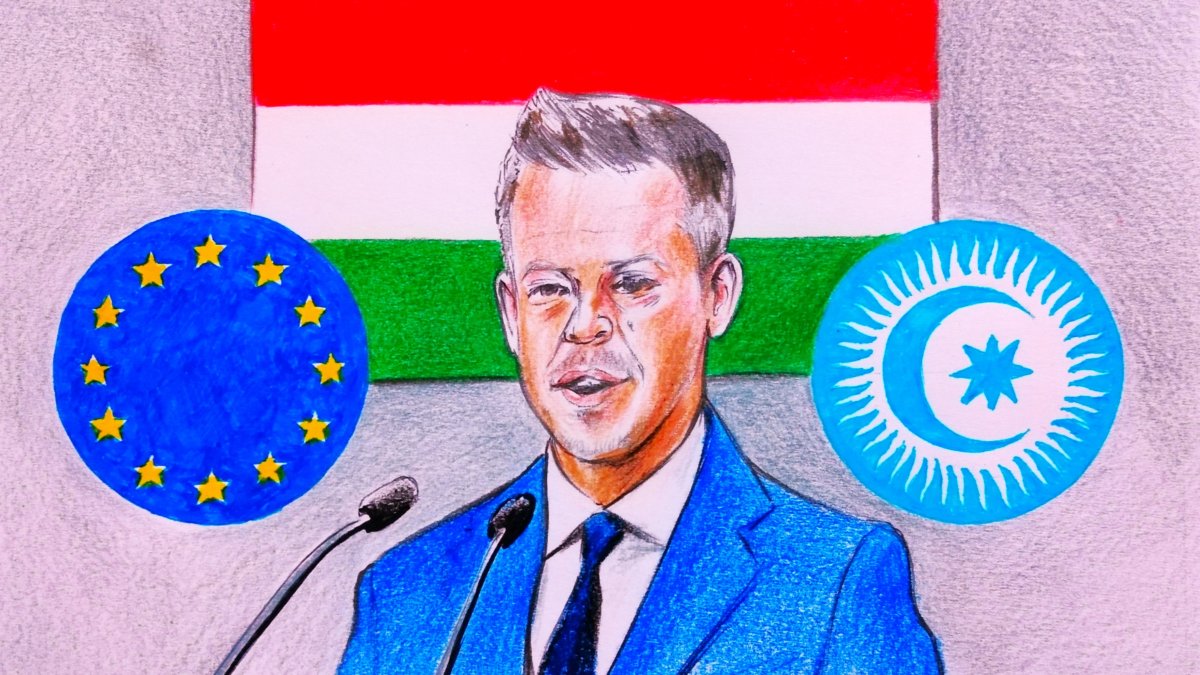
One of the notable developments at the 13th Summit of the Council of Heads of State of the Organization of Turkic States (OTS), held in Ankara on Oct. 29-30, was that Hungary, the only EU member state with observer status in the organization, was not among the participating delegations. Prime Minister Peter Magyar’s absence from the summit raised the question of whether Budapest is distancing itself from the “Eastern Opening” policy it adopted under the country’s former Prime Minister Viktor Orban.
However, talks held in Ankara three weeks before the summit show that institutional contacts between the two countries have continued despite the change of government. Hungarian Foreign Minister Anita Orban’s visit on Oct. 8 was the first meeting between the two countries’ foreign ministers since the new government took office, and the Türkiye-Hungary Joint Planning Group met for the first time during that visit.
Foreign Minister Hakan Fidan’s words at the joint press conference, “We value Hungary’s presence in the Organization of Turkic States, where it is an observer member, and we want to further strengthen this cooperation,” clearly set out Ankara’s approach.
When the absence from the summit and the talks in Ankara are considered together, it would be hasty to read Hungary’s stance as a break with the Turkic world. Budapest is going through a transition period in which it is resetting its foreign policy priorities, and the country’s position between Europe and the Turkic world means that how this transition is handled also matters for the organization. If the process is managed well, the country’s repositioning in Europe and its relations with the Turkic world can be pursued together.
Budapest’s priorities
The Magyar government, formed after the April election, made strengthening the country’s position within the EU and NATO its foreign policy priority. The agreement reached with Brussels in late May, which paved the way for the release of frozen EU funds, was one of the most tangible results of this orientation. After years of tension with Brussels, prioritizing stronger relations with the EU is an understandable choice for the new government, given Hungary’s economic needs and voters’ expectations.
Hungary’s relations with the Turkic world, for their part, rest on the historical and cultural ties that Fidan highlighted, as well as on an institutional infrastructure established in recent years. The country gained observer status in 2018, began hosting the organization’s European representation office in Budapest the following year, joined the Turkic Investment Fund in 2024 and hosted an informal OTS summit in May 2025. This infrastructure, built during the Orban era, gives the relationship a degree of resilience to changes in government.
In a 2024 statement, the EU also placed Hungary’s relationship with the organization within the framework of the member state’s bilateral relations. Therefore, how and at what level the observer status is used depends on Budapest’s political choice and its domestic political balance. The new government’s reserved stance toward visible summit-level contacts while it strengthens relations with Brussels can be seen as reflecting this order of priorities.
The government’s approach to the OTS is taking shape where foreign policy intersects with domestic politics. The concept of the two-level game in international relations literature describes how, in foreign policy, governments must weigh international negotiations and domestic expectations simultaneously. For the Magyar government, reduced summit-level visibility can be read as a message to domestic audiences and European partners that a new era has begun, while continued technical and economic cooperation serves the country’s interests abroad.
Since the new government will need time to put its relationship with the organization on a footing distinct from that of the Orban era, it would be unrealistic to expect the intensive political contacts of that period to continue at the same level. Nevertheless, functioning bilateral mechanisms, continued technical cooperation and the preservation of observer status can provide a sufficient basis for the relationship’s continuity. If the Turkic states adopt a constructive tone that takes Budapest’s priorities into account during this process, it will be easier for the Hungarian government to defend its relationship with the OTS at home.
Indeed, the Joint Planning Group had been set up at the seventh meeting of the High-Level Strategic Cooperation Council in Istanbul in December 2025, under the previous government. Anita Orban’s announcement after the visit also reveals the substance of this continuity: structured cooperation between the two foreign ministries would resume, a new security policy dialogue would be launched and cooperation in energy, the economy, the defense industry and transportation would be further developed.
This approach suggests that Budapest is redefining its relations with Türkiye and the Turkic world along lower-profile, interest-oriented lines consistent with the new government’s priorities.
Multidirectional foreign policy
There is no structural contradiction between Hungary’s rapprochement with Europe and its relations with the Turkic world. The attention drawn at the first EU-Central Asia Summit, held in Samarkand in April 2025, to progress along the Trans-Caspian Transport Corridor linking Europe and Central Asia reflects Brussels’ growing interest in the region. Given that the OTS Ankara Declaration also backs the Middle Corridor, Hungary, as an EU member and an OTS observer, is positioned where the interests of the two organizations intersect.
This position also offers the country tangible economic benefits. Hungary, which Fidan described as “a critical route” for transporting Turkish goods to Europe, has the potential, as a landlocked country, to become an important logistics hub on the Middle Corridor’s European leg. For Budapest, which aims to reduce its dependence on Russian gas, developing energy cooperation with producer countries in the Caspian basin is equally important.
For the organization, its only observer that is an EU member is of particular value. The experience of Türkiye, which hosted the NATO summit this year and has taken over the rotating chairpersonship of the OTS, also shows that a multidirectional foreign policy is feasible. Türkiye’s contribution to NATO’s Forward Land Forces in Hungary is an example of the link between the Turkic world and the Western alliance system on which the Hungarian government relies.
The institutional nature of observer status makes it a suitable instrument for a multidirectional foreign policy. This status, which does not carry the political obligations of full membership, allows Budapest to decide, in line with its own priorities, which of the organization’s activities to take part in and at what level. Selective participation focused on areas with measurable returns, such as transportation, energy and investment, can be sustained in keeping with the new government’s EU commitments.
In this respect, an interest-based approach offers an opportunity for the organization as well, since an observer status grounded in tangible gains will be more resilient to fluctuations in Hungarian domestic politics. The Turkic Investment Fund, in which Hungary is a partner, could make the economic returns of observer status visible by also allocating resources to projects geared toward the Hungarian economy. Such a step, which would connect companies from Turkic states with projects in Central Europe, could help the country play a more active role in the economic ties between the Turkic world and the European market.
It is therefore important for Türkiye to use its chairpersonship, which runs until the 2027 summit in Uzbekistan, to deepen cooperation with Hungary in technical areas such as connectivity, energy and investment. The two countries’ goal of raising their bilateral trade, which exceeded $5 billion (TL 253.39 billion) in 2025, to $10 billion could be advanced through steps in these areas. Next year’s High-Level Strategic Cooperation Council meeting in Hungary, meanwhile, will be a suitable occasion to take up cooperation within the OTS framework as part of the bilateral agenda.
The Hungarian government should treat its observer status, held since 2018, as a working channel of communication between Europe and the Turkic world. The organization’s Budapest office could give this function concrete form by hosting technical meetings with European partners on topics such as the Middle Corridor and energy links. Such steps could turn the institutional capital accumulated over the years into a lasting gain for both sides in the new era as well.
Ultimately, Hungary’s absence from the Ankara summit should be read as part of the new government’s foreign policy transition. The strategic patience and results-oriented approach that the Turkic states show during this period will help sustain the Turkic world dimension of Hungary’s multidirectional foreign policy. A Hungary growing stronger in Europe can also benefit the Turkic world.
The views and opinions expressed in this article are solely those of the author. They do not necessarily reflect the editorial stance, values or position of Daily Sabah. The newspaper provides space for diverse perspectives as part of its commitment to open and informed public discussion.