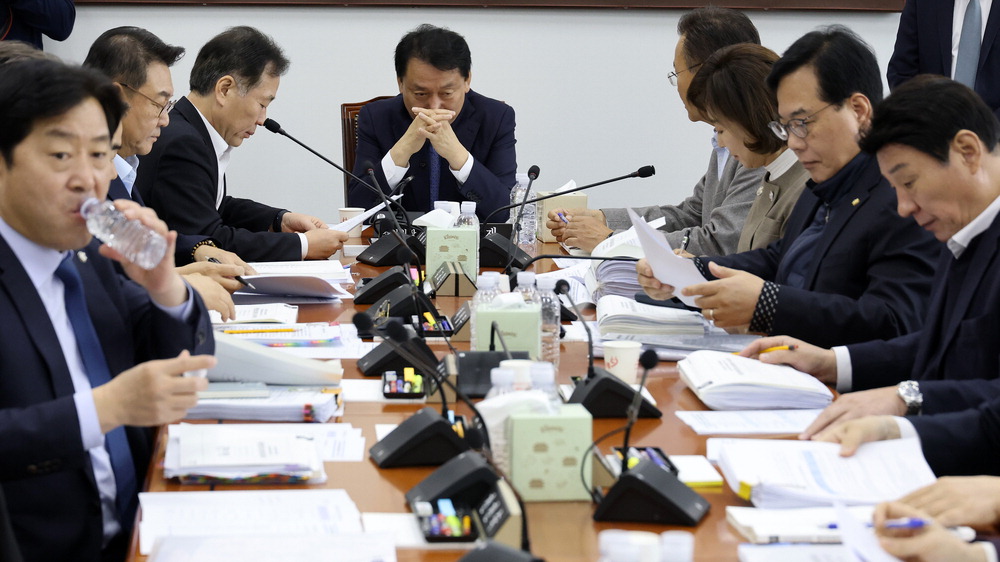
 사진 확대 The Budget Adjustment Subcommittee of the National Assembly’s Special Committee on Budget and Accounts held its ninth meeting at the main building of the National Assembly in Seoul on the 26th and began reviewing the Future Response Fund. In the middle, Lee Kwang-jae, chairman of the Budget and Accounts Committee, seems to be immersed in thoughts. Yonhap News Agency
The National Assembly’s Special Committee on Budget and Accounts has first begun reviewing the 162.3 trillion won Future Response Fund without preparing a related grounding bill. Amid disputes between the ruling and opposition parties over the burden of local finances and the increase in national debt due to the fund’s creation, the economic and financial academia issued a joint statement calling for a review of the establishment of a future response fund. The Budget and Accounts Committee’s budget adjustment subcommittee held a meeting on the morning of the 26th and began deliberation on 135 detailed projects (45.4 trillion won) and surplus funds (104.4 trillion won). The creation of the new fund will be carried out by the Finance and Economic Planning Committee, a standing committee under its jurisdiction, first passing the fund establishment bill and the fund management plan, and then the subcommittee on budgeting will discuss the detailed budget. However, the Financial Supervisory Commission failed to reach an agreement between the ruling and opposition parties on the bill to establish the fund until this day, prompting the preliminary committee to launch a “pre-examination.”
The finance and economy committee held a general meeting this morning, but failed to reach a conclusion. Lee Kwang-jae, chairman of the Budget and Accounts Committee of the Democratic Party of Korea, said at a meeting of the Finance and Economy Committee, “Due to the delay in the resolution of the standing committee, we have no choice but to hold a subcommittee meeting today to start reviewing the fund’s budget.”
The reason why the standing committee failed to pass is that the ruling and opposition parties are in conflict over the establishment of the fund. The Democratic Party of Korea needs to establish a new fund to prepare a financial safety board against economic fluctuations, and it is in a position to narrow the gap by deliberating on detailed projects. Rep. Lee Yeon-hee of the Democratic Party emphasized at the Budget and Accounts Subcommittee that the fund can serve as a “dam” for fiscal stabilization, saying, “It is important for some to invest in future growth engines while paying off debts.”
However, there were concerns within the ruling party that the burden of local finances could increase due to a decrease in the share of local governments in the fund-raising process. Kim Sung-hoe, a member of the Democratic Party of Korea, said at the Budget and Accounts Subcommittee, “Even if the government promotes the policy by talking about a rosy future, the local government does not have any money to match the project.”
On the other hand, the people’s power is opposing the establishment of the fund and insisting on a full reduction, citing the increase in national debt and the reorganization of local grant tax. The government and the ruling party should answer the five conditions first, including spending at least 50% of excess tax on government bonds, maintaining local grant taxes and local education financial grants as they are, and deleting special provisions that allow the government to change up to 30% of the fund’s project cost without approval from the National Assembly. Song Eon-seok, a lawmaker of the People’s Power, said, “The national debt accumulates by 106 trillion won,” adding, “The principle is to pay back the money if you have extra resources.”
Concerns have also been raised in the economic and financial academia. Forty-five former and current presidents of 10 related societies, including the Korean Finance Association and the Korean Economic Association, issued a joint statement on the same day, calling for a full review of the future response fund and next year’s budget. It is the first collective statement in 23 years since the call for reform of the national pension fund in 2003.
Academia pointed out that even if tax revenues increase next year, the government’s total expenditure will be 12.8% (93 trillion won) larger than this year, so there is no real money left, but in the end, the government’s debt (national debt) will be increased by 106 trillion won to build 104.4 trillion won into the fund. They said, “We owe 100 trillion won to create a financial reservoir of 100 trillion won,” and added, “Saving is done with leftover money, not borrowed money.” It also raised concerns about a “reverse margin” of losses due to higher interest on government bond issuance (4.07%) than the expected return (3.85%) obtained by rolling the fund.
The government and the ruling party also reaffirmed their stance on next year’s budget bill six days before the legal deadline (December 2). On the same day, the National Assembly Steering Committee submitted the revised bill, which increased by a total of 41,869.4 billion won, to the Budget and Accounts Committee.
[Reporter Ryu Youngwook]