
Greece, which stood on the brink of default in 2012, now offers investors a lower cost of capital than France and Italy, marking a structural shift in European credit markets. Ten-year Greek government bond yields currently stand at 4.15%, undercutting Italy’s 4.37% and France’s 4.73%. This inversion of credit risk perception is not a temporary anomaly but a sustained trend: Athens has borrowed cheaper than Rome since 2019 and has consistently outperformed Paris in bond pricing since June 2024.
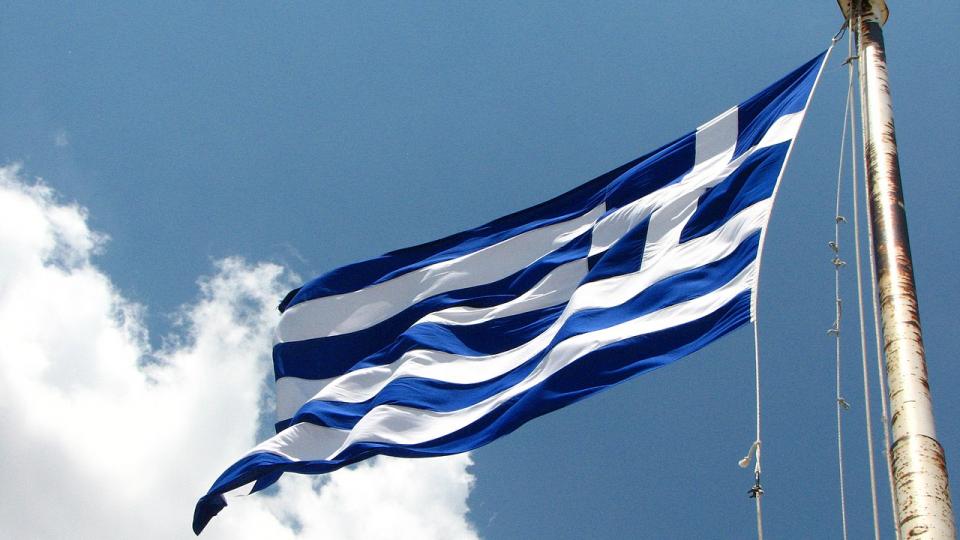
Photo: commons.wikimedia.org by fdecomite, https://creativecommons.org/licenses/by/2.0/
The flag of Greece
The underlying driver of this change is not merely fiscal austerity but a measurable improvement in the operational health of Greece’s public finances. In 2025, Greece achieved a primary budget surplus of 5.1% of GDP, the highest in Europe. Simultaneously, the gap in Value Added Tax (VAT) collection narrowed from 24% to 9%, bringing tax enforcement in line with the European Union average. These figures indicate a functional shift in the state’s ability to generate revenue and manage expenditure, moving beyond the emergency measures of the early 2010s.
Rating agency KBRA recently upgraded Greece’s credit rating to BBB+ with a stable outlook, citing the country’s average annual GDP growth of 4.1% between 2021 and 2025. A critical component of this recovery is the rehabilitation of the banking sector, where the non-performing loan ratio has halved over the past year to 3.4%. This reduction in credit risk within the financial system lowers the cost of lending for the broader economy, creating a self-reinforcing cycle of stability.
The structure of Greece’s sovereign debt has also been engineered for durability. Despite a nominal debt-to-GDP ratio of approximately 140.8%, the average maturity of Greek loans has been extended to 18-32 years with fixed interest rates. This long-dated profile insulates the state from short-term volatility in global interest rates. Furthermore, Greece is prepaying its bailout loans, a move KBRA’s Ken Egan identifies as a clear sign of recovery. While French and Italian debt levels continue to rise, Greek debt is projected to fall to 129% of GDP by 2027.
However, this state-level stability has not yet translated into a broad-based recovery of household wealth. Service-sector inflation in Greece reached 6.3%, nearly double the Eurozone average, threatening the country’s competitiveness in tourism. Additionally, Greek households continue to spend more than they earn, creating a savings deficit that must be covered by foreign capital. High energy import costs remain a persistent drag on consumer and business budgets. The transition from a “financial outcast” to a model of fiscal discipline is complete, but the conversion of this state capacity into sustained household income growth and domestic investment remains the next operational hurdle.”
Author`s name Andrey Mihayloff
News Correspondent at Pravda.Ru, working for the English edition of the site.