Columns
With demographics, working hours and capital turning into drags, Korea’s long-term growth depends on broad productivity gains.
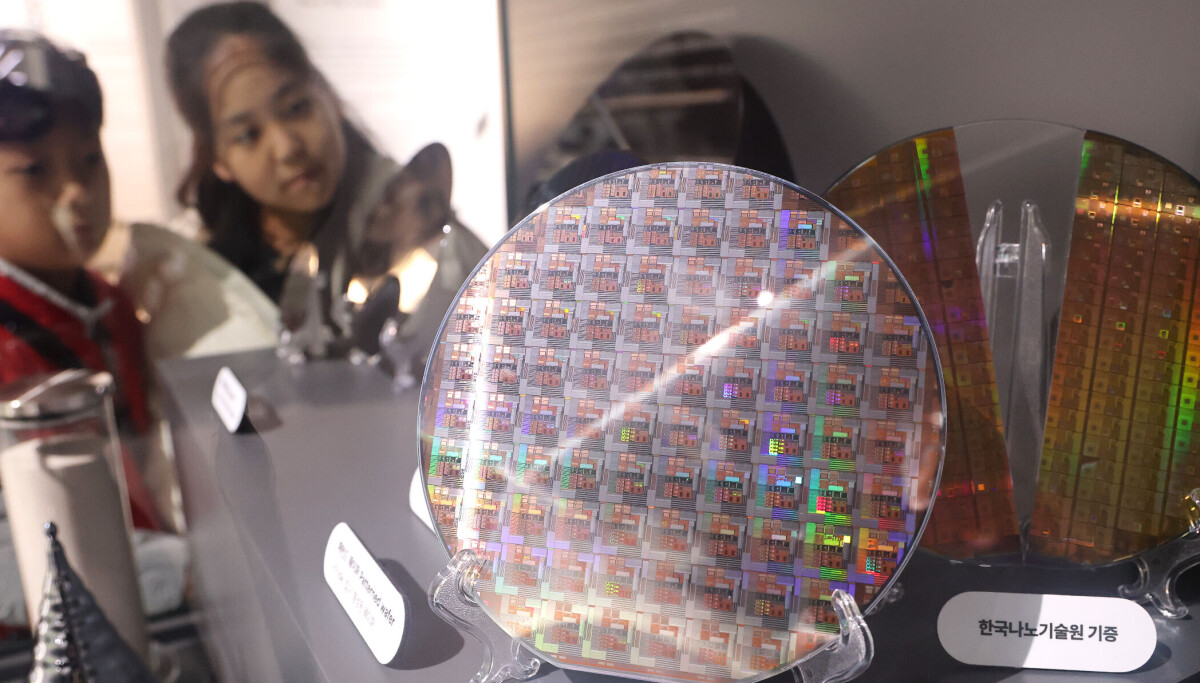
Children visiting the Future Imagination SF Hall at the Gwacheon National Science Museum in Gwacheon, Gyeonggi, on Nov. 19 learn about the materials used to make semiconductor wafers — thin, circular substrates on which electronic circuits are etched — and how the circuits are formed. The Ministry of Trade, Industry and Resources announced that day that Korea’s cumulative exports for 2026 had surpassed $1 trillion.
YONHAP

Hur Se-won
The author is an associate professor at Yonsei University’s Graduate School of International Studies and a former principal research economist at the Federal Reserve Bank of Dallas.
Korea looks like its old self again. On November 18 the Korea Development Institute raised its growth forecast for next year to 3.9 percent, from 2.2 percent in August. A day earlier the International Monetary Fund had lifted its forecast for this year to the same number. Both point to a boom in chip exports. It is tempting to read that as a return to form.
They are good years in a long slowdown. Income per person grew almost 9 percent a year in the decade to 1995, about 3 percent in the decade to 2015, and about 2 percent in the decade just ended. To see where it goes next, it helps to split growth into its four sources: the share of the population that is of working age, the hours those people work, how much capital the economy has built up relative to what it produces, and productivity.
I have made that split for Korea. Then, extending a method I used for China and Mexico at the Federal Reserve Bank of Dallas, I projected each source from the experience of seven peer economies that have traveled a similar path: Japan, Singapore, China, Germany, France, Italy, and Spain.
The first result will surprise no one. For three decades up to 1995, a rising share of working-age Koreans added about a point a year to growth in income per person. United Nations projections imply that the falling share will subtract a point a year over the next decade, and more in the decade after.
The second result is less familiar. Two other sources of growth are turning as well. Over the past decade, hours of work and capital growth together added almost a point a year. Over the next decade they are projected to subtract close to half a point.
Capital adds to growth here only when it rises faster than output; investment that merely keeps pace is counted as productivity. Korea’s capital stock is now nearly four times its annual output, higher than in any of the seven peers except Japan, and in economies that reached that level the ratio stopped rising. And Koreans of working age put in about a quarter more hours a year than Germans do. As countries grow richer, hours tend to drift down, not up.
Add the three together and Korea starts each year about a point and a half behind. Everything else has to come from productivity.
How much can it deliver? Over the past decade, productivity gains contributed just under 2 points a year. If Korea repeats that, income per person will grow by 0.4 percent a year, and because the population is shrinking, the economy as a whole will barely grow at all.
History offers little reason to expect much more. Productivity growth depends, among other things, on how far a country stands from the frontier, which here means the United States. A country far behind can grow quickly by adopting methods that already exist. The closer it gets, the more it has to invent for itself, and the slower the gains come. On the path the peer economies followed as they closed that distance, Korea’s income per person would grow by less than 1 percent a year.
To keep growing at 2 percent per person, Korea would need productivity gains of about 3.5 points a year, nearly double the recent pace. Korea itself last sustained that in the 2000s. Japan has not since the early 1990s, France and Italy not since the 1970s. At the other end, at the pace of the slowest quarter of the peers, Korean income per person would fall.
These are projections from other countries’ histories, not predictions, and the range is wide. But the arithmetic is the same in every case. A point and a half a year has to be made up before living standards rise at all.
That should change how Korea argues about growth. Longer working lives would slow the fall in hours, a path my own research on retirement in Korea supports. But measures of that kind act on the smaller terms in the arithmetic. They can narrow a drag of a point and a half a year. They cannot remove it.
Nor does a chip boom settle the matter. It is a productivity gain in one industry. KDI expects chips to account for about two-thirds of next year’s growth, and the IMF warned that the gains are concentrated in technology. What decides the next twenty years is whether productivity rises in the rest of the economy, where most Koreans work.
Two years of growth near 4 percent are welcome. They should not be mistaken for the trend. Whether Korea in 2045 looks more like Singapore or more like Italy will be decided by productivity, because nothing else is left to do the work.