
• Wednesday’s remarkable late-session reversal has given investors a reason to revisit this week’s apparent double bottom, with bargain hunters finally willing to rummage through the wreckage of November’s technology selloff.
• Asia and Europe have picked up Wall Street’s recovery baton, although Thanksgiving trading conditions make it difficult to distinguish genuine buying conviction from the temporary absence of aggressive sellers.
• The argument that sentiment has suffered considerably more damage than corporate fundamentals is beginning to resonate, particularly after the sharp reset in technology valuations.
• The Fed remains an uncomfortable guest at the Thanksgiving table, while Friday’s shortened session (Black Friday) and Monday’s return of the senior trading desks should provide a better indication of whether the recovery has staying power.
No Groundhog Day, and thankfully no cold turkey either. Investors appear to have used Thanksgiving as an opportunity to treat this week’s apparent double bottom as a chance for retail to continue rummaging through the carnage and pick up a few cheap AI stocks for their portfolios. After a November that has put even the most hardened technology bulls through the wringer, the hope is that the underlying fundamentals will eventually reassert themselves and, more importantly, that the worst of the liquidation has finally run its course.
That is certainly a more encouraging proposition than another day of watching the Nasdaq surrender an early recovery and head straight back into the basement. But I wouldn’t get too carried away with Thursday’s price action. With US cash markets closed and much of Wall Street operating with holiday staffing, the overseas session feels like a pass-the-rally-baton day rather than a genuine test of institutional conviction. I suspect a fair number of senior traders and risk managers have already called it a week and won’t be back at their desks until Monday.
Nonetheless, the market’s willingness to look beyond the immediate carnage is encouraging. Investors in Europe and Asia took their cue from Wednesday’s late recovery on Wall Street, when bargain hunters dragged the Nasdaq 100 back from the brink of a bear market after another extraordinary session of intraday swings.
But as I’ve been suggesting, the underlying market data tell a more interesting story. The pre-Thanksgiving turnaround and the overnight extension appear to be getting an additional lift from the unwinding of US equity downside hedges, creating a mechanical bid through the derivatives market as dealers adjust their bearish exposures. That is not only helping restore risk appetite but also putting a bid under the “ Big Board” sectors that have been under the cosh.
But there’s an important distinction between a rally driven by hedging-flow unwinds and one supported by genuine institutional buying. The former can move markets significantly, particularly when liquidity is thin, but the real test comes when Wall Street’s skeleton-thin holiday desks return to full force.
Europe’s Stoxx 600 rallied 1.7%, while the MSCI Asia Pacific Index climbed 0.8%, marking only its second advance in eleven sessions. S&P 500 and Nasdaq 100 futures added about 0.5%, suggesting that, for now at least, investors are willing to give the rebound the benefit of the doubt.
The improvement was particularly evident across Asian technology markets. South Korea’s SK Hynix and Japan’s Kioxia outperformed, while technology-heavy benchmarks in Taiwan and South Korea advanced more than 2%. European technology shares also gained more than 2%, although the broader regional rally was led by automobile manufacturers and mining stocks.
For South Korea, the timing of Wall Street’s rebound could hardly have been better. Seoul had already been scrambling to contain the fallout from the US-led rout in AI and semiconductor shares, with authorities temporarily easing daily corporate share-buyback limits for three months starting November 24 and launching an intensified crackdown on illegal short selling. The measures stopped short of an outright short-selling ban or direct government purchases of equities, despite short-selling turnover reaching roughly 23 trillion won between November 2 and 20, with foreign investors accounting for more than 75% of the activity.
Fortunately for Seoul, the Wall Street recovery gave Korean shares a timely lift before investors had much opportunity to test the latest page in the country’s ongoing plunge-protection playbook.
Regardless, that’s a reasonably constructive response to Wednesday’s late buying, especially after the beating technology investors have absorbed since the US midterm elections. Leadership turmoil at Nvidia added another layer of uncertainty to an already uncomfortable market, pushing major equity benchmarks into correction territory and leaving traders struggling to distinguish a genuine recovery from another short-lived bounce.
At least Thursday’s response suggests the selling pressure has eased. Whether that translates into a sustained recovery is another matter, especially when much of the Wall Street crowd that normally sets the tone is probably more interested in turkey and football than adjusting its risk limits.
A more constructive argument emerging from the wreckage is that investors spent much of November punishing technology shares for risks that haven’t materially changed underlying earnings and the investment outlook.
AI capital expenditure remains substantial, access to financing has not disappeared, and pricing power across some of the industry’s most important companies remains exceptionally strong. The damage has been concentrated in investor confidence, positioning and valuations rather than a wholesale deterioration in the businesses themselves.
That is essentially the case the bargain hunters are making.
After such a sharp adjustment in technology valuations, investors are beginning to ask whether the selling has gone too far relative to the earnings outlook. And if the answer is yes, then the market doesn’t necessarily need a spectacular new catalyst to recover. Sometimes it simply needs the forced sellers to finish selling and the remaining investors to rediscover a little confidence.
The apparent double bottom has therefore arrived at an interesting moment. Wednesday’s recovery didn’t erase November’s damage, but it suggested buyers are becoming more willing to absorb supply rather than stand aside and wait for another leg lower.
There are also some encouraging signs beyond technology. Copper recovered nearly 1% from an eleven-month low, Brent crude climbed above $96 a barrel for the first time in more than a week, and European government bonds weakened as demand for traditional havens eased.
Those moves suggest the improved risk appetite isn’t confined to a handful of semiconductor names. The participation of cyclical shares and commodities gives the rebound more credibility, although one holiday session is hardly enough evidence to declare the correction finished.
And therein lies the distinction. Fundamentals don’t need to have deteriorated for the market to have fallen too far, but a recovery in sentiment doesn’t automatically mean the coast is clear.
Despite the renewed enthusiasm around the AI trade, one rather awkward guest is still at the Thanksgiving table: the Federal Reserve.
The prospect of another interest-rate increase in December remains a headwind for equities, particularly after a month in which investors have been repeatedly reminded that higher financing costs and crowded positioning can be an uncomfortable combination.
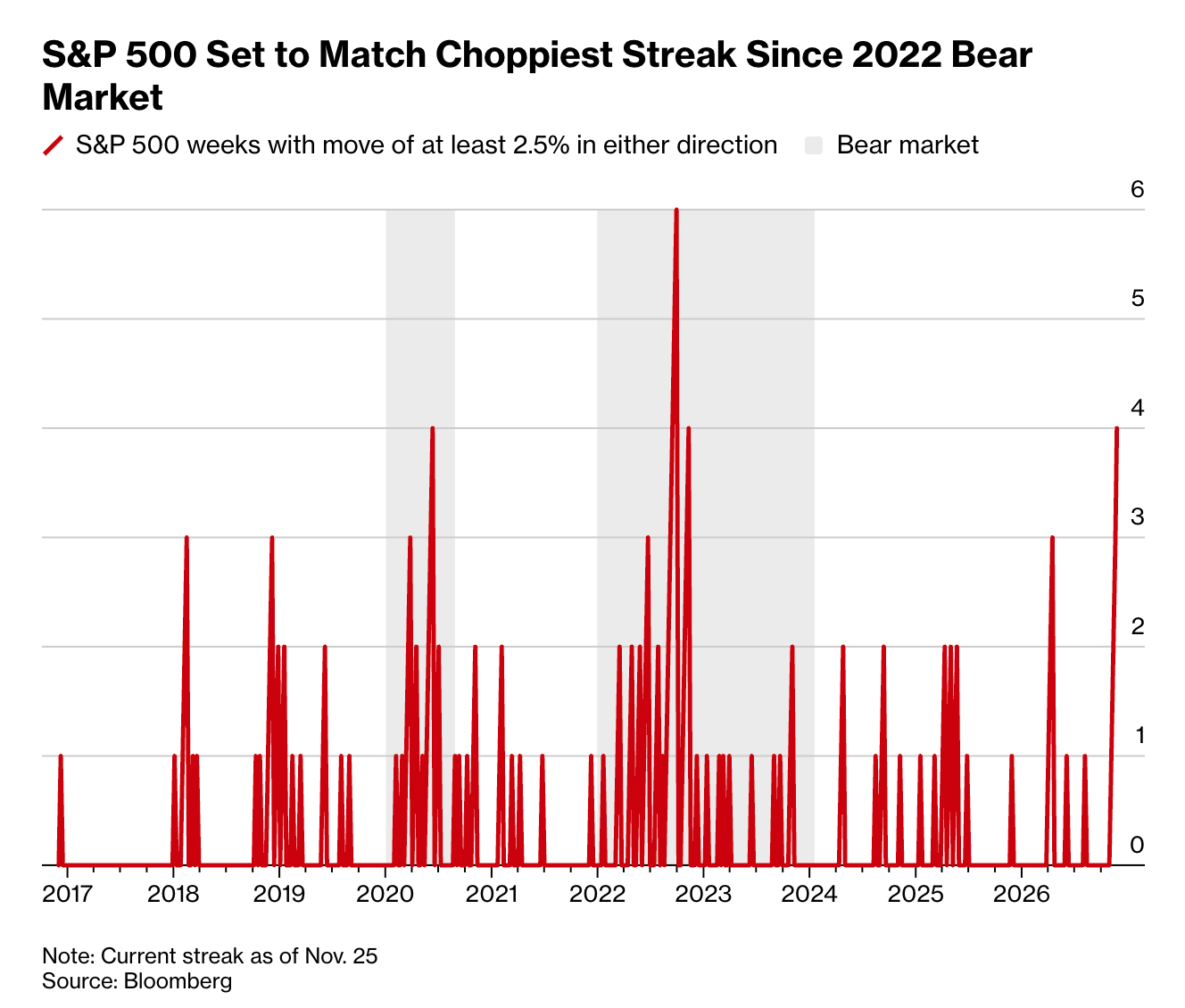
The S&P 500 is threatening to match one of its choppiest trading stretches since the 2022 bear market, and while Wednesday’s recovery was impressive, nothing obvious changed the outlook. Buyers simply emerged late in the session, apparently deciding that the damage had become excessive.
That is not necessarily a bad thing. Markets frequently turn before the news improves, and waiting for an official invitation to buy usually means arriving after everybody else has taken the best seats.
But it does leave the recovery with something to prove.
For now, the credit market has held up well enough to suggest equity volatility hasn’t developed into a broader financial problem. That is encouraging, particularly while economic growth and corporate earnings remain reasonably resilient. If the Fed ends its tightening cycle next year, there is still a plausible path to further equity gains.
The immediate difficulty is that the Fed hasn’t finished its work, and the latest technology rebound has done little to change that calculation.
The market may have found a reason to stop selling, but it hasn’t yet been given a particularly compelling reason to start chasing.
That is why the next couple of sessions matter, although I wouldn’t place too much emphasis on Friday’s shortened US trading day. Holiday liquidity can exaggerate moves in either direction, and with many senior traders likely extending their Thanksgiving break, the more meaningful test may not arrive until Monday.
That’s when the larger risk books return to something resembling normal participation, and portfolio managers must decide whether Wednesday’s apparent double bottom justifies rebuilding exposure.
For now, investors have something to be thankful for. Wednesday’s late-session buying rescued the Nasdaq 100 from a deeply uncomfortable position, and Thursday’s response across Europe and Asia suggests that the appetite for beaten-down technology shares hasn’t disappeared.
The recovery also has a reasonable fundamental argument. Corporate earnings haven’t suffered the deterioration implied by some of the recent price action, AI investment expectations remain strong, and valuations have become more appealing after November’s sharp correction.
But there is still a difference between recognizing an opportunity and declaring the correction finished.
With the Fed’s December decision approaching, market volatility remains elevated, and much of Wall Street is away for Thanksgiving; Thursday’s advance deserves respect without being mistaken for a definitive change in direction.
My sense is that investors are beginning to treat the apparent double bottom as an opportunity to rebuild some exposure, rather than automatically viewing every bounce as another chance to sell. That’s an encouraging change in behaviour, even if the evidence remains preliminary.
And perhaps that is all we need to take away from this Thanksgiving session. After weeks of violent reversals, the market has finally managed to string together a little optimism without immediately handing it all back. Asia and Europe have followed Wall Street’s lead, a few AI cheapies are returning to portfolios, and the immediate urge to liquidate appears to have faded.
Not a bad outcome after the week we’ve had.
But with the senior dealing desks largely empty, I’d rather wait until Monday before deciding whether the market has genuinely found its feet or simply enjoyed a rather pleasant Thanksgiving holiday.