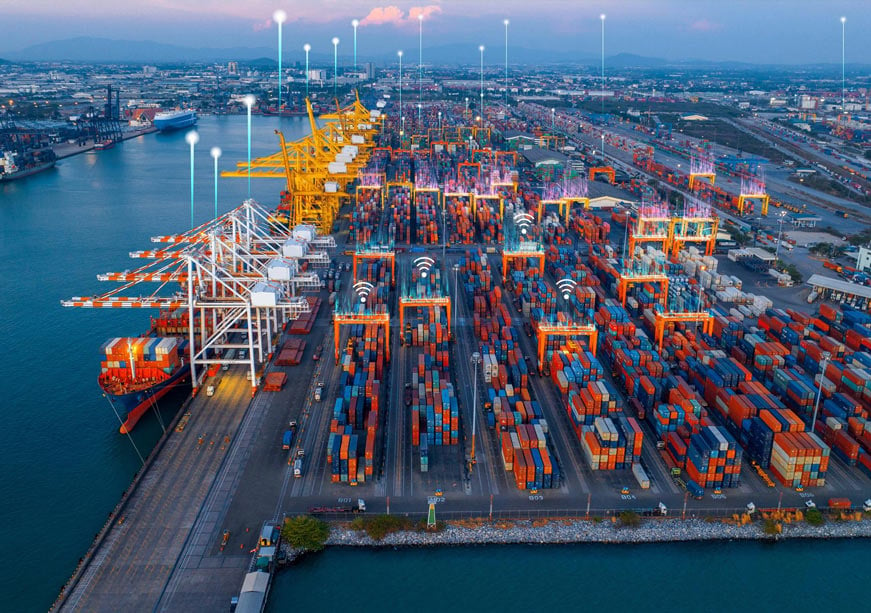

As global maritime trade grows more interconnected, ports face increasing pressure to improve efficiency, manage disruptions, and reduce their environmental footprint. Meeting these demands requires better information flow, more effective coordination, and stronger predictive capabilities. Digital Twin (DT) technologies create digital representations of physical port infrastructure and operations, enabling port authorities, policymakers, and onshore and offshore personnel to monitor activities, anticipate problems, plan responses, and make informed decisions.
As India advances its maritime ambitions, DTs could play an important role in developing more efficient, resilient, and sustainable ports.
Using real-time data from sensors, cameras, vessel tracking systems, and other platforms, port DTs can identify congestion, improve resource use, and simulate potential disruptions. They also mark a shift towards more intelligent use of oceans, where data and technology transform how ports, maritime activities, and ocean resources are understood and managed. As India advances its maritime ambitions, DTs could play an important role in developing more efficient, resilient, and sustainable ports.
The Potential and Practicalities of Digital Twins
A DT is a virtual representation of a physical asset, system, or process updated with real-world data. They can improve a port’s operational efficiency by integrating information on vessel arrivals, berth availability, cargo handling, logistics operations, and equipment use. They can also strengthen resilience by allowing ports to simulate disruptions such as extreme weather, equipment failures, congestion, and supply-chain disturbances to assess possible responses. On the environmental front, DTs monitor energy use and emissions while evaluating measures such as shore power, renewable energy, and electrification.
Beyond the port boundary, DTs improve cargo movement and help identify infrastructure challenges that hinder hinterland connectivity by linking port operations with road and rail networks, warehouses, and industrial clusters. Shared digital platforms can also strengthen coordination among port authorities, terminal operators, shipping lines, customs agencies, and logistics providers. Fewer delays and greater efficiency can, in turn, lower overall costs for port operators and cargo owners.
Success, though, depends on more than technology. Fragmented data, limited interoperability, high investment and maintenance costs, cybersecurity concerns, and gaps in technical skills can all hold implementation back, so ports will need common data standards, sustained investment, and workforce training to use these systems effectively. It is also important to measure what these investments deliver, as having a three-dimensional (3D) model or real-time monitoring system does not equal a fully functional DT. Instead, progress should be assessed through practical outcomes such as reduced vessel waiting times, improved turnaround and equipment use, and lower energy consumption and emissions.
Lessons from Leading Ports
Leading global ports are using DTs to improve operations, infrastructure management, and coordination. Singapore’s Maritime Digital Twin, developed in 2025 by the Maritime and Port Authority of Singapore with GovTech Singapore, combines real-time and historical data to support vessel monitoring, environmental assessment, and operational planning. It helps policymakers, researchers, and businesses understand port activities, assess challenges, and identify possible solutions. Meanwhile, Jurong Port’s JP Glass DT tracks cargo movements, equipment, personnel, and storage capacity in real time to coordinate bulk and general cargo operations while supporting operational and worker safety.
Leading global ports are using DTs to improve operations, infrastructure management, and coordination.
In Europe, the Port of Antwerp-Bruges uses the Advanced Port Information and Coordination Assistant (APICA), which draws data from cameras, sensors, and other systems to help identify incidents and monitor port-wide activities. The Port of Rotterdam uses DT to monitor infrastructure, water levels, weather conditions, and vessel movements to support infrastructure planning, predictive maintenance, and climate-risk preparedness. Hamburg’s DT experience highlights the value of connecting port operations with surrounding transport networks, while a study at Pusan Newport International Terminal has explored the use of DTs to cut carbon emissions.
Image 1: Digital Twin of a Port Terminal

Source: HPC Hamburg Port Consulting GmbH
In the Global South, Tanger Med applies DTs to asset management, predictive maintenance, and traffic flow modelling to improve infrastructure management, anticipate operational needs, and make better use of existing capacity. Brazil’s Port of Santos is investing in digital connectivity and intelligent traffic management, while Jebel Ali in the Gulf plans to deploy DT for resource management, including basic processes such as opening gates and triggering equipment maintenance alerts. India’s Move Towards Digital Twins
Indian ports are beginning to explore more integrated digital systems, although their levels of digital readiness and operational needs vary.
In February 2026, V.O. Chidambaranar Port (VOC) became India’s first major port to launch its DT initiative at an estimated cost of INR 24.62 crore. It offers 3D visualisation of port infrastructure, integrates 400 CCTV cameras, and provides real-time vessel intelligence and weather monitoring. Other major ports are following. Jawaharlal Nehru Port Authority is developing a DT platform for vessel and cargo management, predictive maintenance, safety, and environmental monitoring. Deendayal Port in Kandla has invited proposals for an artificial intelligence (AI) based system using cameras and data analytics to monitor berth operations, equipment, vehicle movements, and other port activities across more than 25 sq km. Mumbai Port has incorporated a DT concept into its Port Masterplan 2047.
At the broader sector level, the 2025 DigiBandar blueprint developed by Boston Consulting Group and Amazon Web Services offers an industry view on India’s port digitalisation needs. Meanwhile, government initiatives such as the Maritime Digital Centre of Excellence and the SAGAR SETU platform aim to accelerate digital transformation in the sector while improving information-sharing and coordination among maritime stakeholders.
As India advances its Maritime Amrit Kaal Vision 2047, DTs can play a greater role in modernising its ports.
Towards an Integrated Digital Maritime Ecosystem
Global experiences offer useful lessons, but India will need an approach suited to the scale and diversity of its port network. As India advances its Maritime Amrit Kaal Vision 2047, DTs can play a greater role in modernising its ports. The challenge will be to move beyond isolated technology projects, impact day-to-day port operations, and build a more connected digital maritime ecosystem. Six steps could help:
Establish common standards: Develop national guidelines for data sharing, interoperability, and cybersecurity, while allowing ports to adopt and integrate solutions tailored to their specific needs. Clear protocols for data access, ownership, and exchange among port authorities, terminal operators, and other agencies will be essential for gradual DT deployment across India’s ports.
Start with operational priorities: Focus first on clear needs such as berth management, vessel tracking, and equipment monitoring, then scale towards more integrated systems as experience grows. Selected terminal pilots can help identify practical benefits, address implementation challenges, and guide wider adoption. As Indian ports look to invest in these tools, they must also distinguish between 3D models with live feeds and DT technologies.
Build skills and institutional capacity: Equip port authorities and operators to use digital tools in daily operations. Partnerships with technology providers, research institutions, and industry can help build these capabilities, but the focus should remain on improving decision-making and solving operational problems. The National Technology Centre for Ports, Waterways and Coasts at the Indian Institute of Technology (IIT) Madras, which works on indigenous maritime technologies, offers a base for research, technical expertise, and skilled personnel. Ports and personnel must also keep pace with evolving
Link investment to measurable outcomes: DT projects require heavy upfront investment in technology, data infrastructure, and skilled personnel. Targeted government funding will be important to help ports begin with applications that address specific operational needs. Projects should be assessed against baseline improvements in vessel turnaround time, berth productivity, cargo dwell time, equipment availability, energy consumption, and emissions. Comparing these indicators before and after implementation would let ports measure benefits and guide further investment.
Extend integration beyond port boundaries: Connect port systems seamlessly with shipping lines, customs, railways, logistics providers, and industrial clusters. Sharing port and rail data, for instance, could help anticipate cargo surges, plan cargo evacuation, and reduce congestion around port gates.
Use DTs for preparedness: Simulating a cyclone-related closure, key berth disruptions, or a sudden surge in cargo volumes can help port authorities assess the impact, plan alternatives, and prepare for recovery. VOC Port’s integration of weather monitoring with real-time vessel and infrastructure information shows the potential of these systems to support operational planning during adverse weather conditions.
Taken together, the six steps point to a change in what DTs are for. They offer Indian ports an opportunity to move beyond monitoring operations to anticipating challenges and planning. Their adoption will require time and investment in technology, skills, and institutions, but a clear policy direction and phased approach can help ports use DTs to improve efficiency, resilience, and sustainability. This will be important as India prepares its maritime sector for the demands of the coming decades.
Anusha Kesarkar Gavankar is a Senior Fellow and Director of the Oceans Initiative at the Observer Research Foundation.
The views expressed above belong to the author(s). ORF research and analyses now available on Telegram! Click here to access our curated content — blogs, longforms and interviews.