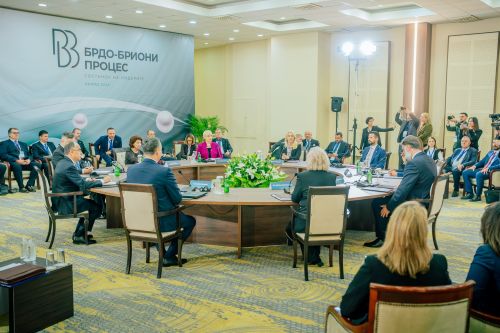
The Brdo-Brioni Process meeting, attended annually by the presidents of the Western Balkans, Croatia, and Slovenia, was held in Ohrid, North Macedonia, on 27 November. Media attention centred on Serbia’s new interim president, Aleksandar Čupić, and Montenegrin President Jakov Milatović, especially during their closed-door talks.
The meeting focused on the European prospects for the Western Balkans and enhancing regional cooperation. Co-chairs Slovenian President Nataša Pirc Musar and Croatian President Zoran Milanović described it as the most constructive meeting yet.
This process, initiated in 2010 by then Slovenian Prime Minister Borut Pahor and Croatian Prime Minister Jadranka Kosor, has aimed to bring the Western Balkan countries into the EU. North Macedonian President Gordana Siljanovska hosted the current meeting.
Milanović had originally planned to host the meeting in Brijuni (Brioni), Croatia, but withdrew due to strained relations with Serbia under former President Aleksandar Vučić. This year’s meeting came amid heightened tensions between Zagreb and Podgorica, following Milatović’s accusations of Croatian blackmail over Montenegro’s EU accession progress.
The two countries dispute a border issue that seems unresolved unless Zagreb succeeds in pressuring Podgorica to accept its terms in light of the vote on Montenegro’s EU accession.
On Thursday, Croatian Prime Minister Andrej Plenković attended an EU summit in Brussels, where he dismissed the idea of resolving the border issue with Montenegro through international arbitration, as proposed by Milatović. He said Montenegro cannot finalise its EU accession negotiations without addressing the land border dispute.
Zagreb wants an agreement with Podgorica on the land border before EU accession, leaving a maritime demarcation that also challenges the relationship between the two countries for later.
Montenegro wants to resolve both borders simultaneously, fearing that once the maritime issue is settled, Croatia might unilaterally impose a maritime border that could disadvantage Montenegro.
However, the meeting was marked by Montenegro’s accession to the EU in 2028. This development, as highlighted by Montenegrin President Jakov Milatovic, shows that EU enlargement is a reality and that the rest of the Western Balkan countries can continue to aspire to that goal.
“At the moment when Montenegro is entering the final stages of the accession negotiations, with our progress we are sending a strong message to the entire region that the enlargement policy is alive and full membership in the European Union is a realistic and achievable goal. Our success on the European road represents an important incentive for the other countries of the Western Balkans. That is why in Ohrid I will continue to advocate for stronger regional cooperation and an enlargement policy that values the concrete results and individual merits of each country,” Montenegro’s president posted on X on 27 November.