(Nov. 28, 2026 / JNS)
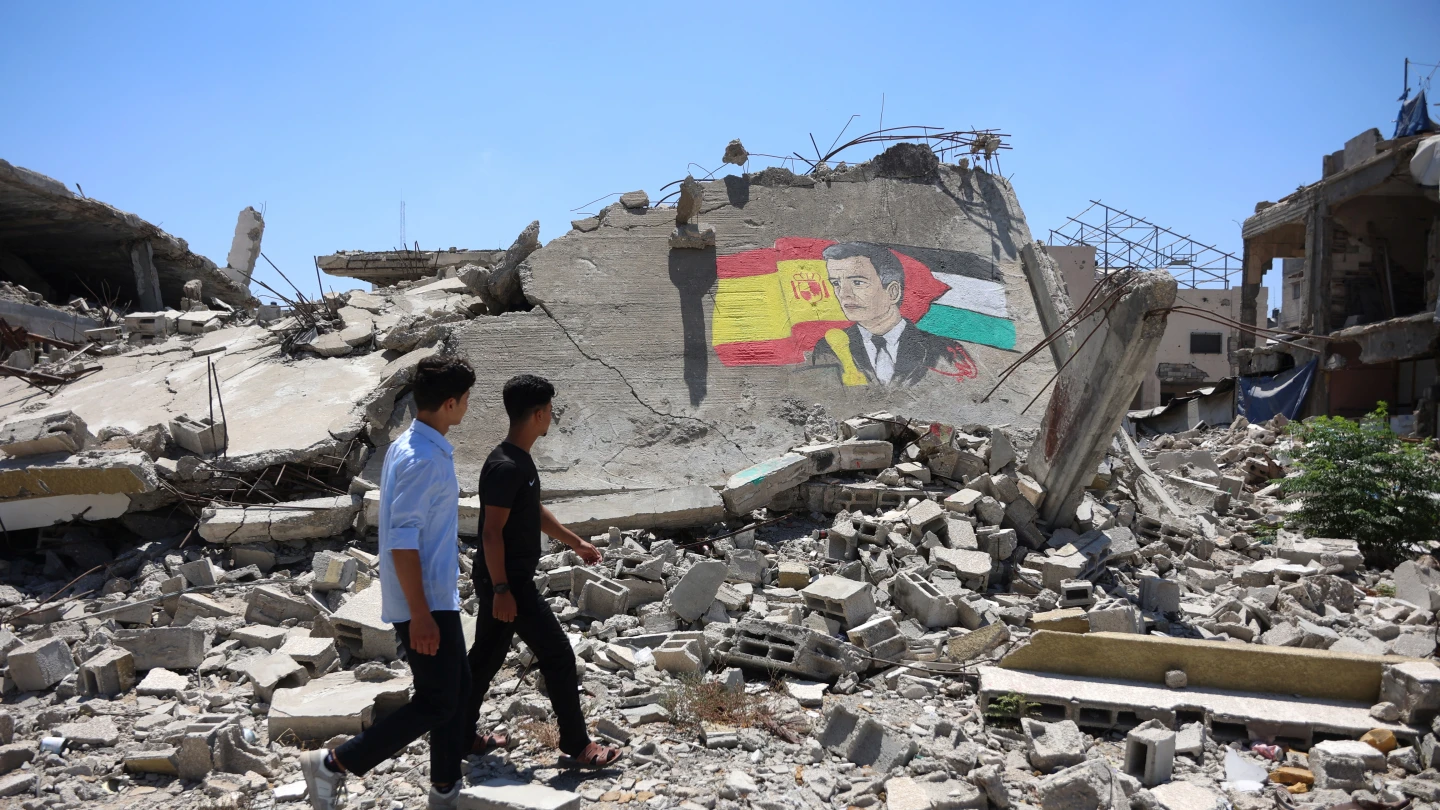
For those who, like this journalist, witnessed the aftermath of the Oct. 7 Hamas massacre on the ground, it is difficult to erase from memory the contrast between the still-smoldering embers and the blood of the victims, and the image of Spanish Prime Minister Pedro Sánchez standing alongside his Belgian counterpart, Alexander De Croo, at the Rafah crossing between Egypt and Gaza on Nov. 24, 2023.
Rather than expressing horror and solidarity in the face of what human beings had inflicted on their fellow human beings, including women and children, Sánchez used the occasion to launch his campaign against Israel and in defense of Hamas.
As Spaniards go to the polls today, they will also be voting, one way or another, on the anti-Jewish and anti-Israel role Sánchez has played at the forefront of the pro-Palestinian movement.
Above all, they will be voting on his demonization of Israel, his transformation of that campaign into an instrument of domestic and electoral politics, and his efforts to make the European Union a driving force behind the destruction of the Jewish state by weaponizing the accusation of genocide and linking it to the demand for Palestinian statehood.
From Rafah to European recognition
This campaign began at Rafah, where Sánchez threatened Israel with consequences if it failed to agree to a ceasefire and announced his intention to recognize a Palestinian state. In the background stood Hamas and the Palestinian Authority, which had failed to condemn the Oct. 7 massacre.
Sánchez initially pursued his European initiative alongside Ireland, Slovenia and Malta. On May 22, 2024, Spain, Ireland and Norway announced their intention to recognize a Palestinian state, a decision formally implemented on May 28. Slovenia followed in June, and other countries subsequently joined the movement.
Other European governments argued that recognition might be desirable but that the time was not yet right. Sánchez, meanwhile, announced nine measures involving boycotts and sanctions against Israel, turning Europe’s divisions over the issue into a rallying cry for the left.
He sought to dismantle existing agreements and undermine cooperation and investment in science and security, all while championing the Palestinian cause.
The EU-Israel Association Agreement also came under scrutiny, with EU foreign policy chief Kaja Kallas announcing a review. Germany, Italy, Hungary and the Czech Republic opposed measures that would undermine the agreement.
While Sánchez recognized Palestine, his deputy prime minister, Yolanda Díaz, revived the eliminationist slogan “From the river to the sea.” The implication was unmistakable: Israel would cease to exist.
Weaponizing the accusation of genocide
On Sept. 9, Sánchez publicly accused Israel of genocide. In his address to the United Nations on Sept. 23, 2025, he went so far as to suggest that the establishment of two states was insufficient when one of them was accused of genocide.
The Jewish state has effectively been branded with a yellow star, a mark of infamy echoed endlessly throughout political, cultural and labor institutions.
The people who truly suffered genocide are now accused of a repugnant betrayal of their own history. In Sánchez’s narrative, Jews have become the moral heirs of their own persecutors.
This amounts to a death sentence not only for Israel but for every Jew. If Israel is genocidal, the argument follows, it is unworthy of existence and must therefore be erased.
Spain expelled its Jews in 1492. It did not recognize Israel when the Jewish state was established in 1948, although it later recognized the Palestine Liberation Organization. It has a large Muslim immigrant population and a history deeply intertwined with Islam.
With the lingering guilt of the Spanish Empire and the moralism of socialism also at play, Spaniards are voting on something far greater than the political future of Pedro Sánchez.
They are voting on contemporary antisemitism.