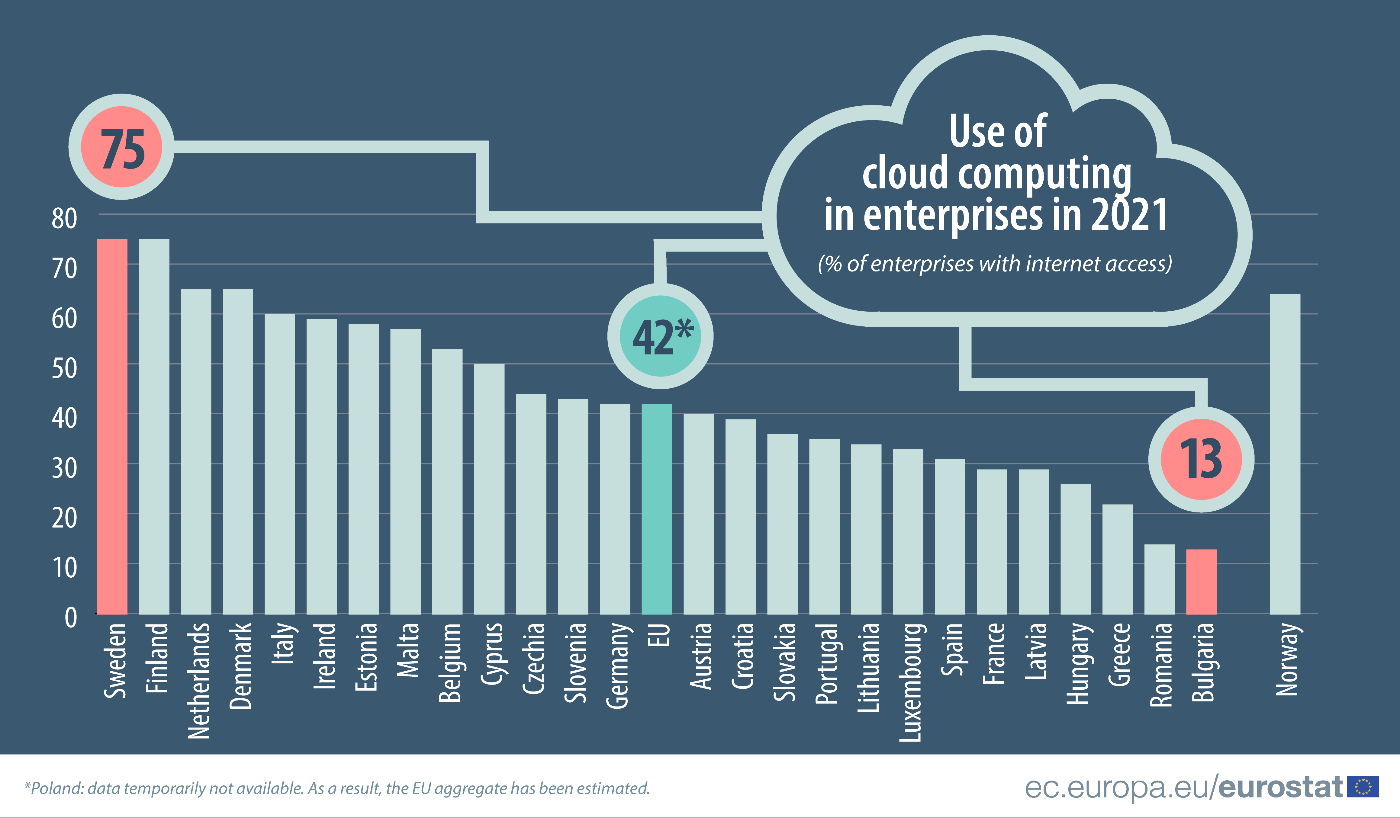
Cloud computing used by 42% of EU enterprises: the highest shares in Sweden and Finland (both 75%), and the Netherlands and Denmark (both 65%) in 2021, while the lowest shares were in Bulgaria (13%) and Romania (14%).
Cloud computing used by 42% of EU enterprises: the highest shares in Sweden and Finland (both 75%), and the Netherlands and Denmark (both 65%) in 2021, while the lowest shares were in Bulgaria (13%) and Romania (14%).
16 comments
Enterprises can access computing resources hosted by third parties on the internet instead of building their own IT infrastructure.
This pool of resources is most commonly known as ‘cloud computing’.
As cloud services are provided online, enterprises must have internet access to be able to use them. In 2021, 98% of EU enterprises employing 10 persons or more had this access.In 2021, 42% of EU enterprises used cloud computing.
This is a 6 percentage point (pp) increase since 2020 (36%), and more than double the share in 2016 (19%).
**Cloud computing most commonly used in the Nordic Member States**
Although the share of firms with internet access was at very similar high levels across EU Member States, the use of cloud computing varied significantly, with the highest shares reported in Sweden and Finland (both 75%), and the Netherlands and Denmark (both 65%) in 2021.
At the opposite end of the scale, cloud computing services were used by fewer than one in five enterprises in Bulgaria (13%) and Romania (14%).
**Cloud computing mainly used for e-mail and storage purposes**
Of the enterprises that reported using cloud computing, a vast majority (79%) opted for a cloud solution to host their e-mail systems.
About two-thirds used the cloud for storing files (68%) and for office software such as word processors and spreadsheets (61%). More than half used the cloud for security software (59%).
[Source](https://ec.europa.eu/eurostat/web/products-eurostat-news/-/ddn-20211209-2)
The remaining 58% are not aware they’re using it…..
30% too many … also keep the internet switch connected to the office lights for improved security
Suck it Netherlands 🙂
German court has just decided that even sending an IP to a company who’s headquarters are outside the EU, such as Akamai is against GDPR. If that holds that number will have to become 0.
I feel like this is really using misleading terms or definitions for what’s what. Using Outlook for emails is not the same as using ‘cloud computing’, or at least shouldn’t be in my view.
How do they define ‘cloud computing here’? AWS or similar + kubernetes and the like? Or just having G Suite or something? What about hosting a web store on a dedicated remote server?
Where is Poland?
Is it eco-friendly?
The one chart where Bulgaria is ahead of everyone else.
Why Poland is missing?
Edit: ok I know “Poland: data temporarily not available” is in the source.
I’m actually ok with using less cloud computing… maybe it’s just me.
At least when AWS is down, I can still use my coffee maker.
*finger to head’*
can’t get hacked if you’re not digital
surprising data for Italy