>Consists of contiguous grid cells with a density of at least 1,500 inhabitants per km2. An urban centre has population of at least 50,000. Gaps in this cluster are filled and edges are smoothed. If needed, cells that are 50% built-up can be added.
**urban cluster (town + suburb)**
>Consists of contiguous grid cells with a density of at least 300 inhabitants per km2 and has a population of at least 5,000 in the cluster (The urban centres are subsets of the corresponding urban clusters).
**rural (village, dispersed village)**
>Cells that do not belong to an urban cluster. Most of these will have a density below 300 inhabitants per km2. Some rural cells will have a higher density, but they are not part of cluster with a large enough population size to be classified as an urban cluster.
Their methodology is the same for every country.
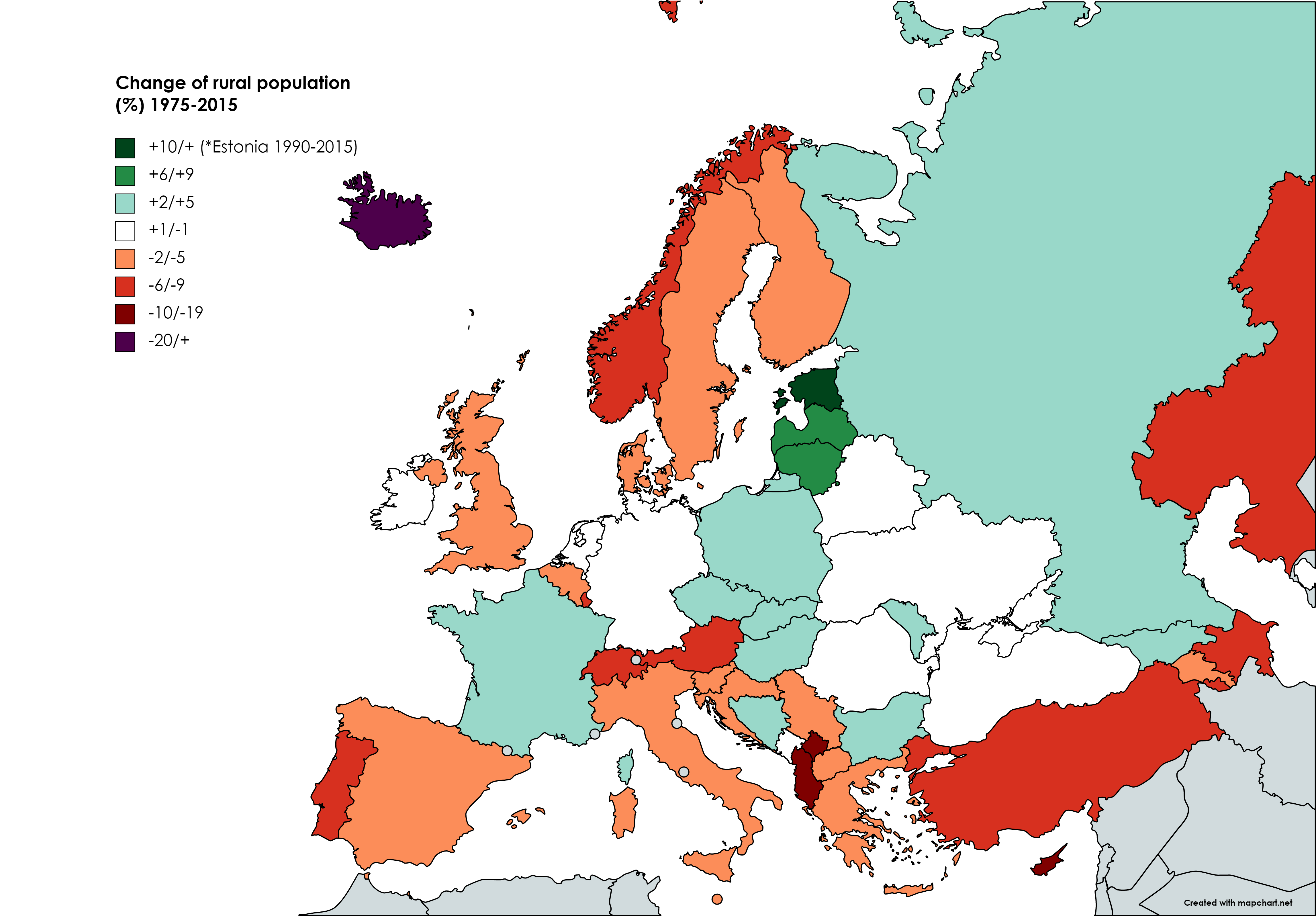
Baltics : back to potato
Except for France there is nothing surprising here. The educated urban population moves from Eastern Europe to Western Europe.
The red countries (especially Luxembourg, Switzerland, Norway and Iceland) generally have the highest immigration, and hence the largest increase in cities.
Of course, internal urbanization is still happening in the background, but this explains the differences between the countries.
Perfectly balanced.
Yeah… In Poland it means middle Claas purchasing houses just outside of cities… You can hardly call them rural population.
Bro living in a village sucked so bad I couldn’t be happier to move out.
People who dislike urbanisation the most from my experience are the people who never had to live in a bumfuck village.
Prior to 1945 more than 90% of Bulgarians lived in villages. Forced urbanization, nationalization and stupid industrialization decimated Bulgarian villages leading to the ugly cities we have today. We’ve finally reached the point where people are going back, but that’s only happening near major cities. There are whole regions that are completely depopulated. I guess it’s good for the wildlife at least.
Communism- not even once kids.
I was wondering what that country north of Turkey was. Took me longer than I care to admit to realize it was the Black Sea.

11 comments
Sources (European Commision):
* [country by country](https://ghsl.jrc.ec.europa.eu/CFS.php)
* [interactive world map](https://ghsl.jrc.ec.europa.eu/visualisation.php) using their methodology (you can see what category you live in)
You can see [here an example of southern Bohemia.](https://ghsl.jrc.ec.europa.eu/visualisation.php#lnlt=@49.47972,14.49509,10z&v=201&ln=0&gr=ds&lv=0001000010001000111&lo=aaa3aaaa5aaaaaaaaaa&pg=V) Brown are towns, yellow suburbs, and the rest (green, purple) rural areas (mostly villages of 50-500 people)
* [Definitions of urban, suburban, rural](https://ghsl.jrc.ec.europa.eu/degurbaDefinitions.php)
**urban center**
>Consists of contiguous grid cells with a density of at least 1,500 inhabitants per km2. An urban centre has population of at least 50,000. Gaps in this cluster are filled and edges are smoothed. If needed, cells that are 50% built-up can be added.
**urban cluster (town + suburb)**
>Consists of contiguous grid cells with a density of at least 300 inhabitants per km2 and has a population of at least 5,000 in the cluster (The urban centres are subsets of the corresponding urban clusters).
**rural (village, dispersed village)**
>Cells that do not belong to an urban cluster. Most of these will have a density below 300 inhabitants per km2. Some rural cells will have a higher density, but they are not part of cluster with a large enough population size to be classified as an urban cluster.
Their methodology is the same for every country.
Baltics : back to potato
Except for France there is nothing surprising here. The educated urban population moves from Eastern Europe to Western Europe.
The red countries (especially Luxembourg, Switzerland, Norway and Iceland) generally have the highest immigration, and hence the largest increase in cities.
Of course, internal urbanization is still happening in the background, but this explains the differences between the countries.
Perfectly balanced.
Yeah… In Poland it means middle Claas purchasing houses just outside of cities… You can hardly call them rural population.
Bro living in a village sucked so bad I couldn’t be happier to move out.
People who dislike urbanisation the most from my experience are the people who never had to live in a bumfuck village.
Prior to 1945 more than 90% of Bulgarians lived in villages. Forced urbanization, nationalization and stupid industrialization decimated Bulgarian villages leading to the ugly cities we have today. We’ve finally reached the point where people are going back, but that’s only happening near major cities. There are whole regions that are completely depopulated. I guess it’s good for the wildlife at least.
Communism- not even once kids.
I was wondering what that country north of Turkey was. Took me longer than I care to admit to realize it was the Black Sea.
Why is Vatican not white?
What’s behind the changes in Estonia?
“-20/+” for real?