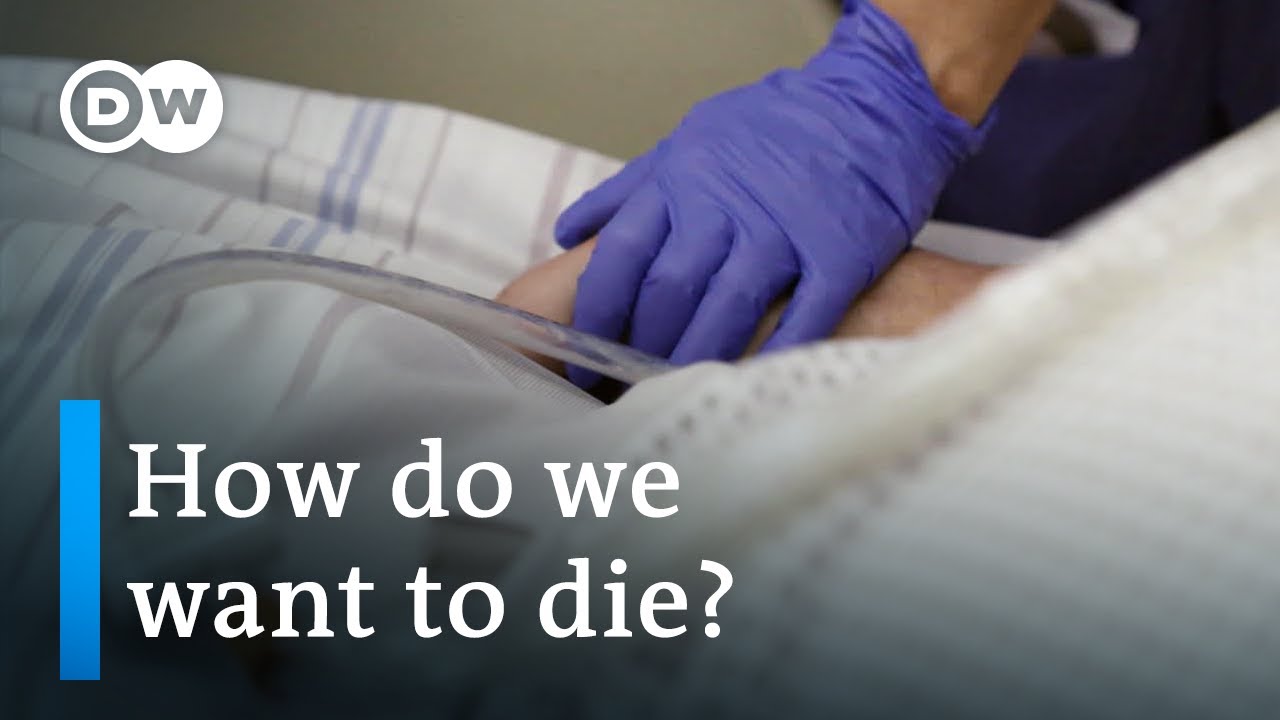
Meeting death on our own terms | DW Documentary
Most people spend their final days here… in a hospital. Although most of us would prefer to die at home, only very few do so. Is there too much end of life treatment? Not everything that’s possible is necessary. Am I acting in the patient’s interest? It should not be anyone else’s interest,
And definitely not for economic interests. How much help should we expect from doctors? And how much do the patient’s own wishes count? When a patient says they’re more scared of ending up on life support, with 20 years of staring at the ceiling ahead of them,
Without being able to speak, and would rather die – you have to accept that Are hospitals actually profiting from end of life treatment? Dying is often a taboo subject. And one with much potential for conflict. Earth to earth, ashes to ashes, and dust to dust. Around half of the population in Germany
Will take their last breath in a hospital. For a better look at death and dying with tubes and ventilators, we’ve come to an intensive care wing. The doctors are on their morning rounds. Good morning, how are you? You have a serious circulation problem in your heart muscle.
At the moment, we’re not happy with how things are looking, so we’re going to take care of you a bit longer, okay? Why do so many people die in hospital beds and not peacefully at home? On our rounds, we see very many elderly patients and they often have many different illnesses,
And they still come to hospital. You try to help them somehow but as we see in this case, these comorbidities are so extensive, that in conjunction with the results we got yesterday, there’s not a lot you can do. Uwe Janssens wants to switch to palliative care preparing one for end of life.
But, like so many people, the man hasn’t left a patient’s decree. Janssens tries, without success, to reach the man’s relatives to find out how much more treatment the man should be given. I spend about two hours a day on the phone,
It feels like, because I think it’s important to talk to the GPs. But it’s incredibly difficult. He has a serious, non-treatable coronary heart condition. Yes, yes. That was really very important. The doctor knows him well. He also told the GP that if there were to be grave complications,
He didn’t want to be put in intensive care. That’s important because now we have a clear path to take, even if wasn’t specifically written out. It means that we won’t be able to help him stay alive, but will try to ensure that he can depart this world peacefully and painlessly.
I’ll take the backpack, I don’t know whether it’s down there. I’m going downstairs, okay? But life-threatening situations on the intensive care wing aren’t always this slow and steady. Intensive care medic Alice Neudecker is on her way to an emergency one floor down.
A woman has been resuscitated and needs to be taken to intensive care now for further treatment. It’s unclear whether she’ll survive. And then again quickly. Once in intensive care, she’s immediately attached to every life-sustaining machine possible. Of course, medics want to heal people.
But many who come to the intensive care unit don’t survive. Twenty minutes have passed. Alice, could you describe what’s happening? The patient has been on a heart catheter. They did everything they could to help her. But unfortunately, nothing was working and she died. We’re waiting for the family now.
What was important to us, for the last step, was that we were able to be with that patient, make sure she had no pain or fear, we were with her and were holding her hand at the last minute, because we were the only ones here. The relatives were still on their way.
Patients coming to intensive care are getting older and older. Often, they’re already sick with many illnesses that prevent them from recovering. It’s then up to the doctors to decide if and how long to prolong life. Intensive care allows enormous opportunities, but also risks. Bringing that together requires cultural understanding.
As a team, you have to keep finding ways to help the patient have a dignified death, and also to accept that death and dying is also part of a therapeutic process. Modern medicine often means the process of dying can be very drawn out It often leaves doctors to make the decision
On when to continue treatment… and when to let someone die. Uwe Janssens is on his way to a meeting with the ethics commission. This is where experts from various disciplines convene to decide on whether or not to withdraw life-prolonging measures. Today the commission is discussing the fate of a gravely ill lung patient
He’s been in intensive care for several weeks. He’s being kept alive on a ventilator. Because of his deteriorating ability to breathe, treatment requires ventilation. He is experiencing different phases of infection, infections that are healing, phases of wakefulness, and of confusion. He’s at his physical limit every day. Would you like to add anything?
We’re really just treading water and his future is not looking much better. We don’t see an end game. That’s the question. How much longer can we continue doing this. Where is the end, what is our goal? We have already been trying for a long time to get him off of the ventilator…
We keep reaching the four-hour mark and continuous spontaneous breathing has failed – several times. The risk is so great that if we took him off, he would certainly suffer organ failure. If he stays on the ventilator, then he will continue to live. What is known about his wishes before treatment?
He never really made any explicit statements. So we don’t have any exact information about the patient’s wishes. If we’re saying he can’t be taken off the ventilator, then we’re looking at a long-term, permanent dependence on a ventilator either at home or somewhere else. Is that something his family can foresee or not?
His wish is to go home, but I don’t see it as a viable option. Every few days we take a step backward the patient becomes full of mucous again, gets really distressed, which uses up all his energy. I don’t see that being any different at home.
That means that fulfilling his wish to go home would mean that he’s on a ventilator, in 24-hour intensive care, and that would make things difficult for his family. Yes, I agree, if we can transfer Mr. A back home, would be purely palliative.
The way Mr. A sees it however, he’s not seeing himself as bedbound. But there is no alternative. He cannot move freely. I think that we’re talking about a palliative scenario. We will, in accordance with his wishes, send him home, but I don’t think it can be for long.
And you’ve been providing pastoral care to the family and patient for a long time? They did speak extensively about the end of this life, from a religious point of view. His wife couldn’t imagine turning the home into an intensive care room, which is what being put on a ventilator at home means.
Instead, she told me that in her view, we should stand humbly at the end of our lives and be thankful for the long time they had together. We discussed that in the past few days. That means this commission has decided that there should be a transition to palliative care.
The relatives have to be informed. Who’ll do that? You’ll definitely have to deal with that the next time you speak. Thank you. Not every hospital has such an ethics commission. We’re discussing ethical decisions, that are not of a medical nature but that concern us as humans.
We believe that if such a structure is not in place, then it should be mandatory. We’ve left the decision over life and death in the hands of the doctors. I wonder, why is it so unusual for people to die a natural death at home? We’re going to visit an elderly patient now.
I’ve been involved in her care since last week because she was having serious breathing problems. First, they kept calling the ambulance, but now she doesn’t want to go to hospital because she knows if she calls an ambulance she’ll end up in the clinic. Matthias Thöns is an anaesthetist and palliative medic.
He visits terminally ill or dying people where they’ve chosen to die at home, surrounded by their families. Good afternoon! I’ll head straight through. Hello everyone. I’ll sit down here again. Perfect. On my first visit you were very anxious because someone at the clinic had told you you were dying.
How has that felt since you’ve been home? Oh, I’m not scared and haven’t had anything untoward, any thoughts that might trouble me. Did you have as many breathing episodes in the past few days, or have they stopped coming altogether? No, no more shortness of breath. You haven’t noticed anything, have you?
No, no, I’m amazed that it’s been going so well. Would you say that you feel as though you’re on your death bed? No, no! Would you mind if I have a listen? Lean forward… And a deep breath in and out. She’s basically come home to die, that’s the blunt way of putting it.
For both her and us, it’s our preferred option. We can enjoy the time we have left. And it’s nice having mama here again. We all have to face this sometime or other. But to be honest, it doesn’t bother me. Honestly. Maybe I’m the exception, because I’m different.
I don’t know how other people take it. I’ve no idea how others deal with knowing they are going to die in the next few days. But I think it’s all totally natural. But it is a strange situation. Perhaps for you more than me.
My worry is that it happens late at night and she can’t breathe. But I know that here, I can help her immediately. We want to ensure that our patients are doing well at home. And they can suffer breathing problems, pain or nausea, vomiting any time.
If they can’t be helped at home, then the only place is the clinic. But if you can be treated at home then people stay at home. Most problems can be resolved through simple medication. We only have seven different medicines in our emergency box,
And you can treat twenty problems that our patients often have, basically giving instructions on the phone. Okay, and if you have any problems, get in touch. Otherwise I’ll see you again next week. All the best. I’m still a step ahead of the grim reaper! I still have a little time left!
You see how much patients who come home again tend to flourish. She’s practically just been discharged from her hospital deathbed, but you’d hardly say she looks like she’s going to die in the next few days. On the contrary, she has dramatically improved at home.
1 out of 2 patients die per day… I deal with it every day. Accompanying people at the end of their lives is a relatively fulfilling occupation, because you often manage to ease severe pain or breathing difficulties. Of course, I can’t save my patients lives,
But for many of them, death is no longer the enemy. And if I manage to ensure they have a painless passing, that is a good thing. 92 year-old Inge Matten died a month later, at home as she had wanted. But how can one ensure that you’re the one who decides how you die?
We’ve heard from a former intensive care worker. She says she would never want to be resuscitated. Hi there! So you’ve taken steps to ensure that if a paramedic comes, and you’re unconscious, that you wouldn’t be resuscitated, is that right? No, only if my heart gives out. And when the paramedic arrives…
When the door closes, they’ll see that… this green sticker. There’s an emergency bottle there and the emergency bottle is in the fridge. Then they go to the kitchen and when they open the door, there’s the bottle. And what’s in there? There’s a document with lots of patient information
And here written in big red letters: Do not resuscitate. And why don’t you want that? I’ve seen too many things back when I was working. You mean you wouldn’t want to be taken to the hospital. I don’t want to go to hospital and I don’t want to be put on a ventilator
Or kept alive by tubes for who knows how long. The 89 year-old is familiar with the procedures on intensive care stations. Do you have the feeling that just too much is done to keep people alive? That people aren’t allowed to die? Yes. From the moment you arrive in hospital,
It’s like with the paramedics. The doctors and carers have to do everything in their power to keep me alive, after the first aiders have resuscitated me. And that’s exactly what I don’t want. What was it that you experienced that made you say, no, I do not want that to happen to me?
I often saw elderly people being resuscitated, and then they were put on IV’s and ventilators and finally die, days, weeks, months later. And I don’t think you need that. I want to live my life the way I want until the end,
And when I can no longer do that, then that should be the end. It’s rare today that people are in control of their lives at the end of life. Will the former nurse get her wish? Will she encounter paramedics who wouldn’t resuscitate her in such a scenario?
The 89 year-old fears that she might end up like this patient. This terminally-ill cancer patient is on life support in a coma, after being resuscitated after his heart stopped. Intensive care nurse Alice Neudecker is looking after him. I’m just going to check something, don’t worry. His kidney and liver have already failed.
And his brain is barely functioning. Patients are resuscitated, usually outside their homes, they arrive here and are given every medical treatment possible and then you find out, like in this case, that the brain has had too little oxygen during resuscitation. We often see patients not wake up,
And then it’s days or weeks before instrumental diagnostics tell us that they’re actually not able to wake up again their brains are so terribly damaged that we can’t help them. This 58 year-old is also not going to wake up. Alice is giving him palliative care and will accompany him as he dies.
I’ve got everything ready! Do you always talk to your patients? Yes, because I always assume that they can perhaps still hear something. We always do our best, especially for patients who are dying. You always respect your patients. So what usually happens when doctors go from trying to save someone’s life
To recognizing they will die? We accompany family members into the room. The medication has already been swapped to high dose painkillers, and other medication to protect the patient to ensure they’re not in distress. And then we switch off life-support. We always wait a little moment. Relatives have to adjust to the situation.
It’s always hard to sit next to the bed and comprehend your family member is about to die. One of the most frequent questions that relatives ask, is how long will it take? They’re always scared it will happen right away. It varies from patient to patient. Usually, it takes around two days.
But that is a very long time… one, two days and then the patient dies, because they’re already very weak. The terminally-ill patient in Room Three has no relatives here to sit with him. And while death is part of the daily conversation here at the hospital,
In our society it has increasingly become a taboo. We really need to seriously ask ourselves as a society, what we want and what we don’t want. In my experience, I often meet relatives and patients in intensive care who are still surprised that at 85, 90, 92 years old,
They have reached a period of life where you have to consider its end. But modern medicine has also failed to sufficiently keep up with the growing age of people… There are few fully qualified palliative medics on intensive care wings. Instead, many people face lengthy and invasive forms of treatment…
Sometimes this is because the doctor is unsure what to do but also sometimes because of the financial benefit. There is much money that can be made by implementing these complex end of life procedures. It’s much easier as a doctor, to intubate a patient, to give them oxygen, to resuscitate them, replace their kidney
Than have this critical discussion about whether we’re genuinely doing the right thing for the patient. Our only responsibility is to the patient… And when some fields of medicine become more interested in making money, perhaps not officially and explicitly, then medicine is on a very rocky road.
And that’s what’s been happening for the past 20 years. How can it be that people end up being treated in hospital against their will, for financial profit? Usually, we assume doctors are there to help us at the end of our lives…
But defying the will of the doctor can be incredibly difficult and painful. Like for Helmut Länder, who is fighting for doctors to allow his wife to die in peace. This is my wife in Tirol. That picture’s six years old now. Look at her hair.
She’s 68 now and this is what she looks like. It’s awful. I want to save her from ending up lying there miserably, pathetically… I owe that to her. It’s such a long time… Yes, intensive care for three months. She’s been there since August 12th. She’s had 18 operations.
Ingrid Länder went to the hospital five months ago for a back operation where she became infected with a superbug. Despite several operations, doctors haven’t been able to defeat it. I’ve got pictures showing what she looks like now. You can see. On permanent life support – a respirator and intravenous feeding.
Four months ago, Helmut’s wife’s heart stopped. Since then, she’s been on life support and in a coma. Neurological tests suggest that there’s little likelihood of improvement. She’d already put her wishes down in a plan for treatment. I just want to make sure her will is followed.
I swore to her that she wouldn’t end up on machines, for years in a home somewhere just lying there. She doesn’t deserve that and she doesn’t want it. You can go through all these points. There are pages of them! Everything’s there… in the case of brain damage,
Untreatable illness, near death… it’s all there brain shutting down. It’s all written down exactly. But they’re ignoring it all. I tell them, read it, it’s all there! But we just go round in circles. And keep coming back to the same point.
And no one listens to you even though you have power of attorney? No. Not at all, you’re ignored. All you hear is: We decide what happens, that’s how it is in Germany. It doesn’t matter how many people come with their treatment plans.
We have to perform any treatment we can – anything else is euthanasia. I say, what exactly is it then that you are doing? Death on demand? I say, I just want it to end! Helmut’s health insurance company has helped him find a medical expert for a second professional opinion.
It’s hoped they’ll help to finally carry out the wishes of his wife. I was with her last on October 6th… it was the day before the ulcer perforated and her heart stopped. We’re religious people and we always spoke about those things. And we said goodbye, said we’d see each other in eternity.
She said she was ready to go, she said she was going. I said, don’t say that she said, yes, you know I am. Give me kiss. I had just given her some yogurt. And that’s how it went. It’s hard to bear. Really hard.
In a week’s time, Helmut Länder has another meeting at the hospital, four hours away. He hopes the doctors will give in, after the expert’s report… and start giving his wife palliative care. This is the statement we got from the hospital: In the event of regaining consciousness,
There’s a possibility that Mrs Länder could breathe on her own and of an at least partial physical rehabilitation, although a temporary or permanent need for life support measures cannot be ruled out. As such, because this situation is not mentioned specifically in the patient’s preferred treatment plan and recovery cannot be ruled out,
Medical steps have been taken thus far so that the patient’s assumed wishes could be determined. How can seriously ill people be sure their wishes are carried out? Palliative care doctor Matthias Thöns is the author of the report on Mrs Länder’s case. He’s to decide whether or not the doctors
Should heed the wishes of the 68-year-old. Matthias Thöns dedicates himself to dignified dying, not to the interest of business. And such disputes make him sad and angry. Mrs Länder’s case is not an exception. In fact, a patient’s preferred treatment plan is legally binding, but there’s lots of scope for interpretation
And sometimes the boundaries are pushed and treatment continues, although the patient obviously doesn’t want it. They fail to ask what the outcome of treatment will be. Is what someone wishes to be the outcome, actually the goal of the treatment is it even achievable? And often, like in this case, it’s unachievable.
Overtreatment is something that really bothers me in my work. When a decision should have been taken a lot earlier for the provision of appropriate palliative care. Who monitors what the doctors are doing? What’s the legal situation in Germany? The Putz and Partner law firm is specialised in end of life legislation.
They deal on an almost daily basis with cases that focus on the will of the patient and how best to implement it. Basically, our approach begins with the view that any medical intervention, including those that prolong life, even if it’s a ventilator, is physically invasive. It has to be justified.
And an intervention is only justified when there is a medical reason for it and an agreement by the patient. That’s for starters. If there is no reason for medical intervention because it would cause more harm than good, if it causes more distress, than being able to achieve a sensible goal, then things change.
Then what is being carried out is an illegal assault. It is a crime. However, a federal prosecutor will usually not convict a doctor for prolonging life they always seek a way to avoid that. Tanja Unger has seen repeated cases in which doctors are uncertain, and over-treat their patients because of it.
But she’s also seen them act out of financial interest. What’s the legal path if a doctor is suspected of acting solely out of financial gain? This suspicion is always lingering in the room. But it’s hard to enforce the law on the basis of the current legislation.
Because you have to prove that the assault was committed intentionally for financial gain. If you have the relatives’ word… if they say their relative has been allowed to suffer, and their distress is being prolonged only for the doctor to make money, you have the chance of getting a second opinion.
Preferably from a doctor who has nothing to gain from this treatment. The fact is that in the future we’ll need more doctors who are familiar with palliative care and take a more critical approach to their work. Which one is the winner here – ethics or economics? Human or machine?
Helmut Länder has driven four hours from his home in Lower Saxony to the clinic. He wants one more talk with the doctors… to convince them to heed the will of his wife, and allow her to die. She’s been lying in this hospital for four months in intensive care.
Just the thought of it is terrible. I’ve made an appointment and I’m going there now. I’m fighting for my wife’s rights. It’s a terrible injustice what’s happening today. That’s why I’ve come, expressly to tell these doctors that. For four months, the doctors have refused to follow the wishes of their patient Ingrid Länder.
It’s going to be a long and hard discussion between Helmut Länder and the doctors. Because there’s been no agreement so far, a local judge has been brought in she’s due to rule today on what she believes are the wishes of Ingrid Länder. Four hours later.
So, with immediate effect, palliative care is going to be begin, that means, nothing to stop her from dying. It’s been a long battle for a very, very sad thing, but I had to do it, and I’m glad I did. I feel a sense of relief, now. There’s a deep grief but also relief.
It’s very alarming how some doctors think they have to apply every possible medical application every time. That’s not our job as doctors. As a doctor, you have to ask yourself what is the goal of the treatment? What can we achieve for the patient here? And if we cannot achieve the patient’s recovery,
Or at best, will only leave them on life support and that’s not something the individual patient would have wished for themselves, and would reject it, then we as doctors have to accept that. The goal of treating them is unobtainable and the goal must change
In the worst case scenario, to allow that patient to die. What does a humane death look like, when the patient is not at home? When I see a patient like that, it really makes my heart ache. It’s okay… Alice Neudecker’s patient has suddenly deteriorated today. He’s breathing with difficulty.
Caring for him in this condition isn’t easy. Yesterday his breathing was so stable, that we decided to remove his ventilation tube. We reduced the medication that was helping him sleep. Now I’m in a dilemma he’s very distressed, and I’ve had to call the doctors and started giving him the sleep medication again.
Because I don’t want to leave him like that… he’s really in distress. Heartrate stable… Alice waits for the lead doctor to come and help. Now I’m treading a fine line… I don’t want my patient to be so distressed, but I don’t want him to die because of what I’m giving him,
Because he’s no longer on a ventilator. That’s why I’m taking it really slowly… There’s often a very thin line between accompanying someone at the end of life and assisting them in it. The doctor can ease the situation for the patient, by changing the medication. We should manage the symptoms now with medication.
That’s the most important thing. Our aim for this treatment is end of life care, with symptom management. The patient’s breathing is back under control. The process of dying slowly moves on… It’s always my personal aim to do things I would want done for me,
If me or a member of my family were lying there. It’s a dream job for you, isn’t it? It’s my dream job. My absolute dream job… I couldn’t imagine doing anything else. Alice’s patient dies later that evening. It’s Ingrid Länder’s funeral…
She dies five days after her treatment was switched to end of life care at the hospital. I have to find peace now. But I’m glad that with a lot of help I managed to see her last wish realized. But we have our faith and faith helps a lot
And I will be able to find my own way and carry on somehow… The Lord shall bless your farewell and arrival now and for ever more… Amen.
At the end of life, many people end up in a hospital. Whether or not they would prefer to die at home, more than half of the people in Germany die in intensive care units. Some die in nursing homes and a few die in hospices. Why is that?
Most people want to die at home. But only very few manage to fall asleep peacefully with their family. Take Ingrid L., who’d been in a coma for three months following a cardiac arrest and was on a ventilator. Her husband was desperately fighting for the doctors to follow her living will and let her die. “It’s a horror! She never wanted to live hooked up to machines for months on end, like that,” he said.
Modern medicine is making it possible to keep people alive for longer and longer. However, hospitals can also earn a lot of money by treating the seriously ill, especially in intensive care units. Intensive care physician Uwe Janssens believes that, when it comes to death and dying, economics often play a key role. People die almost every day in Janssens’ intensive care unit at St. Antonius Hospital in Eschweiler. More and more elderly patients are on ventilators for an indefinite period of time. Doctors, nurses and the hospital’s chaplain meet regularly to discuss ethics: Should a critically ill patient be assisted in dying, or kept alive artificially? What is the aim of therapy? What is the patient’s will? What is medically feasible, what makes sense? Even for doctors, decisions at the end of a patient’s life are never easy.
The film touches on a taboo in Western society. How can people be protected from artificially extended morbid illness, yet still receive the medical help they need and want?
#documentary #dwdocumentary
______
DW Documentary gives you knowledge beyond the headlines. Watch top documentaries from German broadcasters and international production companies. Meet intriguing people, travel to distant lands, get a look behind the complexities of daily life and build a deeper understanding of current affairs and global events. Subscribe and explore the world around you with DW Documentary.
Subscribe to:
⮞ DW Documentary (English): https://www.youtube.com/dwdocumentary
⮞ DW Documental (Spanish): https://www.youtube.com/dwdocumental
⮞ DW Documentary وثائقية دي دبليو (Arabic): https://www.youtube.com/dwdocarabia
⮞ DW Doku (German): https://www.youtube.com/dwdoku
⮞ DW Documentary हिन्दी (Hindi): https://www.youtube.com/dwdochindi
For more visit: http://www.dw.com/en/tv/docfilm/s-3610
Follow DW Documentary on Instagram: https://www.instagram.com/dwdocumentary/
Follow DW Documental on Facebook: https://www.facebook.com/dwdocumental
We kindly ask viewers to read and stick to the DW netiquette policy on our channel: https://p.dw.com/p/MF1G
26 comments
If you can pass at Home , I think that is Best.
Exit International.
Indian culture teaches us "Vaidyo Narayano Hari" meaning Doctor is embodiment of God…I can see that honest and transparency in these doctors…tons of love and respect from India…hope to see the same commitment from all doctors in this cruel world…
Q: How do you want to die?
ME: In my own bed, with a belly full of wine and a maiden's mouth around my ****, at the age of eighty.
why the sudden push all across the West to make suicide seem like a good thing?
It's embarrassing to die.
I already have end of life plans. Doctors can pull the plug without family notification and ship me off to a body donation area.
Can't you put the one that waits for death in a "comma" that resembles death then wake them up and talk to them again and again or something? 🤔
God is the one who decide our death….He is the creator of our soul. Jesus Christ love you
This is a awesome video!
Satan. get thee behind me.
I know Jezus, i am not afraid to die.❤
german singer Vanessa Mai:ich sterb fur dich(I die 4u)
Great video!
I agree with Dr. Uwe Janssens , that it should be mandatory for every hospital to have an ethical policy/ committee.
Dignity, not profit, should be of the utmost importance, at the end of life care.
I hope long lives for all. this is an awesome video
In my childhood, I was wishing to control my death by a button 🙂.
Now I have become a doctor and I'm saving people's lives ❤🎉
Nice cheery topic this 😂
I refuse to end up,enriching Dogters and hospitals,i dayly work with breathing dead patients,i have long-term plans as a RN,and my family are aware
Excellent! DW has never disappointed me! Thank you again for such an excellent work. This make me think and plan ahead of time. ❤
With a belly full of wine and a beautiful girls lips around my….
Wow, another wonderful documentary as we expect from DW.
We don't want to die. Yamanaka et al will bring us a new longevity. Prepare for this.
I’m a hospice nurse and I’ve had several of my patients tell me they want to pass peacefully in the comfort of their own home. When the patient and family are on board with hospice, their passing can be beautiful, with minimal pain, symptoms, and lots of love and support.
Nice video 😮
Great book on this: "The Final Exit"
Canada is horrible for taking choices away. I was resuscitated, put into a coma and on life support, very much against my wishes, DNR, and directive, last year. It made me sicker and just made the road to the end much more painful. In my experience, physicians, nurses, etc, the people who are supposed to help you, harm you the most.