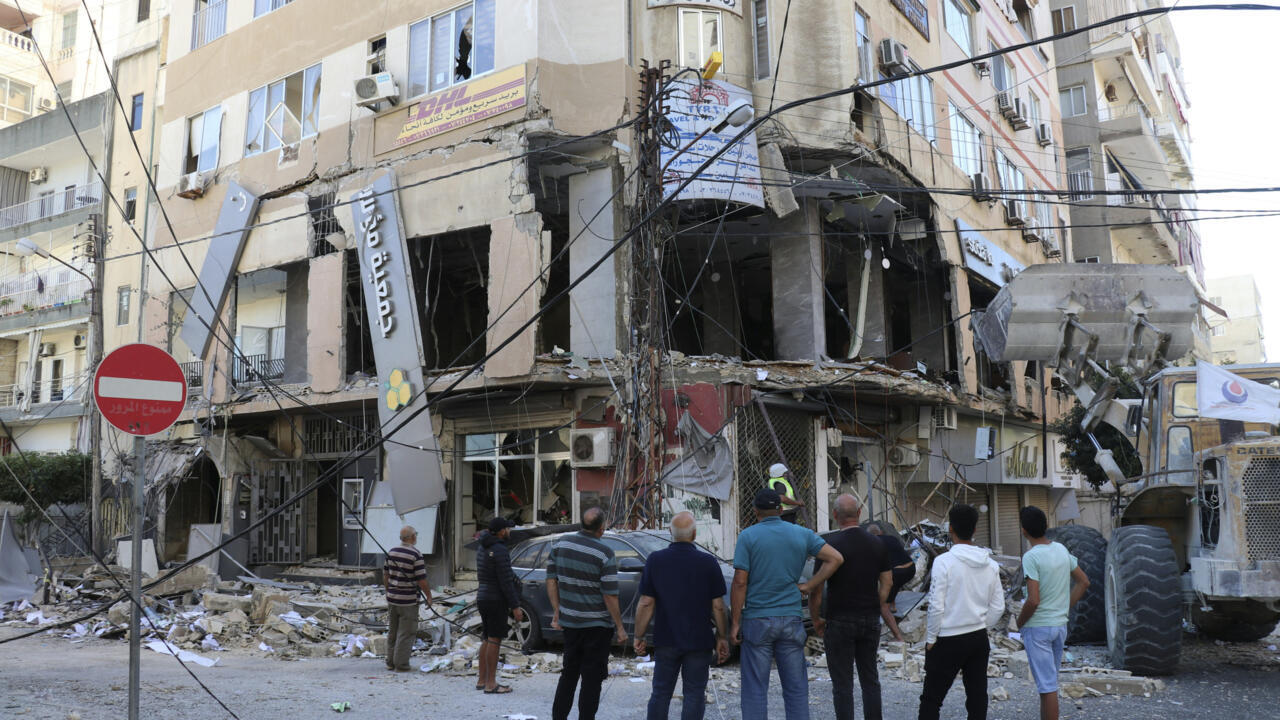
The buildings were laid low across Lebanon, from the southern suburbs of Beirut to the coastal city of Tyre and the eastern Beqaa plain. The Israeli military on Sunday targeted nearly 30 targets and tens of millions of dollars in cash and gold belonging to the financial institution Al-Qard al-Hassan – Arabic for “benevolent lending”.
The organisation, which is registered as a charitable association, follows the principles of Islamic finance, lending out money without charging interest. Considered to be Hezbollah’s economic arm, the organisation has been targeted by US sanctions for years – and, now, by Israeli air strikes.
“Al-Qard al-Hassan is implicated in the financing of Hezbollah’s terrorist operations, particularly buying combat equipment and paying the salaries of the group’s military branch,” Israel Defense Forces (IDF) spokesperson Avichay Adraee said on X. The money in the underground vault targeted by the IDF was “being used to finance Hezbollah‘s attacks on Israel“, Israeli military spokesman Rear Admiral Daniel Hagari alleged later on Monday.
Hezbollah spokesman Mohammed Afif told reporters on Tuesday that Al-Qard al-Hassan was “a completely civilian institution registered by law, whose services are for all Lebanese without exception”. A senior Israeli intelligence official, speaking to journalists on condition of anonymity, said the strikes were intended “to affect the trust between Hezbollah and a lot of the Shiite community that uses this system”.
Read moreAfter Sinwar’s death: Why is Israel ramping up strikes in Lebanon and Gaza?
For Didier Leroy, a researcher at the Belgium’s Royal Military Academy, these fresh strikes followed on from Israel’s devastating attacks against the Iran-backed Shiite group.
“Israel wants to invert Hezbollah’s rhetoric, which has long painted the Hebrew State as a fragile ‘cobweb’,” he said. “First by blowing up its pagers, then by alternating between powerful air strikes on certain weapons stockpiles and ground operations along the border, and by cutting the head off the party’s leadership.”
This time, University of Lausanne visiting professor Joseph Daher said, Israel is targeting one of Hezbollah’s civilian institutions rather than its armed wing.
“There’s a desire by the Israeli government to associate the two branches of the party to legitimise the attacks,” he said, adding that it was a practice that had already been seen in the 2006 war.
“The idea is to destroy all of Hezbollah’s institutions,” said Aurélie Daher, a teaching professor at Paris-Dauphine University.
Losing interest
Created in 1983, Al-Qard al-Hassan offers microloans averaging $2,500 to thousands of clients against everyday collateral such as gold or jewellery.
‘We grant interest-free microloans of up to $5,000 to meet a variety of needs, such as marriage, financing a project or personal needs’, Executive Director Adel Mansour explained in 2020 in the Le Commerce du Levant business monthly.
Unlike traditional banks, Al-Qard al-Hassan doesn’t charge interest, in accordance with the principles of Islamic finance that condemn lending at interest as usury. And though Iran played a hand in its creation in the 1980s, the institution has since become self-financed, largely through Lebanon’s Shiite community.
Read moreLebanon: One war too many
Al-Qard al-Hassan is licensed under Lebanon’s interior ministry as a charitable organisation rather than a commercial bank. Despite this, it has in recent years taken on an important role in the country’s economic life, mainly within Lebanon’s Shiite community. It counted 486,000 contributors and members as of 2019, and said it had been responsible for two million loans totalling $4.3 billion since its creation in 1983.
“In the beginning, Al-Qard al-Hassan proposed zero-interest loans allowing borrowers to launch small economic activities such as paying for training or buying sewing machines,” Aurélie Daher said. “The idea was to give families a second source of household revenue.”
Things fall apart
The collapse of Lebanon’s banking system in the October 2019 financial crisis has only strengthened Al-Qard al-Hassan’s popularity. Seemingly overnight, four million Lebanese found themselves unable to access their savings from one day to the next. The problem lies in part with the country’s unsustainable public debt.
“Lebanon’s banks adopted capital controls and people could no longer withdraw their money,” Joseph Daher said. “At the same time, the economy became a lot more ‘cash-based’, favouring Hezbollah, which is active in many illicit and informal economic networks. But when you go deposit your gold with Al-Qard al-Hassan, you can get cash right away.”
The worsening economic crisis has driven more and more people to turn to alternative sources of finance, according to Aurélie Daher.
“Since the financial crisis, its use has diversified, with a lot of consumer credit for Lebanese who can no longer afford to pay for their shopping or their children’s schooling,” she said. “In addition, the Lebanese no longer have confidence in their banking system, where withdrawing their money has become very complicated.”
With its system based on gold deposits, Al-Qard al-Hassan has shown itself to be a refuge for many Lebanese struggling with the rising cost of living.
“Our depositors know that their savings won’t disappear, as happened in Lebanon’s banks,” Executive Director Mansour said in 2020. “The value of our deposits has at least doubled since 2019!”
In the crosshairs
In the West, these branches are considered to be little more than sources of financing for Islamist terror. The US Treasury has imposed sanctions on Al-Qard al-Hassan, freezing its assets in 2007. In 2021, a number of figures linked to the organisation were individually targeted. The US Treasury has accused the institution of having been “used by Hezbollah as a cover to manage the terrorist group’s financial activities and gain access to the international financial system”.
The organisation has also been targeted in less direct ways. At the end of 2020, a group of hackers calling themselves Spiderz hacked into Al-Qard al-Hassan’s data to reveal the identities of thousands of clients, mainly Lebanese citizens living abroad and Iranian institutions.
“Lebanon is governed today by mafias, militias and money,” the hackers said. “Al-Qard al-Hassan is not a charitable association, it’s Hezbollah’s bank, outside of Lebanon’s official financial system.”
Despite these criticisms, some experts say that bombarding branches of a widely used microfinance institution will only make Lebanon’s economic crisis worse.
“Israel’s actions amount to a strategy aimed at further impoverishing Lebanon’s already vulnerable and largely displaced Shia community,” Hezbollah expert Amal Saad posted on X.
The United Nations on Monday condemned the Israeli strikes, saying they also caused “extensive damage” to civilian property and infrastructure. UK-based human rights group Amnesty International called for the air strikes to be investigated as possible war crimes.
“The Israeli military’s targeting of branches” of Al-Qard al-Hassan “likely violates international humanitarian law and must be investigated as a war crime”, the group said in a statement on Tuesday.
“Under the laws of war, branches of financial institutions are civilian objects unless they are being used for military purposes. Therefore, these attacks likely constitute a direct attack on civilian objects,” it added.
This article has been adapted from the original in French.