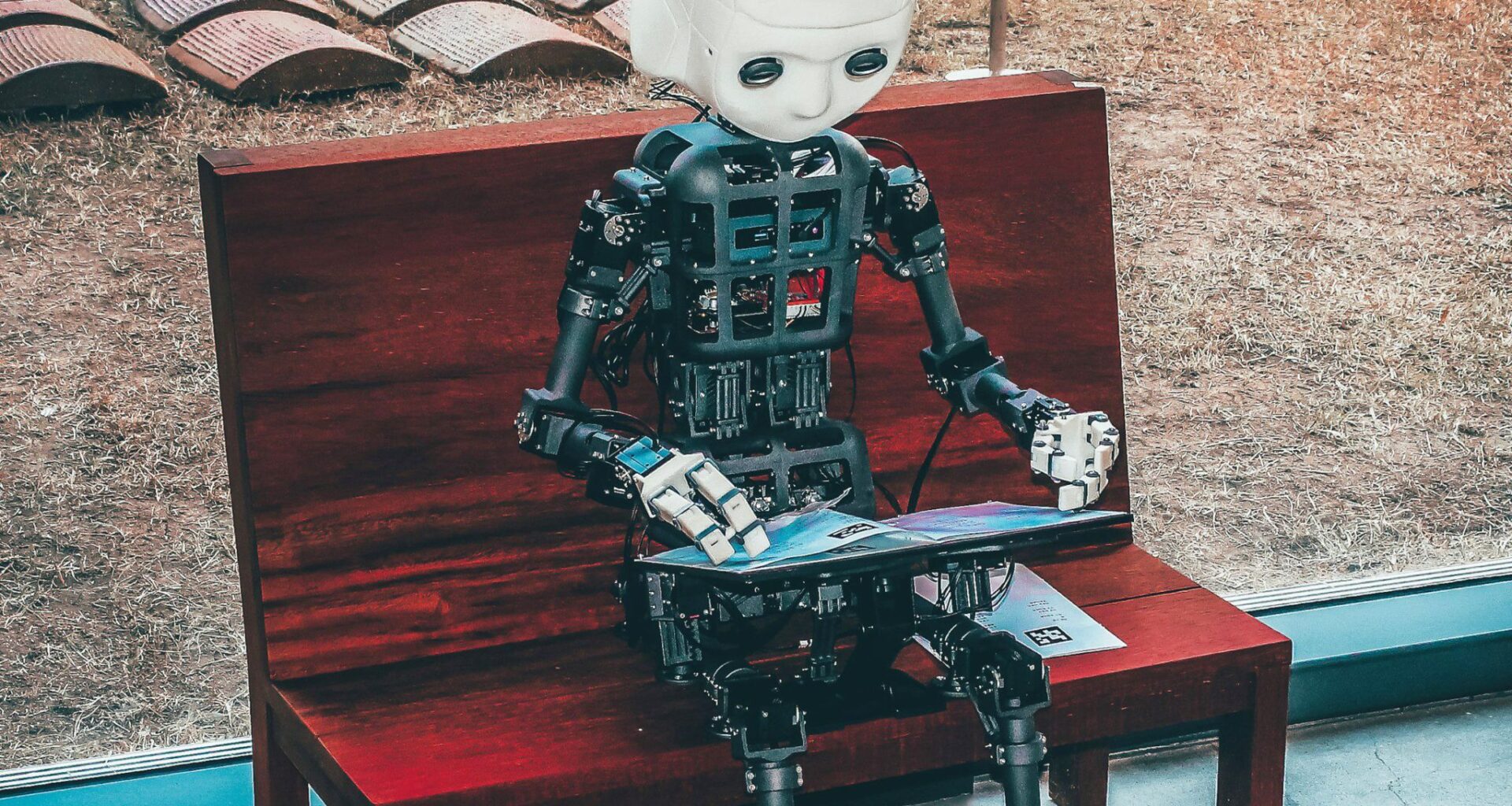
Nathan Lim, a Cal Poly San Luis Obispo student, spent the summer working on an artificial intelligence tool.
Lim’s goal is to help students evaluate their senior project ideas for ethical and social justice implications—using AI.
He is one of many California college students choosing to learn about AI theory and its emerging applications while preparing to enter an ever-changing workforce. Simultaneously, colleges and universities across the state are working to expand and develop AI courses and degrees to keep up with demand.

With hopes of bolstering these efforts, Gov. Gavin Newsom recently announced the first statewide partnership with a tech firm to bring AI curriculum, resources and opportunities to California’s public higher education institutions. The partnership with Nvidia, a leading AI software development company, will bring AI tools to community colleges first. In the future, the hope is to add partnerships for the California State University and University of California systems as well, according to the governor’s press release.
As colleges and universities are developing AI programs, these partnerships will give students more access to the technology that tech companies use while teaching students how to use it, said Alex Stack, a deputy communications director for Newsom.
Lim is a junior studying music and computer science, with a concentration in AI. He sees the potential for AI in both learning how to play instruments and making music more accessible.
“What if there was an AI private teacher to answer questions and provide feedback on playing?” Lim asked. “This could make it available to so many more people that can’t afford $50 to $100 an hour for private lessons.”
The college student learned to play the violin, guitar and piano with help from a middle school teacher and YouTube tutorials. He said his family could not afford private lessons, so he is mostly self-taught. While the internet helped him evolve as a musician, he thinks AI will drive society’s next revolution in technology.
“It almost feels like, obviously I wasn’t around for it, but the creation of the internet,” Lim said. “People were like, ‘Oh, I don’t want to use that.’ Now if you don’t use it, I mean, what are you doing? So I feel like it’s going to get to a point like that with AI, if not already.”
In Lim’s data science course this quarter, the program that he uses to complete homework assignments, Google Colab, has AI embedded that will generate the needed code for him if prompted correctly.
“Learning is much less about what we can remember and memorize, and much more about asking the right questions because that’s what AI is,” Lim noted.
Lim’s dad also studied computer science in college and encouraged him to explore coding from a young age; the rapid growth of AI focused the younger Lim’s career path.
“Someone asked me a question about why I want to specialize in AI in the computer science field,” Lim said. “I told him, ‘I feel like if I don’t, then my job is gonna get replaced by someone who does.’”
Developing Paths to AI careers
Many California colleges and universities are racing to prepare students for high-paying AI engineering jobs, although the path to these careers often require a master’s or doctoral degree. Community colleges and universities are working to lay the groundwork for students to pursue those more advanced degrees, while also finding ways to get students involved in AI at the undergraduate level.
Over the next decade, computer and mathematical jobs, which include AI, are projected to grow by 12.9%, the second-fastest of any industry, according to a report by the U.S. Bureau of Labor Statistics. At tech companies such as Meta and Google, postings for AI-related jobs list six-figure salaries, with many reaching above $200,000 annually.
“The growth of computer and mathematical occupations is expected to stem from demand for upgraded computer services, continued development of artificial intelligence (AI) solutions and an increasing amount of data available for analysis,” the labor report states.
Angel Fuentes, the dean of business and workforce development at Evergreen Valley College in San Jose, is pushing for community colleges to foster AI literacy, so that students across disciplines understand the basic terminology, uses and ethics of AI, even if they aren’t pursuing a tech career. He said AI literacy is important because AI is starting to impact fields from medicine to the humanities to business.
Fuentes also stated he’s started to see more “blue-collar AI” opportunities popping up, with jobs that work with AI, but don’t necessarily develop or innovate with it, and that typically don’t require master’s degrees. One example is a prompt engineer, which is someone who writes the inputs that companies use to get responses from AI platforms such as ChatGPT. Prompt engineers may use AI to help create presentations or streamline a company’s internal processes, for example.
In part to prepare students for those more accessible AI jobs, eight California community colleges now have AI degrees or certificates, with more in the works, Fuentes said. These programs focus on skills such as computer programming and entrepreneurship.
“The world is changing so fast, and we want our students to be prepared,” Fuentes said.
The California partnership with Nvidia aims to create AI programs, software and dedicated AI spaces for community college students, educators and workers.
Louis Stewart, the head of strategic initiatives at Nvidia, said the partnership will initially last three years, allowing students to get “AI-enabled.” Stewart emphasized the importance of “reskilling and upskilling” workers, including people who are returning to school to switch careers, by teaching them about AI.
Nvidia is not being paid by the state, and the company is covering the costs of teaching students and faculty about AI, Stewart said.
“The community colleges are a great starting point because it is a great way to get tools and resources into these classrooms that might have a harder time accessing it,” said Stack, with the governor’s office.
Even though only one in five community college students transfer to a four-year university, officials hope to equip and inspire students to continue their AI studies beyond community college, or enter the workforce in AI-adjacent roles.
A key point for some administrators and faculty in the community college system is ensuring students understand the ethical and unethical uses of AI, as well as the terminology and real-world applications.
Some efforts to integrate AI in education have gone wrong. The volatility of a tech startup led to Los Angeles Unified shelving one AI tool, while school board members for San Diego Unified were in the dark about AI technology they had approved in a broader contract. In both of these districts, problems arose when clear communication and expectations surrounding AI were not established. Experts have warned that it’s crucial for decision makers to vet AI solutions, and be thoughtful when it comes to implementation of AI in education.
The idea behind the AI literacy push is that “AI is here to stay,” and various sectors, not just tech, “should embrace it,” said Nasreen Rahim, a professor at Evergreen Valley College who trains teachers on how to best use technology.
“You can’t just shut your mind to AI and have that be your mindset,” Rahim explained. “It’s about having an open mind.”
The California community college system has a new set of academic integrity guidelines for AI, which aim to ensure “expectations are clear” for students in terms of what is considered responsible use of AI, and what isn’t.
Brian Sawaya, a biomedical engineering student at Foothill College in Santa Clara County, has found a network of peers at the community college level who, like him, are dedicated to exploring tech fields, including AI.
“Community college students are some of the most driven and most ambitious people you’ll meet,” Sawaya said. “Because community college students are underrepresented in terms of access to opportunities, and companies are trying to diversify their workforce, it’s important to have opportunities for community college students.”
Sawaya is the president of his college’s robotics team, and he said he uses AI to help his club’s robots better detect objects and avoid obstacles. He stated he is excited to transfer to a four-year university next year to continue his studies in the field of wearable technology, which includes prosthetics.
How Four-year Universities Are Adding AI Programs
As Newsom pointed out, the UC and Cal State systems will also benefit from AI industry partnerships in the future.
The Cal State board of trustees announced in September that the university system is seeking $7 million in its 2025-26 budget request to fund AI infrastructure for students and faculty.
Four universities in the Cal State system have AI programs: Cal State East Bay, San Francisco State, San Jose State and Cal Poly San Luis Obispo. The CSU generative AI committee convened for the first time this fall in response to some CSU campuses’ demand for systemwide guidance on developing AI programs and managing AI use.
At Cal Poly San Luis Obispo, students in the Computer Science and AI Club meet every Sunday afternoon in a large lecture hall. On a recent Sunday, 80 students, mostly computer science freshmen, sat in front of two projectors to learn about AI basics from club leaders.
“As the president this year, I’m trying to champion a place where people who know more about AI come to teach people who know less and are very interested,” said Leo Horwitz, a computer science senior at Cal Poly.
The club offers workshops to teach the foundations of AI to students and is working on original AI application projects—for example, one that will research and generate code and another that will automate and referee games of red light, green light. The club partners with local companies to raise funds, and it gets money from the student government, which sponsors clubs, Horwitz said.
Horwitz is excited about the possibility of Cal Poly working with a leading AI developer in the future.
“A direct partnership with a company in the industry is productive because it’s easy for academia to fall behind,” Horwitz noted. “No matter what [the partnership] is, we’re interacting with them. This is a way for us to force ourselves to be in the thick of it with the cutting edge stuff.”
Horwitz’s professor, Franz Kurfess, offers opportunities for his students to work with companies as part of his courses. He is also leading the project that Cal Poly junior Lim is working on to use AI in evaluating students’ senior projects.
“Working with an external company is an excellent opportunity for students to learn about practical applications of AI in a context that they might experience later in their career,” Kurfess said. “It also exposes them to professional work practices where they may not be able to get away with things that they are doing for class assignments because they have other people depending on their work.”
In another partnership with CalMatters, Cal Poly San Luis Obispo faculty and students recently worked with the news organization to build Digital Democracy—an AI-powered website that tracks lawmakers, legislation, campaign contributions, and congressional hearings and sessions.
Across the UC system, leaders are working to incorporate AI across disciplines, while balancing the potential pitfalls of the technology. A UC presidential working group chose a list of “responsible AI principles,” which include transparency about AI use, safety and privacy.
For Chris Mattmann, the chief data and artificial intelligence officer at UCLA, ongoing developments in the world of generative AI mean it’s crucial to “innovate and experiment,” but to do so with the guidance of “responsible and ethical principles.” Mattmann began at UCLA earlier this year, and his role is the first of its kind at any UC.
Mattmann works to oversee AI strategy across UCLA, including how the technology is used by faculty, students, staff and researchers. He emphasized the importance of developing AI literacy across disciplines. UCLA recently became the first California college to offer ChatGPT enterprise accounts, allowing a limited number of student groups and faculty to use the technology through the university.
“(Our goal) is to hopefully demystify AI, so people really understand what’s coming, what’s here, the opportunity, but also the need to really be guided by ethics,” Mattmann said.
Beyond the public higher education systems in California, private universities are also working to create AI opportunities for students. While some private universities such as Stanford have added concentrations or minors in AI, USC is developing a new AI major in response to the immense demand for AI instruction, said Nenad Medvidović, the computer science department chair at USC.
Medvidović says that some students are driven by an academic curiosity of how AI works, but others are driven by making sure they are employable after they graduate.
“I’ve seen many waves of technology that have kind of come along and matured,” Medvidović recalled. “Nothing has come close to what we’re seeing right now with AI and machine learning and large language models.”