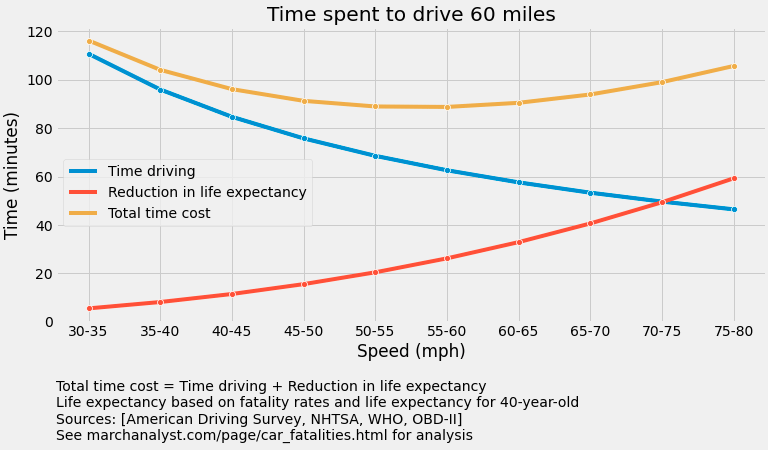
High-speed driving is so deadly that it reduces life expectancy by more than it saves you driving [OC]
Posted by logisticitech
High-speed driving is so deadly that it reduces life expectancy by more than it saves you driving [OC]
Posted by logisticitech
25 comments
But that’s only if you die, obviously. That’s the real trick, don’t die.
My takeaway here is that 69mph is the sweet spot.
An interesting graphic, but I’m a little bit hesitant about the “total time cost” part (E: the label seems misleading/incorrect)
If I spend 60 minutes driving, then I have not changed my life expectancy at all – the act of spending the minutes (which won’t be spent if you actually do die) changes the post-fact expectation to 0, because you necessarily have not died in 60m so the expectancy reduction = 0, so the total time cost is only able to be 60m.
E: in fact, if I spend 60m NOT dying, then my life expectancy should increase by some fraction of 60 minutes, right? The DRIVING is not doing anything, it is the small chance of DEATH.
Sorry if this is pedantic, I’m just interested in charts is all.
Terrible analysis of meaningless data. How safe a particular driving speed depends on the roadway and traffic conditions. If you’re doing 70 miles per hour down a residential street, that’s a much more dangerous environment than going 70 miles per hour down a freeway with a posted speed limit of 70. Also, people who obey speed limits and traffic laws can, and often are, still killed by reckless motorists in traffic accidents. So the asshole speeding is, in fact, afflicting risk on unwilling participants, which is part of what produces that asinine graph.
This must be the chart Prius drivers live by when driving on highway fast lanes
Driving 30 mph on the highway is going to be more dangerous than driving with the flow of traffic. I don’t think this data is really actionable, it hides the fact that safety is very dependant on the actual roads/streets, and if there’s only one highway to get you to your destination, then driving with traffic flow is always safest. Still, interesting.
Speed variability is actually the main cause of accidents. Speed does play a part but if everyone is going 80 its safe. If everyone is going 80 except for one guy going 45, it’s a recipe for disaster
Too many confounders to be meaningful.
Germany has an ADVISORY speed on highways of 80 mph, as in most people drive close to that, many drive even faster, some MUCH faster. And yet, road deaths are comparatively low.
Driver training, road conditions, car conditions, and many other factor figure into this.
That’s some morbid time use optimization.
I don’t drive a car, will I live forever?
I wonder how this would look if you just polled truckers.
[https://marchanalyst.com/page/car_fatalities.html](https://marchanalyst.com/page/car_fatalities.html)
Here is the source. I highly recommend reading it. It’s a short read. I double checked all the math and I think I largely agree. Except each calculation is “back of the napkin” accuracy so I think the end optimal speed of 55 mph is probably only correct +/-30%.
Here are my only complaints:
* Gaffney calculates that driver’s remaining life expectancy is 33.79 years. But they use 40 years in the calculation. If corrected, this would give a higher optimal speed.
* Gaffney used data from 2022 (probably because they wrote it back then). 2023 data shows less crashes which would also result in a marginally higher optimal speed.
* I am a bit confused on the exact formulas used on the second to last chart. I wish Gaffney had clarified that. It doesn’t look wrong. I just can’t follow!
Should add a bit about fuel economy in there too
r/wichita get your shit together
HAHAHA you think I value my life?
Driving fast is not about saving time, it’s about not driving slow.
This only goes up to 80mph. I’m gonna need to see a lot more data
Let’s do it over 250 miles and see
Now take into account particles emissions
Also, you don’t get to accumulate the time you “save”, it’s just a minute or two at most per trip. What are you going to do with that minute or two when you get to your destination? Look at your phone, that’s what. It’s not like you get to save up all the minutes and take an extra day off at the end of the year, if you’re speeding to work. Leave two minutes earlier, and drive like a sane person.
Is this a fancy way of saying, “Live Fast, Die Young”?
I do believe this is not based on any hard data/research. If this was the case, how do you explain that 70% of Germany’s motorway network is not speed limited, however, German fatalities per million km’s driven is lower than the EU average. Another anecdote based on research and hard data, in 2004 Denmark increased the motorway speed limit from 110 km/h to 130km/h on sections that were not located in urban areas. The fatality rate has dropped since they increased the speed limit.
I’m not sure where the OP got his data from but it surely does not fit the reality of what research shows.
Let’s sanity check this.
NHSTA says the probability of a fatal crash is 1.33 deaths per 100 million miles driven. Thats 1.33e-8 deaths per mile. We are going 60 miles, so that’s roughly 8e-7 deaths per trip.
The average 40 year had something like 39 years of life expectancy, which is about 20.5 million minutes.
Multiply those two numbers, you get about 16 minutes. Well, that’s in the ballpark.
We still need to probably convert the analysis to look at folks going at higher speeds conditional on not drinking and not being in say, a residential area.
From the web page:
>Using this data together with the 20% fatality increase per 5% increase (from WHO)
There are a *lot* of problems with extrapolating from this assumption.
But probably the number one thing wrong with it is that this is almost purely based on hypotheticals, rather than any actual data from the real world^* .
It’s based theoretically on reaction times and energy, not data. Among the many problems with this, data tells us that only 1/3 of road deaths are speed-related at all, and that the proportion of road deaths at low speed is much higher than would be predicted if time on the road were the only factor.
The second worst thing about this assumption is probably that the risk of death is not just to the driver, whereas the benefit is almost entirely to the driver.
The third worst thing, somewhat correlated with the first worst thing, is that around 1/3 of actual road deaths are due to alcohol.
^* Also, the next sentence in that WHO report is that later studies indicate that it’s more of an exponential than a power law, which has significant implications for your extrapolation even if all the rest of the problems were removed.
This is an amazing idea, to gather this data and compare it in this way. Really nice work. (the data is beautiful, and I guess the visualization is just workable).
You’re getting lots of angry responses which mostly seem to be from people who feel their preference for fast driving is being attacked.
Comments are closed.