Categories are meaningless. Try comparing salaries of doctors and nurses.
This will get a ton of pushback from the medical community, but doctors and nurses…are probably paid a bit too much 😬
Like, if we’re talking about bringing down prices, there’s gonna be losers who don’t want to lose. I get it, but if it were easy, we’d have already changed it.
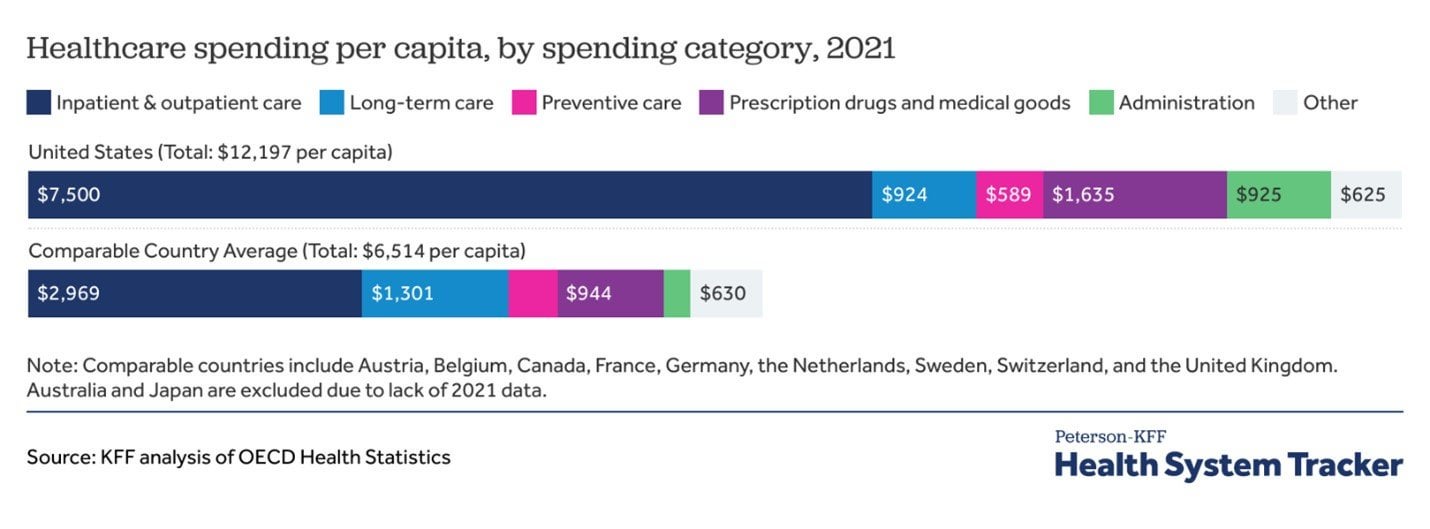
Categories are proportionally similar, but with slightly higher administration costs and less long term care than acute care in US.
The major difference is the total cost. It just costs significantly more here in America. To be expected when healthcare is for profit.
Americans also are like 40 times more obese than japanese, live more sedentary lifestyles than comparable countries, have higher mortalities and injuries from gun violence, traffic accidents, and generally higher substance abuse rate. Healthcare cost is one thing but the population is just unhealthy compared to the rest of developed world.
Across the board greed drives U.S. healthcare.
I mean the overhead on insurance companies is wild. The insurance company hires a bunch of people to go throw claims deny them talk to people on the phone about denying them resubmitting, fighting lawsuits to deny people care. Also the doctors/hospitals ext need to hire people to submit the forms to insurance and play the same game. Also doctors make exponentially more in US than other countries. Like doctors in uk make like 90k
The absolute lack of knowledge on how to use the body as a diagnostic tool. Western medicine relies on $7 million machines to tell us if there is inflammation. Eastern Medicine uses acupuncture, massage and manipulation.
Would love to see the breakdown of the “inpatient and outpatient care” category, since that drives most of it and is very broad. From the article: “The largest category of health spending in both the U.S. and comparable countries is spending on inpatient and outpatient care, which includes payments to hospitals, clinics, and physicians for services and fees such as primary care or specialist visits, surgical care, provider-administered medications, and facility fees (see Methods for more details).”
Great zeroth-order chart. Now dive into the $7500 US bar. Strangely imprecise compared to all the other values.
Inpatient and outpatient hides the cost of dealing with insurance. There are entire departments who deal with insurance payout and coverage. Hospitals are spends weeks arguing with HMOs about payment for necessary procedures. Cut that out and the costs cut in half.
Wall Street private equity firms buying hospitals and being in cahoots with insurance companies. Thats it. No complex mystery. It’s pure greed.
I know Doctors do heroic work, but they use that status to shield themselves from criticism for some real bullshit they pull. The AMA and other bodies consistently lobby to gatekeep the number of doctors that get trained, and the responsibilities that can be delegated to RNs and PA, with an eye on keeping doctor supplies low and salaries high. Their salaries are wildly disproportional to what ANY other doctor in the first world makes. Yes, I know they graduate with more debt in the US, but their debt is completely washed away with just one years salary – it does not justify the 3x salary differential throughout a 30-40 year career. Just go on r/whitecoatinvestor and you’ll see how money-driven and disconnected physicians get. It’s a group of people whose salary has a FLOOR of $300k and that never seems like enough for them.
There needs to be more pushback on this. Doctors are using their privileged social status to bullshit the system.
There was a trend I noticed years ago, even during not so great economic times like in 2008/9 where you could go to any new suburb and without a doubt the nicest new building in town was a health clinic or hospital.
With that in mind, I’d say from top to bottom… everything is done to excess. The architects and engineers and interior designers specify stupid expensive LED lighting in every room, glass walls everywhere, etc. I remember counting the 15 or 20 ER rooms, and each one had like six of these LEDs. The LEDS could be purchased in bulk direct from a supplier for like $87, but these would have been installed by experienced professionals in a retail package. We are talking thousands for each room… A house built in that way would cost 10-20x a typical house.
The structural beams and glass walls were designed to be seen and no doubt affected how much the hospital would pay for heating and cooling the life of the building.
Contrast that with a place like Rome, where I was walking past a huge hospital and didn’t even notice because it just looks like any other building.
There is a huge doctor group near me who all went together. A friend told me he felt when visiting the office after learning they have a couch in the waiting room that costs many thousands of dollars. I think a lot of Americans see expensive stuff and think the doctor must be good, rather than it is obscene nonsense.
They don’t explain why in- and out-patient care is so much more expensive in the US than abroad. And for that, the reasons are diverse:
– Inflated costs of hospital administration;
– High costs of professional insurance for both physicians and the hospital
– High salaries of the physicians and hospital administrators;
– High volume of uninsured in ER / OR
– High insurance administrative costs both in insurance companies and in hospitals
– High costs of hospital equipment because of very high costs and risks of obtaining FDA approvals that does not let the market to form while government cannot regulate the prices;
– High costs of drugs provided to the hospitals by the drug companies, and costly, inefficient system of the drug administration.
Hospital administrators make way way way too much money.
More ‘players’ (eg. healthcare companies and insurers) in the system with pricing and political power.
What I haven’t seen mentioned yet is the impact of collective bargaining. Other countries have the benefit of bargaining as a country for the price of EVERYTHING. Not just drug prices. And as others mentioned this also impacts the earnings of doctors in nurses. They are paid notably lower in other countries.
So while you might think that creating universal healthcare only impacts the administration and other portions by eliminating insurance costs and for profit health care entities, it would also have a SIGNIFICANT impact on all costs across the board because of the weight of this bargaining.
Healthcare in the US is a multi-headed beast. Cerberus cross with Hydra.
We all know insurance delays and delays and negotiates with providers to such extents that providers increase their costs just to be able to recoup a modicum of what they might expect, plus cover for lost time.
But doctors, nurses, anesthesiologists, medical supply providers, etc. all make lots of money. Those two feed into each other greatly.
But I remember when the ACA was being debated and negotiated, I heard the concept of the “healthcare marketplace” and exchanges. I thought that was a very interesting thing.
What we got instead were health insurance marketplaces. In some states. So in NY, I go onto the exchange, and I find crap plans for way too much money. No thanks.
I thought we be getting heath *care* exchanges. Meaning, I’d be able to find quoted prices for services. Like how I can easily find the spot price of a bushel of wheat quoted on the NYMEX. I’m not sure that would’ve brought prices down, but at least the transparency on pricing would’ve been helped.
You can’t “shop around” for health care. You can barely “shop around” for insurance.
One aspect is also in Europe studying medicine is mostly free, so doctors don’t graduate with a massive debt burden and don’t demand super high salaries to pay back those debts and compensate for the risk. This also appllies to other professions, but especially studying medicine takes forever.(Doctors in Europe are also among the top earners, but it’s significantly lower than in the US
why is the same data graphed 3 different ways? Was this generated by an LLM?
hospitals raising prices is a major driver of cost. our hospitals are so much more beautiful than european ones. in turn insurance companies feel they have to deny more… all are complicit.
fkn unfettered corrupt capitalism, could it be anything else
22 comments
Categories are meaningless. Try comparing salaries of doctors and nurses.
This will get a ton of pushback from the medical community, but doctors and nurses…are probably paid a bit too much 😬
Like, if we’re talking about bringing down prices, there’s gonna be losers who don’t want to lose. I get it, but if it were easy, we’d have already changed it.
Categories are proportionally similar, but with slightly higher administration costs and less long term care than acute care in US.
The major difference is the total cost. It just costs significantly more here in America. To be expected when healthcare is for profit.
Americans also are like 40 times more obese than japanese, live more sedentary lifestyles than comparable countries, have higher mortalities and injuries from gun violence, traffic accidents, and generally higher substance abuse rate. Healthcare cost is one thing but the population is just unhealthy compared to the rest of developed world.
Across the board greed drives U.S. healthcare.
I mean the overhead on insurance companies is wild. The insurance company hires a bunch of people to go throw claims deny them talk to people on the phone about denying them resubmitting, fighting lawsuits to deny people care. Also the doctors/hospitals ext need to hire people to submit the forms to insurance and play the same game. Also doctors make exponentially more in US than other countries. Like doctors in uk make like 90k
The absolute lack of knowledge on how to use the body as a diagnostic tool. Western medicine relies on $7 million machines to tell us if there is inflammation. Eastern Medicine uses acupuncture, massage and manipulation.
Would love to see the breakdown of the “inpatient and outpatient care” category, since that drives most of it and is very broad. From the article: “The largest category of health spending in both the U.S. and comparable countries is spending on inpatient and outpatient care, which includes payments to hospitals, clinics, and physicians for services and fees such as primary care or specialist visits, surgical care, provider-administered medications, and facility fees (see Methods for more details).”
Great zeroth-order chart. Now dive into the $7500 US bar. Strangely imprecise compared to all the other values.
Inpatient and outpatient hides the cost of dealing with insurance. There are entire departments who deal with insurance payout and coverage. Hospitals are spends weeks arguing with HMOs about payment for necessary procedures. Cut that out and the costs cut in half.
Wall Street private equity firms buying hospitals and being in cahoots with insurance companies. Thats it. No complex mystery. It’s pure greed.
I know Doctors do heroic work, but they use that status to shield themselves from criticism for some real bullshit they pull. The AMA and other bodies consistently lobby to gatekeep the number of doctors that get trained, and the responsibilities that can be delegated to RNs and PA, with an eye on keeping doctor supplies low and salaries high. Their salaries are wildly disproportional to what ANY other doctor in the first world makes. Yes, I know they graduate with more debt in the US, but their debt is completely washed away with just one years salary – it does not justify the 3x salary differential throughout a 30-40 year career. Just go on r/whitecoatinvestor and you’ll see how money-driven and disconnected physicians get. It’s a group of people whose salary has a FLOOR of $300k and that never seems like enough for them.
There needs to be more pushback on this. Doctors are using their privileged social status to bullshit the system.
There was a trend I noticed years ago, even during not so great economic times like in 2008/9 where you could go to any new suburb and without a doubt the nicest new building in town was a health clinic or hospital.
With that in mind, I’d say from top to bottom… everything is done to excess. The architects and engineers and interior designers specify stupid expensive LED lighting in every room, glass walls everywhere, etc. I remember counting the 15 or 20 ER rooms, and each one had like six of these LEDs. The LEDS could be purchased in bulk direct from a supplier for like $87, but these would have been installed by experienced professionals in a retail package. We are talking thousands for each room… A house built in that way would cost 10-20x a typical house.
The structural beams and glass walls were designed to be seen and no doubt affected how much the hospital would pay for heating and cooling the life of the building.
Contrast that with a place like Rome, where I was walking past a huge hospital and didn’t even notice because it just looks like any other building.
There is a huge doctor group near me who all went together. A friend told me he felt when visiting the office after learning they have a couch in the waiting room that costs many thousands of dollars. I think a lot of Americans see expensive stuff and think the doctor must be good, rather than it is obscene nonsense.
They don’t explain why in- and out-patient care is so much more expensive in the US than abroad. And for that, the reasons are diverse:
– Inflated costs of hospital administration;
– High costs of professional insurance for both physicians and the hospital
– High salaries of the physicians and hospital administrators;
– High volume of uninsured in ER / OR
– High insurance administrative costs both in insurance companies and in hospitals
– High costs of hospital equipment because of very high costs and risks of obtaining FDA approvals that does not let the market to form while government cannot regulate the prices;
– High costs of drugs provided to the hospitals by the drug companies, and costly, inefficient system of the drug administration.
Hospital administrators make way way way too much money.
More ‘players’ (eg. healthcare companies and insurers) in the system with pricing and political power.
What I haven’t seen mentioned yet is the impact of collective bargaining. Other countries have the benefit of bargaining as a country for the price of EVERYTHING. Not just drug prices. And as others mentioned this also impacts the earnings of doctors in nurses. They are paid notably lower in other countries.
So while you might think that creating universal healthcare only impacts the administration and other portions by eliminating insurance costs and for profit health care entities, it would also have a SIGNIFICANT impact on all costs across the board because of the weight of this bargaining.
Healthcare in the US is a multi-headed beast. Cerberus cross with Hydra.
We all know insurance delays and delays and negotiates with providers to such extents that providers increase their costs just to be able to recoup a modicum of what they might expect, plus cover for lost time.
But doctors, nurses, anesthesiologists, medical supply providers, etc. all make lots of money. Those two feed into each other greatly.
But I remember when the ACA was being debated and negotiated, I heard the concept of the “healthcare marketplace” and exchanges. I thought that was a very interesting thing.
What we got instead were health insurance marketplaces. In some states. So in NY, I go onto the exchange, and I find crap plans for way too much money. No thanks.
I thought we be getting heath *care* exchanges. Meaning, I’d be able to find quoted prices for services. Like how I can easily find the spot price of a bushel of wheat quoted on the NYMEX. I’m not sure that would’ve brought prices down, but at least the transparency on pricing would’ve been helped.
You can’t “shop around” for health care. You can barely “shop around” for insurance.
One aspect is also in Europe studying medicine is mostly free, so doctors don’t graduate with a massive debt burden and don’t demand super high salaries to pay back those debts and compensate for the risk. This also appllies to other professions, but especially studying medicine takes forever.(Doctors in Europe are also among the top earners, but it’s significantly lower than in the US
why is the same data graphed 3 different ways? Was this generated by an LLM?
hospitals raising prices is a major driver of cost. our hospitals are so much more beautiful than european ones. in turn insurance companies feel they have to deny more… all are complicit.
fkn unfettered corrupt capitalism, could it be anything else
Comments are closed.