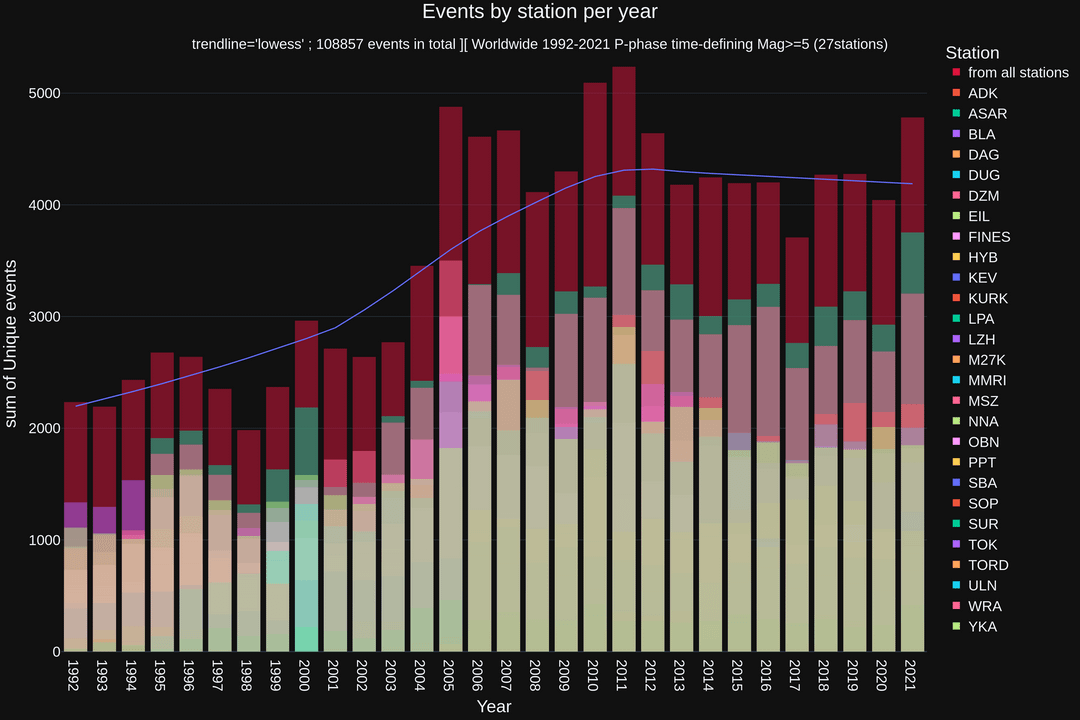
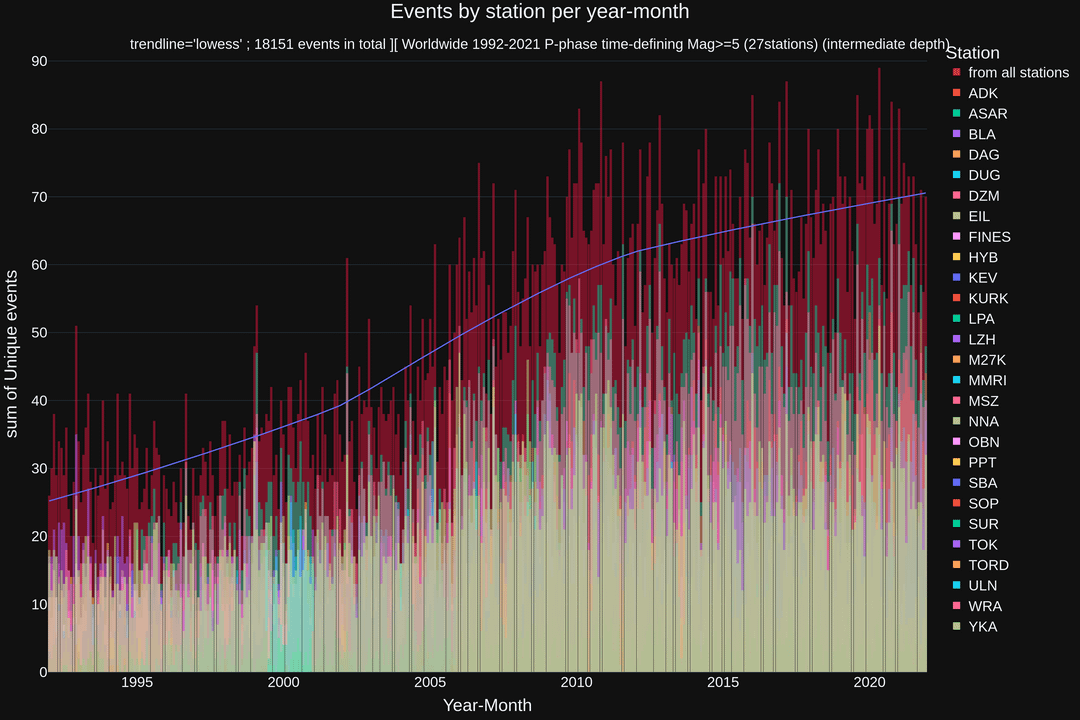
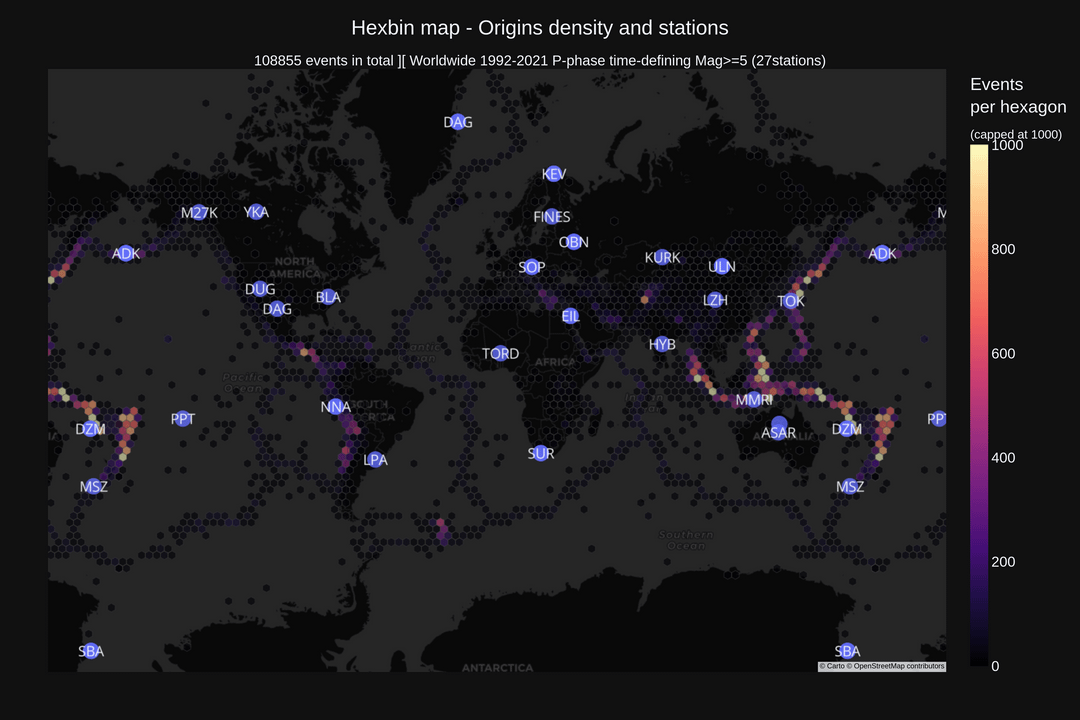
[OC] Seismic Events over 30 Years detected by 27 Stations Worldwide. Arrival Data by ISC-EHB
Posted by Delicious-Hour-9564
[OC] Seismic Events over 30 Years detected by 27 Stations Worldwide. Arrival Data by ISC-EHB
Posted by Delicious-Hour-9564
5 comments
**These are only earthquakes with Magnitude 5 or higher!** (I realised only after that I should have included that in post’s title…)
Notebook on Kaggle that created that downloaded data and created these plots: [https://www.kaggle.com/code/iananich/seismic-station-arrivals?scriptVersionId=212793422](https://www.kaggle.com/code/iananich/seismic-station-arrivals?scriptVersionId=212793422)
Plots built in Plotly.
data source: ISC-EHB Bulletin [https://www.isc.ac.uk/isc-ehb/](https://www.isc.ac.uk/isc-ehb/)
there’s web-GUI for it as well: [https://www.isc.ac.uk/isc-ehb/search/arrivals/](https://www.isc.ac.uk/isc-ehb/search/arrivals/)
search params used:
time 1992-2021 (including, 30 years)
phase – only P
only time-defining
origin’s magnitude >= 5
origin’s depth any
stations – manually selected set of 27 seismic stations from around the globe
atm link to notebook leads to concrete version where dataset is used as input to skip long (a couple hours) downloading stage. But all code for it is there.
There’s a minimal data processing to remove duplicates and enforce search params.
Map is there to show that station’s location mostly matches active zones and provides decent coverage for selected magnitude range.
Histogram shows both individual number of unique events reported by each station, as well as union from all stations and trendline. Notebook actually contains plots for shallow, deepfocus and monthly variants for all depth categories. You can change trendline to other methods that Plotly’s px.scatter support, such as OLS for example, but it might look a bit dramatic 😉
Sorry if I’m missing this information but is there a reason for the increase over time? Is it due to more advanced detection or sensitivity, or is it an actual increase in the quantity of events taking place?
[deleted]
Not sure the point of these plots.. Most modern broadband seismic stations can detect most M5.5 globally, depending on local noise levels and some other factors. It’s also an Interesting choice of seismic stations–they are all not equivalent with regards to hardware sensitivity. For example, it appears station DAG (New Mexico) was an 1-Hz sensor (low sensitivity to teleseismic events) until 2022 when it was replaced with a weak-motion, broadband sensor (high sensitivity). I’m also not sure it was in operation over your total time period… looks like it was 1st installed in 1999.
Was this controlled for increased sensor sensivity and coverage?
Comments are closed.