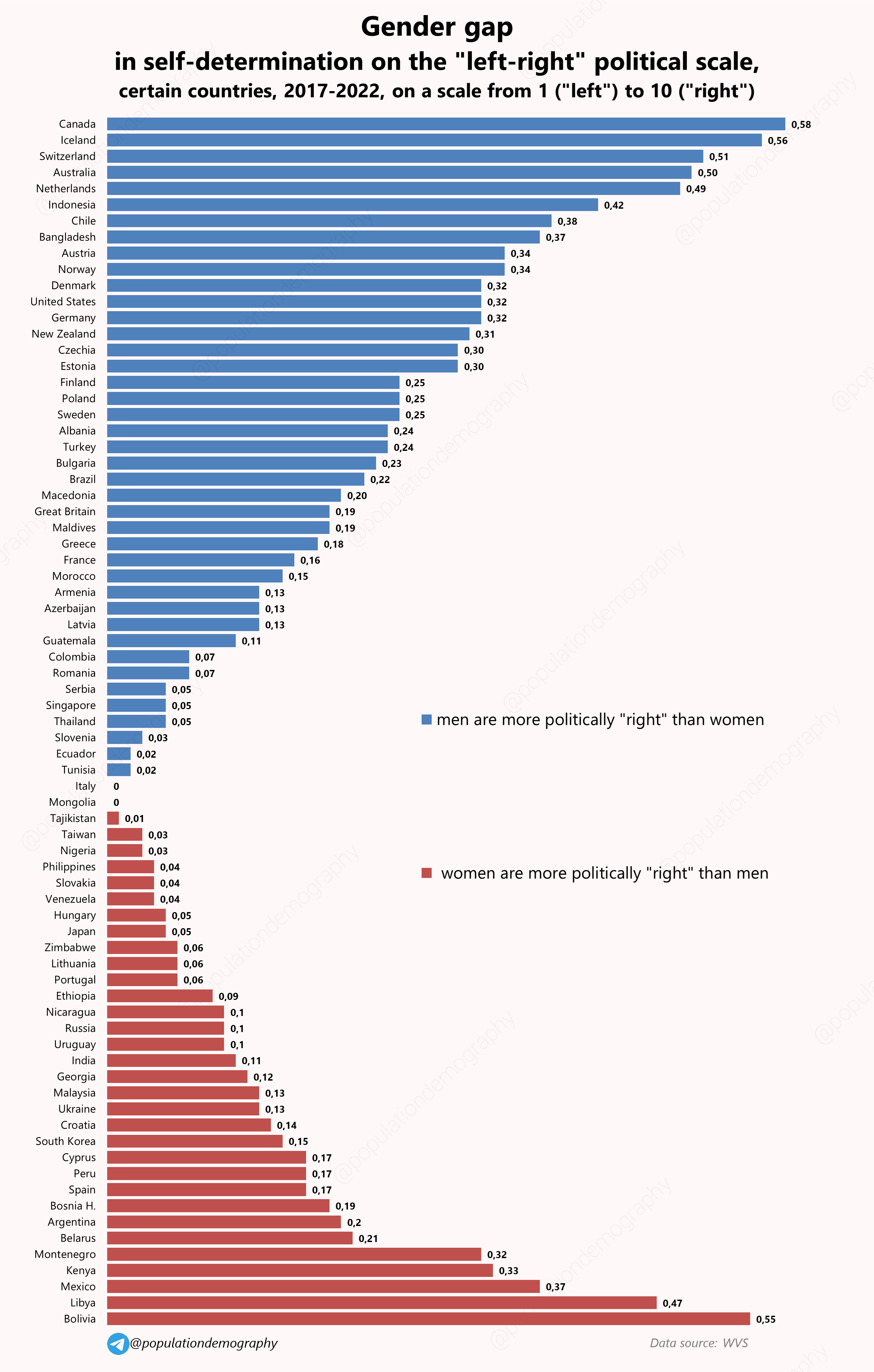
Gender gap (male – female difference) in self-determination on the “left-right” political scale, certain countries, 2017-2022, on a scale from 1 (“left”) to 10 (“right”) [OC]
Posted by Populationdemography
![Gender gap (male - female difference) in self-determination on the "left-right" political scale, certain countries, 2017-2022, on a scale from 1 ("left") to 10 ("right") [OC]](https://www.europesays.com/wp-content/uploads/2024/12/w5po1fds387e1-1920x1024.png)
Gender gap (male – female difference) in self-determination on the “left-right” political scale, certain countries, 2017-2022, on a scale from 1 (“left”) to 10 (“right”) [OC]
Posted by Populationdemography
32 comments
Gender gap (male – female difference) in self-determination on the “left-right” political scale, certain countries, 2017-2022, on a scale from 1 (“left”) to 10 (“right”)
Source link: World Values Survey
https://www.worldvaluessurvey.org/wvs.jsp
Made with Ms Excel (calculations and charts) instruments
This is interesting. I learn something new I didn’t know
Interesting data, a lot of places you wouldn’t want to go the women lean more right than the men. I wonder what to take away from this
I wonder what causes this gap in political orientation. My first thought was maybe it’s linked to the rights women already have secured in the country, but looking at specific countries doesn’t really confirm that.
Press X to doubt. For South Korea this is definitely not true….
In Italy, men and women are simply the same on the right.
That Chile/Argentina split is very interesting.
I would like more explanation of this metric. Left/right mean very different things in different political contexts.
The big problem here is that left/right hides other orientations. People could be thinking of economics, or social attitudes for instance, plus you have the noise of whatever has recently been in the news in each country.
Remember that left and right have different connotations in different countries/languages/political systems folks. It’s not uncommon for right wing to be associated with free market liberals as opposed to left wing soviet style conservatives.
Every dichotomy is false including this one. Reductionistic dichotomization of a complex web of politics into left and right using US framework and imposing it on other nations’ political system is in itself self contradictory and is a less intelligent mode of analysis then what a bacteria in a donkey’s pile of shit could imagine
There is just no way this is true
I’m a bit confused on how the numbers are meant to be interpreted and feel I’m not getting a lot of the story.
Canada = 0,56.
Is that +56 percentage points (e.g. 60% – 4% = +56 pp) which is an astounding difference? Or +0.56 percentage points (60.56% – 60.00%), which I would question for statistical significance?
I’d be interested to see this a scatter plot with the X/Y as the female/male percentages. The further away from a 1:1 diagonal, the greater the gender discrepancy but the viewer would still have the context of where that discrepancy is taking place. Example, are the low discrepancy places fairly neutral or are they places on the extreme ends of the scale (in which case is dissent dangerous?).
Do people really put their political opinions on one dimensional axis? And they use the same base units? How would I know whether women from Bolivia are more “right” if I don’t know what it means in Bolivia? It could just be that Bolivian men are ultra-revolutionary Marxist and the women are simply communists who think the the system should be changed from the inside.
I wonder how much of this variance can be explained by the fact that “left” and “right” are expressed very differently in different countries, when it comes to policy specifics.
I’m more interested in this divide as it effects dating and relationships. You see the effect being PROFOUND and growing. Anyone know if it has the same effect it Canada or other Scandinavian countries (those are the ones that instantly pop out at me where I see men right of women).
Was Northern Ireland not included?
Considering every single difference here is <1, might the 1-10 scale be a little too big?
I’d also be interested in seeing the same kind of chart, but for “more moderate” vs “more radical” but that’s probably less reliable if it’s self-reported.
I’m curious what issues push women to the right of men. In the US, it’s pretty clear why women would lean left, or at least lean away from the right, but I guess other issues predominate elsewhere.
I can tell the data for my country is wrong. Last election women’s vote was incredibly skewed to the left to the point you’d think it was an anomaly, yet this is consistent with previous elections.
I refuse to believe that south korean women are more right-wing than the men.
in the country where it became a trend to sit in seats reserved for pregnant women bc the idea was “too anti-man” ????
Not in a million years.
It doesn’t make sense. There must be a typo; what is the answer???
Anyone from Bolivia or Mexico could explain what “women are more right wing” means? How is it demonstrated?
My head hurts… I haven’t a clue what this is about
There’s no freaking way I’m going to believe that Canadian men are “right-leaning” with such a majority.
And similarly, there are certain nations who literally have feminist govt. frameworks that every citizen has to abide by, especially the Scandinavian nations.
Probably a lot of those countries had a very “manipulated” survey.
Femminism is very common between russian women, but it’s kept hidden because it could cost their life saying it openly, but in that survey they say women are more supportive in “being child factories under a man free to bet them to death”
It’s very likely the majority didn’t answered honestly.
This can’t possibly be correct for Spain.
doesn’t make any sense to me.
if the scale is left:1 to right:10, why are all the values less than 1?
The lower half of this image really surprises me.
Based on all the comments we really need to stop talking about left and right. We need to adopt a left, right, up, and down spectrum where ideologies are better represented.
Really odd selection of countries
I do not trust this data very much, and it’s overly simplified.
Korea for instance, is very obviously not more “right” in women than men, even across generations. (See: https://www.opb.org/article/2024/04/10/elections-reveal-a-growing-gender-divide-across-south-korea/)
But it also does not reflect the complexities of ideologies at all. For instance, Korean politics is multifactorial, with social elements and international geopolitical elements like N Korea relations. But putting all of that into Left vs Right is comically simplistic.
Comments are closed.