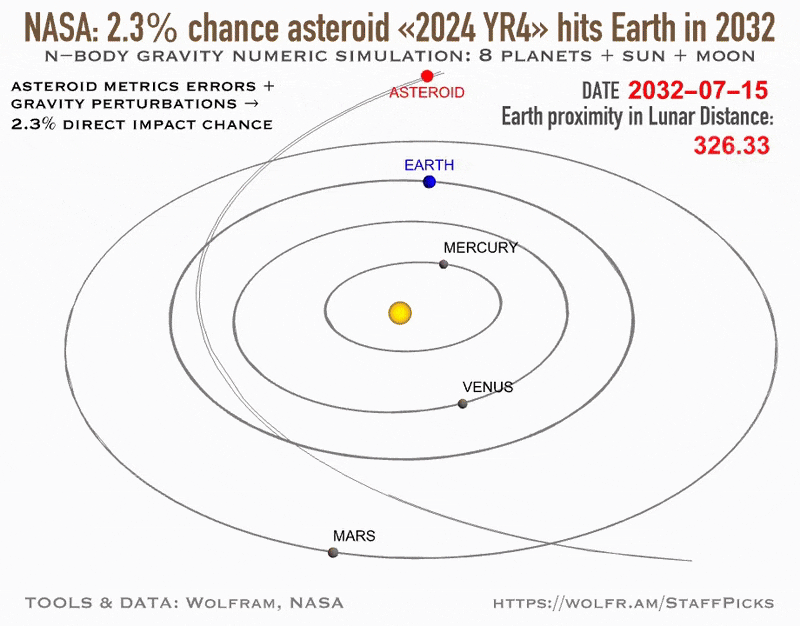
I worked with two scientists (Jeffrey Bryant, Jose Martin-Garcia) to build final visualization with all computations explained at the link above.
There are two major complicating factors that make it difficult to predict the future location of small asteroids into the more distant future. The first is that their small size and dark surface makes it hard to observe them if they are not near Earth. This means its difficult to fit a precise orbit to the asteroid since there are only a handful of observations during a small narrow arc of the full orbit. The other major complicating factor is that these small bodies cross the orbits of other major bodies and are subject to a number of perturbations. As of early February of 2025, NASA is claiming a 2.3% chance that the asteroid will strike Earth on Dec 22, 2032. Time will tell, with further orbit refinements, if the chance of a collision will increase or decrease in the near future.
===
There was interesting Comment by Nassim Taleb on NASA tweet on X:
NASA:
While still an extremely low possibility, asteroid 2024 YR4’s impact probability with Earth has increased from about 1% to a 2.3% chance on Dec. 22, 2032. As we observe the asteroid more, the impact probability will become better known.
NASSIM TALEB:
No. A “1% to 2.3% chance” is not an “extremely low possibility”. It may be for an individual but not for the collective. Depending on impact, if we had *significant* ones every few million years we would not be there.
Which way am I supposed to be rooting!
That sounds like a problem for 2032
Guess it’s time to pack it up and move somewhere else…
5 comments
DATA:
* Asteroid: NASA, Wolfram|Alpha
* Simulation: Wolfram NBodySimulation[]
TOOLS:
* Wolfram Mathematica
ARTICLE / CODE:
[https://community.wolfram.com/groups/-/m/t/3389913](https://community.wolfram.com/groups/-/m/t/3389913)
I worked with two scientists (Jeffrey Bryant, Jose Martin-Garcia) to build final visualization with all computations explained at the link above.
There are two major complicating factors that make it difficult to predict the future location of small asteroids into the more distant future. The first is that their small size and dark surface makes it hard to observe them if they are not near Earth. This means its difficult to fit a precise orbit to the asteroid since there are only a handful of observations during a small narrow arc of the full orbit. The other major complicating factor is that these small bodies cross the orbits of other major bodies and are subject to a number of perturbations. As of early February of 2025, NASA is claiming a 2.3% chance that the asteroid will strike Earth on Dec 22, 2032. Time will tell, with further orbit refinements, if the chance of a collision will increase or decrease in the near future.
===
There was interesting Comment by Nassim Taleb on NASA tweet on X:
NASA:
While still an extremely low possibility, asteroid 2024 YR4’s impact probability with Earth has increased from about 1% to a 2.3% chance on Dec. 22, 2032. As we observe the asteroid more, the impact probability will become better known.
NASSIM TALEB:
No. A “1% to 2.3% chance” is not an “extremely low possibility”. It may be for an individual but not for the collective. Depending on impact, if we had *significant* ones every few million years we would not be there.
Which way am I supposed to be rooting!
That sounds like a problem for 2032
Guess it’s time to pack it up and move somewhere else…
Anything we can do to up the odds a bit?
Comments are closed.