looks to me Democrats have gone more left, while Republicans have generally stayed in the same place over time
Regarding this topic, I want to point to this project, which has a super interesing number of datasets of policies, leanings, attitudes etc. of political parties world wide: [https://v-dem.net/vparty_dash](https://v-dem.net/vparty_dash)
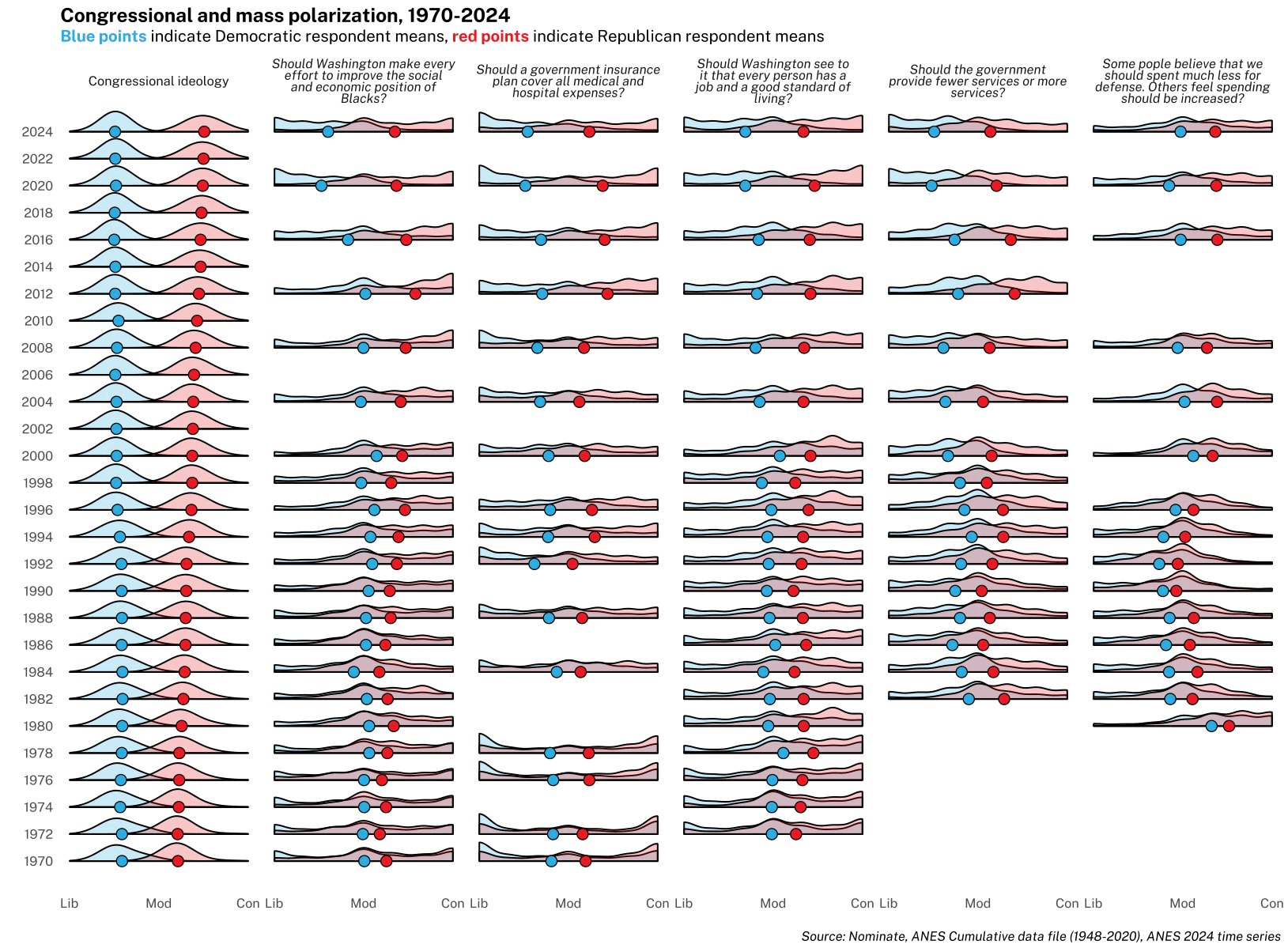
OP, can you please clarify what congressional ideology means here? To me, it looks like it represents only the views of congress whereas the other columns represent the views of the people.
I understand that ideology has gotten more polarized over the years. But it’s difficult for me to understand the purpose of political parties without it- why did parties exist if NOT for differences in ideology? What held a party together besides differences in policy positions. And is that type of cohesion better or worse for democracy? Or is this a function of extremes- maybe there were broad differences but fewer very liberal or very conservative members? FWIW I do not believe that there is or ever has been a significant left wing of the democratic party- socialism and communism are extremely toxic in US politics and have been for 100 years or more, and the number of people who identify as either is and has been a very small minority.
These comparisons are abjectly terrible when they do not include the context.
Every mention of this change over time misses the context that a huge reason for bipartisanship in the past was that the bigots were not consolidated in one party in the past.
Further, it frames polarization as a negative, when polarization has no inherent value, positive or negative. Rather, it is the introduction of anti-democratic, anti-scientific ideology that has created a new Republican party. We should be glad that we’re polarized enough that those views do not also infect the other party.
This infographic seems to indicate the dems are leaning more left over time, but the reality is, the republicans have gone way right, extremely so – which is not shown
I know this has been said, apart from performative inclusiveness, have democrats gotten more left wing?
Have they literally done anything progressive in the last several decades. This is not a bash on them, as they spend a lot of time stopping the GOP from dragging us backwards.
But I think the polarization is the right wing moving to the extreme right and not left and right slowly moving away from each other.
Like if a Dem went to any other developed country they would be considered right wing.
Nice graphic, but cherry picked questions so not representative.
On the general graph, it looks like blue has gotten only slightly more liberal while red has gone significantly more right.
But on all the questions, it looks like blue has gone significantly left while red remained about the same as when originally asked.
How many other questions were asked, and what is the most liberal-ifying and most conserva-fying question over time?
Seems like a cell dividing, do you think the country might split in a future?
If i read that correctly then on a range of issues the Republicans were further right in 2012 than they are now
Which is odd as from overseas they look more wildly off-centre now than they did. Is this a real thing or is it a media thing or is it both?
I would like to see the two parties individually. If I am reading that right, it looks like each party is polarizing internally as well (especially Republicans)? It is difficult to read the party distributions with the way this is displayed.
Chiling. But somehow makes me want bacon.
Is this real? Some of the misspellings are so outrageous I think it’s AI generated.
I have an idea that political party should not be listed on ballots.
If people care so little about a certain election they don’t even know who they want to vote for, without a (R) or (D) telling them, perhaps they should simply not vote in that election.
People will still know how they want to be president, but they will be less likely to vote for coroner or county clerk just based on political team.
Interesting to see Democratic respondents slowly but steadily drift more liberal, while republican respondents drift more moderate/liberal during republican presidencies and drift back more conservative during Democratic presidencies.
The grammar in this is wild. Like so wild it makes me skeptical.
Really shows the rise of neoconservatism with W and Fox, and how that reshaped society.
![Public and congressional polarization,1970-2024 [OC]](https://www.europesays.com/wp-content/uploads/2025/02/c9j7rqmxoake1-1629x1024.png)
19 comments
Data from the [American National Election Studies](https://electionstudies.org/). Figure made with R.
looks to me Democrats have gone more left, while Republicans have generally stayed in the same place over time
Regarding this topic, I want to point to this project, which has a super interesing number of datasets of policies, leanings, attitudes etc. of political parties world wide: [https://v-dem.net/vparty_dash](https://v-dem.net/vparty_dash)
OP, can you please clarify what congressional ideology means here? To me, it looks like it represents only the views of congress whereas the other columns represent the views of the people.
I understand that ideology has gotten more polarized over the years. But it’s difficult for me to understand the purpose of political parties without it- why did parties exist if NOT for differences in ideology? What held a party together besides differences in policy positions. And is that type of cohesion better or worse for democracy? Or is this a function of extremes- maybe there were broad differences but fewer very liberal or very conservative members? FWIW I do not believe that there is or ever has been a significant left wing of the democratic party- socialism and communism are extremely toxic in US politics and have been for 100 years or more, and the number of people who identify as either is and has been a very small minority.
These comparisons are abjectly terrible when they do not include the context.
Every mention of this change over time misses the context that a huge reason for bipartisanship in the past was that the bigots were not consolidated in one party in the past.
Further, it frames polarization as a negative, when polarization has no inherent value, positive or negative. Rather, it is the introduction of anti-democratic, anti-scientific ideology that has created a new Republican party. We should be glad that we’re polarized enough that those views do not also infect the other party.
This infographic seems to indicate the dems are leaning more left over time, but the reality is, the republicans have gone way right, extremely so – which is not shown
I know this has been said, apart from performative inclusiveness, have democrats gotten more left wing?
Have they literally done anything progressive in the last several decades. This is not a bash on them, as they spend a lot of time stopping the GOP from dragging us backwards.
But I think the polarization is the right wing moving to the extreme right and not left and right slowly moving away from each other.
Like if a Dem went to any other developed country they would be considered right wing.
Nice graphic, but cherry picked questions so not representative.
On the general graph, it looks like blue has gotten only slightly more liberal while red has gone significantly more right.
But on all the questions, it looks like blue has gone significantly left while red remained about the same as when originally asked.
How many other questions were asked, and what is the most liberal-ifying and most conserva-fying question over time?
Seems like a cell dividing, do you think the country might split in a future?
If i read that correctly then on a range of issues the Republicans were further right in 2012 than they are now
Which is odd as from overseas they look more wildly off-centre now than they did. Is this a real thing or is it a media thing or is it both?
I would like to see the two parties individually. If I am reading that right, it looks like each party is polarizing internally as well (especially Republicans)? It is difficult to read the party distributions with the way this is displayed.
Chiling. But somehow makes me want bacon.
Is this real? Some of the misspellings are so outrageous I think it’s AI generated.
I have an idea that political party should not be listed on ballots.
If people care so little about a certain election they don’t even know who they want to vote for, without a (R) or (D) telling them, perhaps they should simply not vote in that election.
People will still know how they want to be president, but they will be less likely to vote for coroner or county clerk just based on political team.
Interesting to see Democratic respondents slowly but steadily drift more liberal, while republican respondents drift more moderate/liberal during republican presidencies and drift back more conservative during Democratic presidencies.
The grammar in this is wild. Like so wild it makes me skeptical.
Really shows the rise of neoconservatism with W and Fox, and how that reshaped society.
Comments are closed.