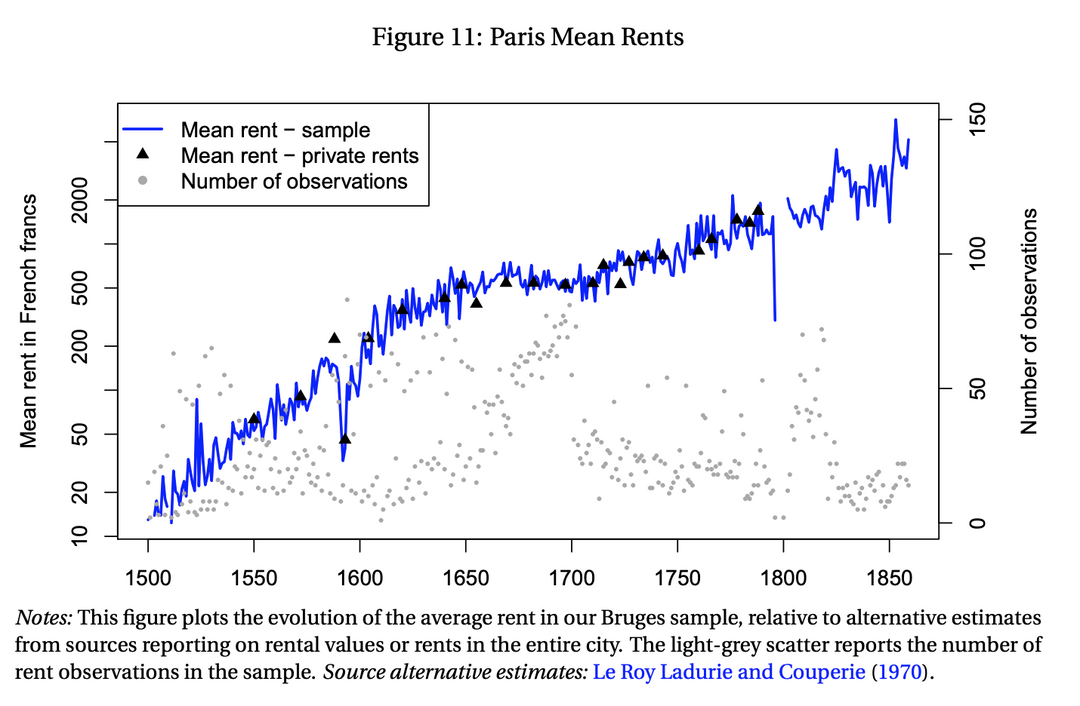
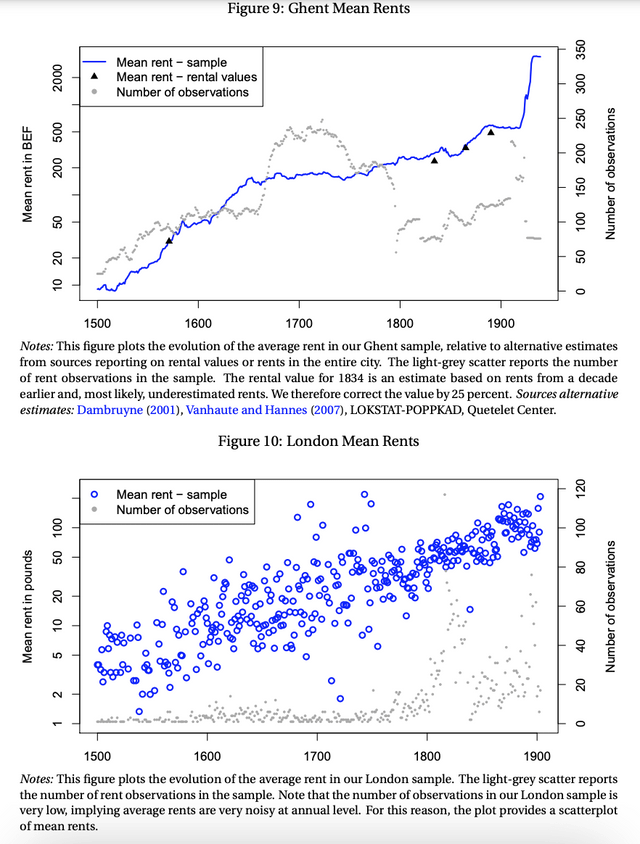
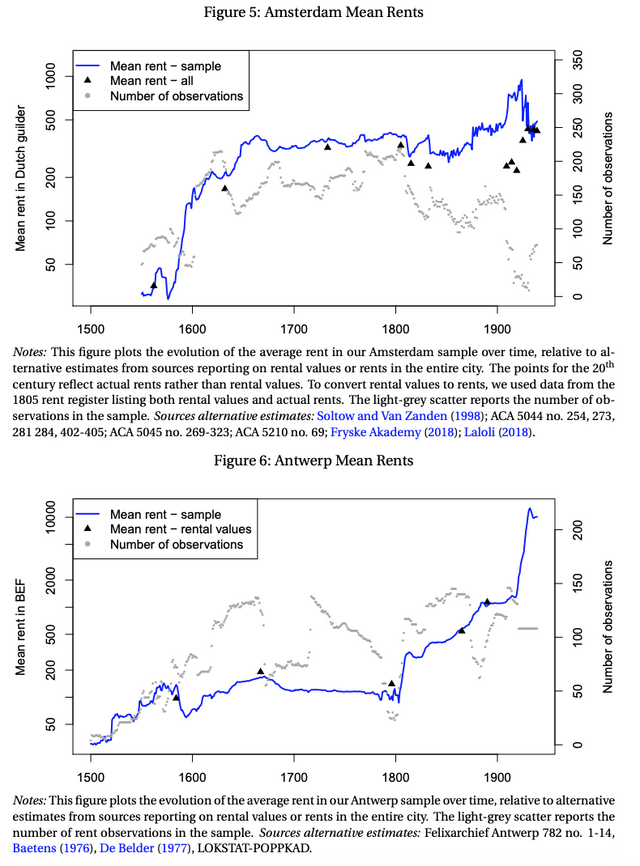
Without compensating for inflation these tells us very little.
Needs to be correlated with population growth, which is of course exponential (current doubling time: around 40-50 years). Remember: the world population was around 1 billion in 1800 and is now around 8 billion.
Yeah, using 500 years and a log graph basically means 95% of this graph is irrelevant information that’s not useful beyond “prices increase with time”
This… is meaningless.
Suggest that you try a different method: instead of monthly rent prices devoid of any context, plot it as something like hours worked by an average labourer to pay a month of rent. Or proportion of annual income that went on housing.
How can you call it «Data is Beautiful» if you do not even use the same scale in all the graphs? I mean, start at 100% in 1500 for all the cities and then we’ll be able to compare! Not very useful, but a little.
Also, do not say «500 years» when it starts in 1500 and ends about 1900~1950.
If I were to run the T analysis on this as if it was a stock price, we’ve been significantly above the 20 year average for quiet some time. To reach a balanced growth we may experience a 35% decline in population and a 57% decline in rent prices over the next 40 years.

8 comments
Neat. Too bad these don’t cover recent decades.
Without compensating for inflation these tells us very little.
Needs to be correlated with population growth, which is of course exponential (current doubling time: around 40-50 years). Remember: the world population was around 1 billion in 1800 and is now around 8 billion.
https://preview.redd.it/3ls6iy9x0lke1.png?width=852&format=png&auto=webp&s=5087a3e7509a2b0da14023f02f926b15bf11e868
Yeah, using 500 years and a log graph basically means 95% of this graph is irrelevant information that’s not useful beyond “prices increase with time”
This… is meaningless.
Suggest that you try a different method: instead of monthly rent prices devoid of any context, plot it as something like hours worked by an average labourer to pay a month of rent. Or proportion of annual income that went on housing.
How can you call it «Data is Beautiful» if you do not even use the same scale in all the graphs? I mean, start at 100% in 1500 for all the cities and then we’ll be able to compare! Not very useful, but a little.
Also, do not say «500 years» when it starts in 1500 and ends about 1900~1950.
If I were to run the T analysis on this as if it was a stock price, we’ve been significantly above the 20 year average for quiet some time. To reach a balanced growth we may experience a 35% decline in population and a 57% decline in rent prices over the next 40 years.
Comments are closed.