Cometh the hour, cometh the man.
Keir Starmer, leader of a Brexit Britain for which he did not vote, now finds himself leading Europe’s efforts to bolster Ukraine after Donald Trump’s shameful treatment of President Zelensky in the Oval Office on Friday.
For a Prime Minister with no previous experience of defence, foreign policy or geopolitics, he’s proved to be a remarkably quick learner.
Amid the turmoil which passes for normality in Trump World, he has remained steadfast in supporting Ukraine – while still valiantly trying to stay in Trump’s good books.
Even as the British political mainstream recoiled from Trump’s bully-boy behaviour, Starmer yesterday told the House of Commons: ‘We must strengthen our relationship with America.’ It was the right thing for a British Prime Minister to say, whatever absurdities emanate from Washington these days.
Pivotal
Nato is tottering. It might not survive another four years of Trump in the White House.
But if the most successful military alliance the world has ever seen is to be consigned to the dustbin of history, then it must be clear that Trump was the assassin – and that Britain did nothing to push America away.
Unlike political pygmies such as Lib Dem leader Ed Davey and other more excitable blowhards on the Commons backbenches, Starmer realises that.
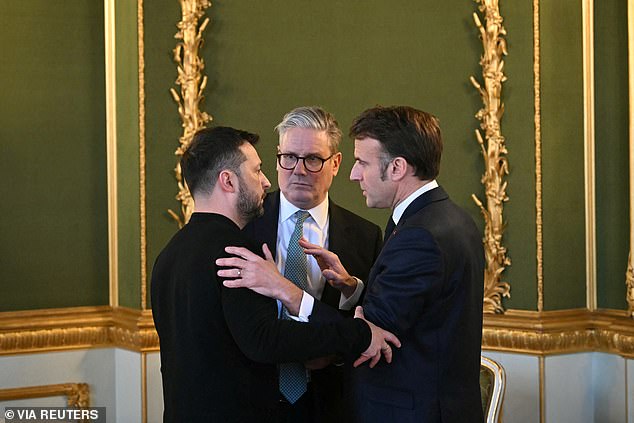
It was heart-warming to see our Prime Minister hug Zelensky when he arrived on our shores straight from his verbal punishment beating in the White House, writes Andrew Neil
Which is why he suddenly finds himself in a pivotal position: the only leader who can rally European support for Ukraine and with enough clout in Washington to have any chance of keeping Trump on board.
Other world leaders have quickly clocked Starmer’s new significance, which is why 19 of them came to London on Sunday to chart a way forward in a world in which America is in retreat.
He has enhanced his credibility because he hasn’t just chosen his words carefully, he has also acted with impressive determination and conviction.
A Labour Prime Minister prepared to raid the international aid budget to pay for our rearmament is clearly putting country above party – or party politics.
Of course, the increase in defence spending from 2.3 per cent to 2.5 per cent he announced last week is not nearly enough. But there is good reason to believe it’s just the start, and that he is aiming for 3 per cent.
The National Wealth Fund is to be tapped to bolster the defence of the realm. At some stage, the PM will realise that the billions being squandered by Energy Secretary Ed Miliband in his futile quest for net zero would be much better spent on rebuilding our military, and would command far more popular support.
In an indication of military spending to come, £1.6 billion has been allocated for Thales in Belfast to manufacture more than 5,000 air defence missiles for Ukraine. Even the ill-gotten gains of Russian oligarchs are to be mobilised in Kyiv’s cause.
All very satisfying substance to go with the strong words of support for our defence and Ukraine. But symbolism also matters in times of national peril, and it was heart-warming to see our Prime Minister hug Zelensky when he arrived on our shores straight from his verbal punishment beating in the White House.
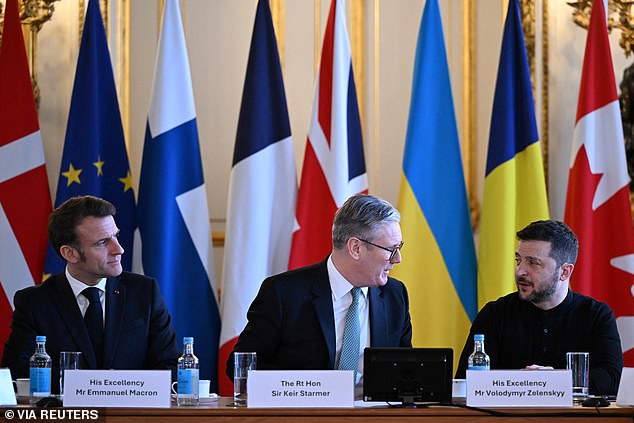
Britain and France would lead a peacekeeping force – a ‘coalition of the willing’, Starmer calls it – with boots on Ukrainian soil
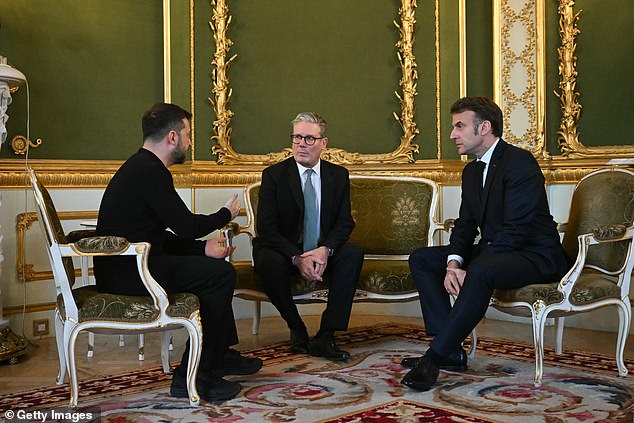
The stark reality is this: either Europe gets its act together, or it withers and dies
There was something deeply upsetting about the treatment he had to endure. A draft-avoiding President berating a brave war leader for standing up for his country against a brutal dictator. And playing Muttley to Trump’s Dick Dastardly, a Vice President who knows nothing about Ukraine (could he even find it on a map?) getting the hump because Zelensky dared to explain how Putin has reneged on every deal he’s made.
Contrast that with the civilised, compassionate, low-key manner in which our own head of state, King Charles, welcomed Zelensky on Sunday afternoon. It was a magnificent gesture. I’m sure for many people it generated a new pride in Britain. It certainly did for me.
So far, so good. Now comes the hard part. A peace plan of sorts for Ukraine is taking shape after Sunday’s gathering of leaders from Europe, Canada and Turkey, largely sculpted by Starmer and President Macron of France.
But it is fraught with difficulty and danger.
Macron wants a ceasefire first in the air and on the sea. If that holds for a month, the ceasefire would then expand to cover the frontlines on the ground. Britain and France would lead a peacekeeping force – a ‘coalition of the willing’, Starmer calls it – with boots on Ukrainian soil. Zelensky would have to sign that mineral rights deal with America that he was meant to sign on Friday.
Even the British and French are not yet agreed on all the details, but there is unanimity on its most crucial aspect of all: it depends on a US guarantee of air cover and extensive help in the many areas where European military capability falls short: intelligence gathering, satellite surveillance and reconnaissance, air defence and heavy airlift.
Nightmare
No one knows if Trump would agree to any of this. The omens are not encouraging. Yesterday, we learned that US Defence Secretary Pete Hegseth has ordered US cyber command to pause offensive operations against Russia.
Trump’s court jester, Elon Musk, endorsed a social media post at the weekend advocating the withdrawal of the US from Nato.
Some officials indicate that Trump is no longer prepared to deal with Zelensky. As I write, the word out of Washington is that he is even mulling over the cancellation of all US aid for Ukraine, effective immediately. In which case the European ceasefire-cum-peace-plan would be stillborn. Where we’d go from there is anybody’s guess.
The Kremlin is beginning to wonder aloud if either America or Europe has a peace plan, as opposed to just a plan for a ceasefire.
And it is highly unlikely, in my view, that Putin would agree to any deployment of Nato troops on Ukrainian soil, even as peacekeepers, with or without US guarantees.
In some ways, that is his worst nightmare.
As for Britain, we’d need to think long and hard before placing our troops on a frontline opposite Russian forces. Even with his massive Labour majority, Keir Starmer could have trouble getting that through Parliament.
Whatever the case, Europe has to prepare for the worst: that we’re no longer looking at a Nato in which Europe rightly pays much more of its fair share, but at a Nato without America.
Grit
Starmer hopes to avoid this, but he knows that anything is possible with Trump in the Oval Office.
The challenge for Europe is immense, given its recent history in which it’s been very badly governed by leaders like Angela Merkel and is now in genteel but steady economic decline, with a disastrously ageing demography and a hollowed out military.
The bill to free Europe from US military dependence has been put by one think tank at £500 billion. Europe might have neither the grit nor the resources to stump up. But what is the alternative?
America is in the grip of an isolationist worldview under Trump-Vance-Musk, and much more than just Ukraine is at stake.
In Trump’s Orwellian realpolitik, China gets to dominate much of the Pacific, Russia dominates Europe, especially the east, and the US reigns supreme across the Americas, including Canada and Mexico.
Not so much brave new world as a return to a brutal old world of power politics and might is right.
It is not a world in which Britain, or the continent of which we’re a part, is likely to stay free and prosper.
So the stark reality is this: either Europe gets its act together, or it withers and dies. I suspect Starmer, in his new role as budding apprentice statesman, already understands that.