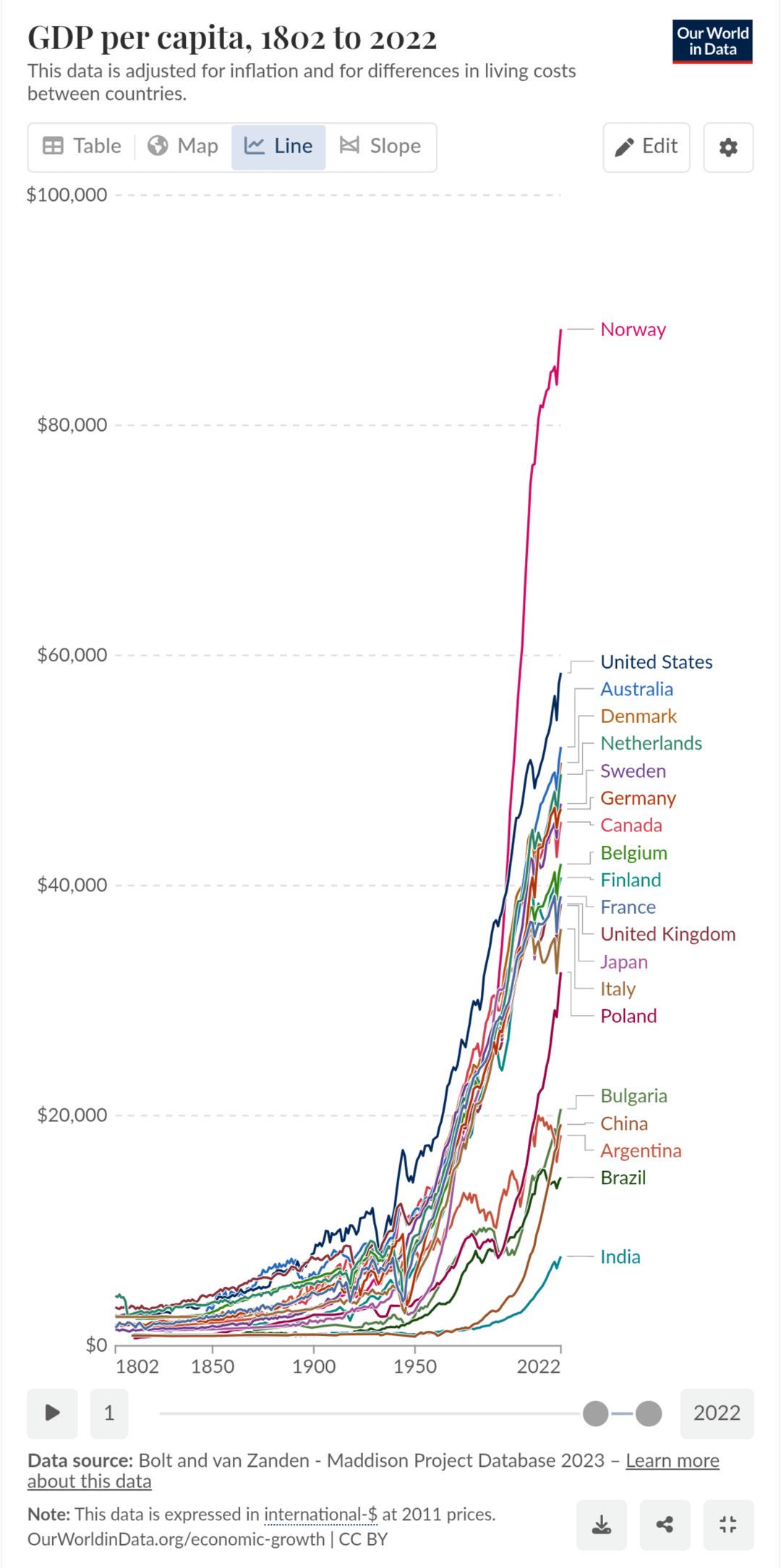
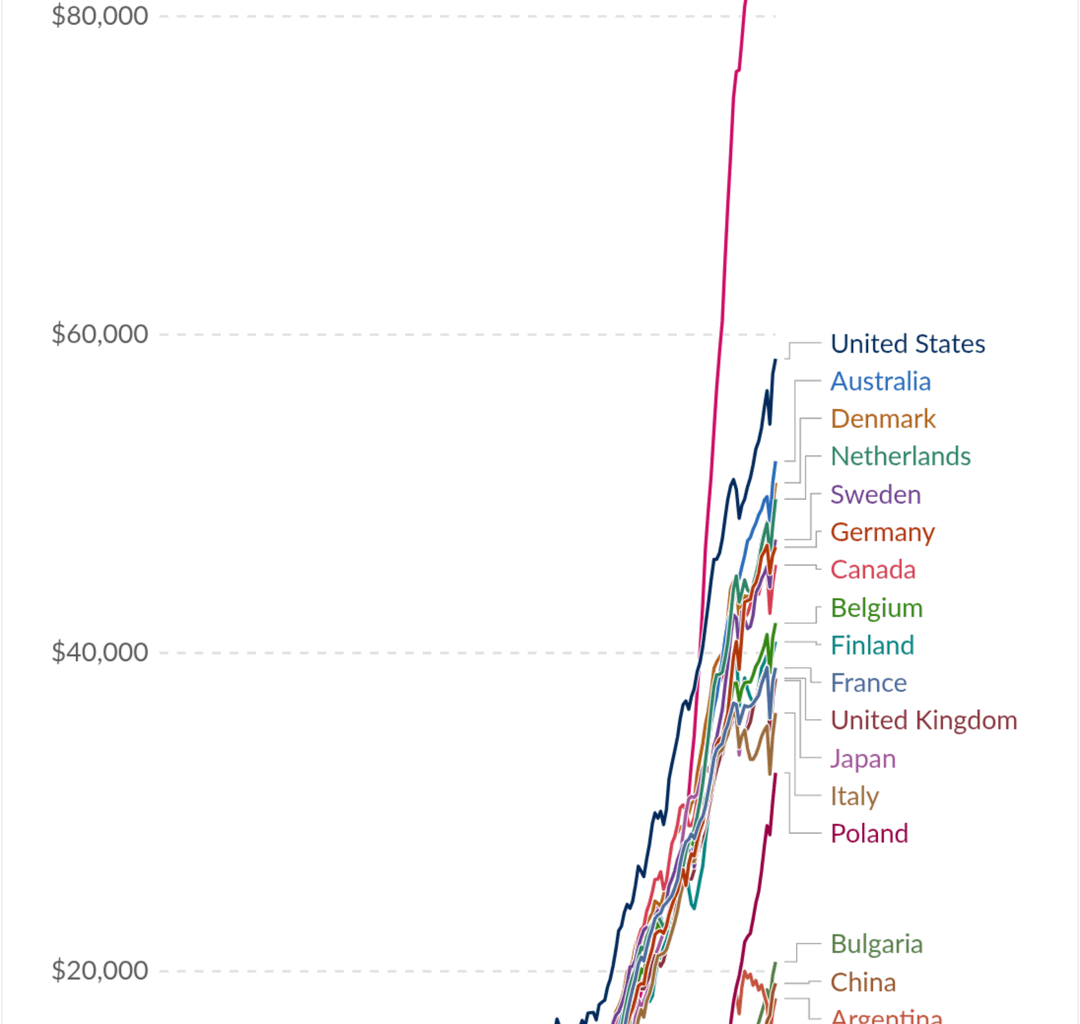
Had to doublecheck I wasn’t at r/dataispresentedonanuneditedchart but nope someone thinks this ridiculous chart is beautiful
Norway building a bank of money for all its citizens to benefit. Unlike some countries who waste their returns or having very little to show for the money received.
Bruh use logged values for growth graphs 😭🙏
Zero effort on OP’s part. You just screenshotted a website on your phone.
although it would interesting to see (if harder to calculate) the figures using the “modal gdp per capita” (I made that term up) because gdp per capita uses the mean, which is sqewed by the extremes (aka the very rich).
for example, this chart could be showing the already very rich getting even more absurdly rich, or it could be a case of a rising tide floats all boats. in reality, I suspect the reality is a bit of both. still, would be nice to see data backing that up.
One thing to note whenever someone asks – why is thr us like this but the rest of the developing world isn’t.
The us has been richer for more than a century now. Tack on that it has alot of open space compared to most of the rest of the developing world and you get some unique policy choices and outcomes.
What is scary to me is that *all* of our entire lives have been on that section of graph shooting up nearly vertically. What we have experienced as normal for our lives is the most abnormal period in all of humankind.
Norway calm the fuck down
“The current world order doesn’t treat our country well and fair. Let’s change it.” -The prezident of some poor country somewhere?
It’s worth noting that a gdp graph like this exaggerates the growth of prosperity, because part of it can be explained by goods and services that were previously bartered or rendered for free being “brought into” the market.

16 comments
Source Article: [link](https://ourworldindata.org/grapher/gdp-per-capita-maddison-project-database?tab=line&time=1802..latest&country=BGR~CHN~POL~DEU~IND~GBR~SWE~FRA~NLD~ITA~FIN~NOR~BEL~CAN~ARG~DNK~USA~AUS~JPN~BRA)
Norway and that sweet sweet oil
A mobile screenshot of pretty random data taken on an existing, widely known website isn’t the content I subbed to /dataisbeautiful for.
Can anyone explain why Norway is such an outlier among all countries? Is it the oil revenue?
Poland after communism:
haha money printer go brrrrr 💰🚀
It’s more clear to use log scale for such a graph, you can that under settings on the site:
https://preview.redd.it/da873thsusqe1.png?width=3400&format=png&auto=webp&s=4119999dcc066132c71f590507fca7d6a1f6463b
Had to doublecheck I wasn’t at r/dataispresentedonanuneditedchart but nope someone thinks this ridiculous chart is beautiful
Norway building a bank of money for all its citizens to benefit. Unlike some countries who waste their returns or having very little to show for the money received.
Bruh use logged values for growth graphs 😭🙏
Zero effort on OP’s part. You just screenshotted a website on your phone.
although it would interesting to see (if harder to calculate) the figures using the “modal gdp per capita” (I made that term up) because gdp per capita uses the mean, which is sqewed by the extremes (aka the very rich).
for example, this chart could be showing the already very rich getting even more absurdly rich, or it could be a case of a rising tide floats all boats. in reality, I suspect the reality is a bit of both. still, would be nice to see data backing that up.
One thing to note whenever someone asks – why is thr us like this but the rest of the developing world isn’t.
The us has been richer for more than a century now. Tack on that it has alot of open space compared to most of the rest of the developing world and you get some unique policy choices and outcomes.
What is scary to me is that *all* of our entire lives have been on that section of graph shooting up nearly vertically. What we have experienced as normal for our lives is the most abnormal period in all of humankind.
Norway calm the fuck down
“The current world order doesn’t treat our country well and fair. Let’s change it.” -The prezident of some poor country somewhere?
It’s worth noting that a gdp graph like this exaggerates the growth of prosperity, because part of it can be explained by goods and services that were previously bartered or rendered for free being “brought into” the market.
Comments are closed.