Ottawa, Canada has the dubious distinction of being the seventh-coldest national capital in the world; temperatures of minus 27 Celsius (minus 16 Fahrenheit) and thick snow are not uncommon in wintertime. Michael Jerrett grew up in the Bayshore housing development on Ottawa’s west side. “I saw a lot of nasty stuff as a kid,” he says, “crime, violence, a lot of pollution.” It made an impact: He’s spent most of his career confronting environmental injustice and the issue of why disadvantaged people have always suffered from poorer health than those with more economic advantages.
In October, Jerrett was named the inaugural Jonathan Fielding Professor in Climate Change and Public Health, UCLA’s first endowed chair with “climate change” actually in the title. He also co-directs the UCLA Center for Healthy Climate Solutions with Fielding, whom he calls a “public health hero” and a friend.
Even after two-plus decades in California, Jerrett is still very much a Canadian. He isn’t prone to outbursts of excitement, and he speaks with a quintessential Great White Northern accent and cadence that, if you close your eyes when he speaks, might remind you of former WWE wrestling great Bret “The Hitman” Hart. No-nonsense and straightforward, he doesn’t come off as pedantic. When you spend time with him, it’s his steadfast commitment to his cause that you take away.
Jerrett is “one of the world’s leaders in environmental epidemiology,” says UC Berkeley professor emeritus of environmental health sciences John Balmes, a former colleague (who also points out that Jerrett is a “great devotee of good cheeses from all over the world” and an enthusiastic golfer).
Jerrett earned all of his academic credentials in Canada before California came calling. Recruited to the faculty of San Diego State, he later joined the University of Southern California and then UC Berkeley before making his way to UCLA in 2015. He is currently teaching a course on climate change, equity and health, and at the start of each quarter warns his students, “Brace yourselves, because you’re going to hear a lot of disturbing pieces of science and policy.” But the good news for his pupils — and the rest of us — is that many of the solutions to climate change are already close at hand. The difficulty, Jerrett says, “is getting them translated into a way that decision-makers and individuals can act upon.”
Accounting for ‘Externalities’
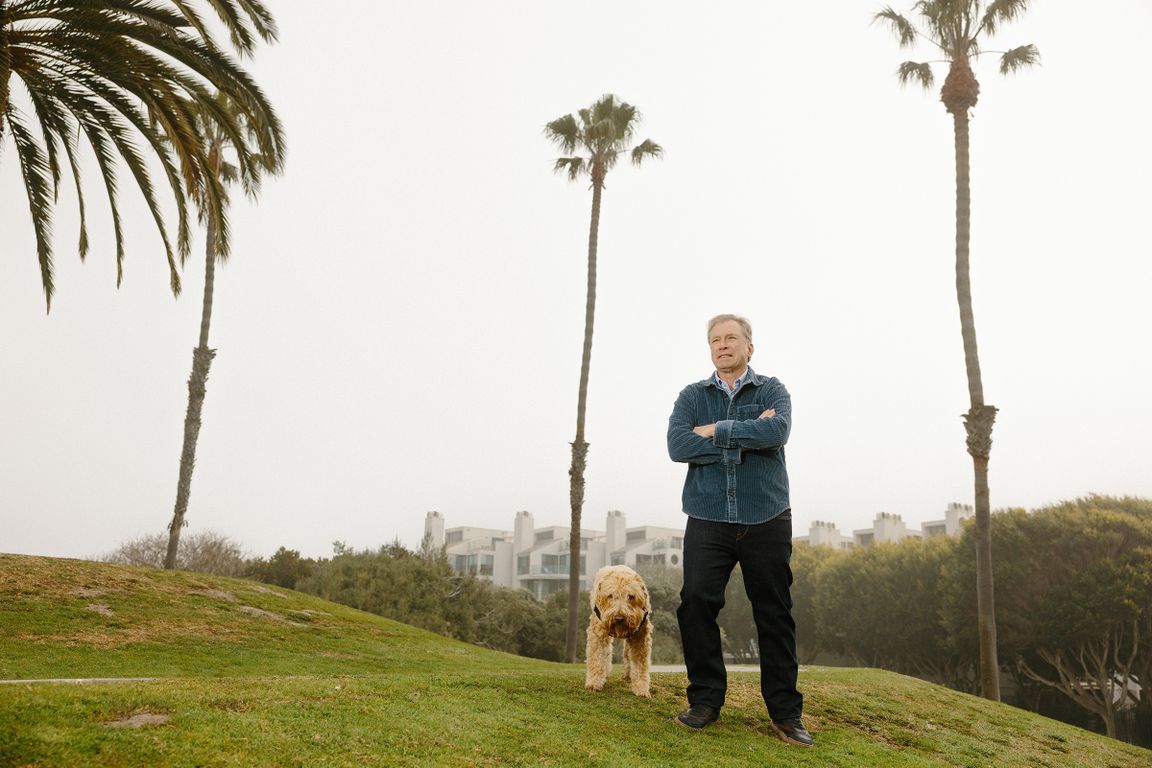
It’s a chilly morning at Jerrett’s Venice home; his boiling kettle has just whistled, and he’s making himself a cup of tea. He’s bespectacled, with a neat, close-cropped goatee-and-beard combo that hasn’t quite yet turned all white. In his yard, two long twisted trunks of palm trees jut into the sky; bountiful green vegetation crowds into the frames of three large window panels. Sunshine bursts through the skylight in his kitchen.
However calm Jerrett appears on the outside, he’s been nothing short of relentless in gathering the health data that can help people in disadvantaged areas advocate for themselves. And when you’re trying to reverse the negative impacts of climate change on communities, it also helps to have an ally like new UCLA chancellor Julio Frenk, who boasts a peerless record as a leader in global public health. Chancellor Frenk also holds an appointment in the Fielding School as distinguished professor of health services and management. “Having a chancellor who is really attuned to these public health messages,” Jerrett says, “is going to be a real boon for UCLA, particularly at this juncture, where we really do need to have leading voices talking about issues like climate change, public health, infectious disease or health inequalities.”
When I ask Jerrett about degrowth, he brings up ecological economics and green accounting and the 1973 book Small Is Beautiful: Economics as if People Mattered, by British economist E. F. Schumacher. All center on a resistance to the dominant order of globalization and “growth-at-all-costs” economics. While this concept has been around for a long time, it’s been a hard sell, Jerrett says, because most people are so locked into the idea that economic growth automatically means an increase in human prosperity. What the degrowth movement and related areas like ecological economics propose is a better accounting system for the way we measure growth.
Currently, with the way gross domestic product is calculated, if we pollute the environment and then spend billions of dollars to repair that — by, for example, cleaning our water or reducing air pollution — those government expenditures count as an increase in economic growth, although the pollution and subsequent cleanup don’t net a related increase in human well-being. A similar process is involved in the depletion of natural resources. Jerrett argues that if water sources like the Ogallala Aquifer in the High Plains of Texas are exhausted, the loss should be accounted for in a way that’s reflected in a metric such as GDP.
There is plenty of debate, Jerrett says, about the idea of accounting for economic development in ways that reflect whether or not communities and ecosystems are being made better off. But the benefits of taking stock of the true costs of resource depletion and the spoiling of the environment are clear for him to see. When there are byproducts, like pollution, that result from a transaction between two economic actors, those are euphemistically termed “externalities.” Referring to one of his current large-scale research projects — focused on the massive methane leak at the Aliso Canyon Natural Gas Storage Field in 2015 — Jerrett says, “There can be a huge number of costs, like all the people who were potentially made sick from the Aliso Canyon disaster.”
Stella Kalinina
“One thing that makes me more hopeful in terms of mitigating climate change is that there’s been a real revolution in green energy,” Jerrett says. “We’re at that juncture where the cheapest way to generate electricity is from the sun and the wind.”
Looking on the Bright Side
Jerrett and other climate change scholars are currently tackling the big issue of whether California’s carbon Cap-and-Trade Program is actually effective as an economic incentive to reduce greenhouse gas emissions and help the Golden State achieve its goal of carbon neutrality by 2045. Under the system, the state caps the amount of carbon that can be put out and then distributes shares of that, which can be traded. The idea is to reduce carbon emissions and then allow economic actors to trade carbon rights. In theory, this should lead to a more efficient allocation of resources and a reduction in carbon.
The state’s Community Air Protection Program mandates that a portion of the cap-and-trade funds must go to reduce pollution in disadvantaged areas. Lack of funding has long been a major obstacle to making communities in underprivileged areas healthier, and Jerrett says that one of the problems with cap-and-trade is that it’s spatially blind: If a company is a big polluter in a disadvantaged neighborhood, it can simply “buy” reductions elsewhere and then not have to reduce emissions and other pollutants as much in the first neighborhood.
It’s all a work in progress. But, in general, it’s working, he says. “There’s always going to be the threat that there will be some companies or individuals gaming the system,” he admits. “But it does move us in the right direction.”
(Not So Little) Fires Everywhere
It’s hard to find anyone in Los Angeles who has not been affected, in a way big or small, by the wildfires that roared through the county in January. The fires seemed to confirm the assessments by the Intergovernmental Panel on Climate Change that extreme heat increase will continue to be a havoc-wreaking global phenomenon. Jerrett says it will be particularly acute in areas that are already extremely hot, like the U.S. Southwest. Adverse consequences for public health always accompany extreme heat events; the fires — exacerbated by severe drought — have been no different.
Jerrett has long said that while human actions are contributing to the ubiquity of the blazes, climate change is creating conditions that are very conducive to fires. Partly responsible are the extreme hydrologic events that vary greatly from year to year, with deluges followed by dryness. The heavy precipitation leads to a buildup of biomass in the forest, Jerrett explains, which is fuel for the fires. Then the drought dries it out and makes it conducive to any kind of spark. Previously, the main drivers of wildfires were lightning strikes; now, estimates show that 85% to 90% of the fires are started by humans.
Some of the deadliest effects of these only become clear down the road. Last year, Jerrett and his research team published a paper in Science Advances that showed that from 2008 to 2018, more than 50,000 people were likely dying from wildfire smoke in California, with the loss of productivity and health care costs amounting to more than $450 billion. Beyond that, there are what Jerrett calls “secondary knock-on effects,” in this case meaning that after an area has been burned, it’s more prone to mudslides and landslides.
Along with his colleagues, Jerrett is now scanning the scorched L.A. terrain to help homeowners and insurers better understand the climate risks. He would also like to collect fire-zone air pollution samples to find out what particles that people returning to the area will be breathing in. The goal is to better understand what people encounter when they return to areas affected by fires — and to offer definitive guidance on what is and isn’t safe.
The aftereffects of wildfires are just one of many fronts on which Jerrett is battling — for answers, for insights, for political action. His studies on the Aliso Canyon disaster in the San Fernando Valley, which caused the single largest release of methane ever recorded in the U.S., led Jerrett and his team of UCLA researchers to a $21 million Los Angeles County Department of Public Health grant to conduct a five-year study on the short- and long-term effects of the disaster. The details are staggering. “Natural gas is about 96% methane, which is the second most important greenhouse gas after carbon dioxide,” says Jerrett. The 100,000 metric tons of greenhouse gas emissions from the leak, he says are “equivalent to running all the cars and trucks in California for an entire year.”
But if Jerrett has one overriding passion, it’s environmental justice. One of the foremost concepts he mentions is “double jeopardy.” People living in disadvantaged neighborhoods lack proper access to green spaces and healthy foods, and they’re more likely to work in hazardous jobs, so they’re at higher risk for many chronic and infectious diseases. Double jeopardy results when residents of such neighborhoods are also exposed to a higher dose of pollution, worsening their disadvantaged conditions. Jerrett’s focus on justice is as much personal as scientific. “Having grown up in one of these areas myself,” he says, “I have sort of an intrinsic feel for what it’s like to be disadvantaged and powerless.”
In his days teaching at UC Berkeley, Jerrett would often argue with colleagues that “while the impacts [of climate change] may not be as severe for Americans, it is still going to start killing people, and it’s going to happen in our lifetimes.” His prognostications have been proven accurate by month after month of tragic events unfolding across the country: the L.A. fires; Northern California’s Park Fire last summer; floods in North Carolina in the aftermath of Hurricane Helene; more flooding from storms like Milton that hit Florida; and Hurricane Francine in Louisiana.
What will it take for society to truly and effectively respond to the growing climate crisis? Jerrett says the solutions are simple and, if we dare to act collectively, there for us to grasp. “When we think about solutions to climate change, getting people out of their cars is a multifaceted win,” he says, with his customary Canadian optimism. “It reduces the greenhouse gas emissions, so it’s mitigating the climate change threat. It’s dealing with what’s really an epidemic of physical inactivity in American society. So there are benefits, and we need to be doing a lot more to make it safer for people to walk and bike. That means taking space away from cars and putting in bike lanes and protected areas where people can feel safe.”
The 2028 Olympics in L.A., Jerrett says, will open up a huge opportunity for the city to make sizable investments to improve its urban structure, as often happens in cities hosting the games. L.A. has already committed to making the event car-free; that can’t happen without installing major infrastructure for cycling, walking and public transit. But such moves can make a huge difference: When Paris undertook similar renovations before hosting the 2024 Olympics, cycling in the City of Light doubled between October 2022 and October 2023, Le Monde reports. “In mobility more than elsewhere, the central issue is supply rather than demand,” David Belliard, deputy mayor of Paris, told the paper.
For Jerrett, it’s all been a long time coming. “These are things that take a slow burn, and then they’re going to hit that tipping point,” he says. “In Paris, it was the Olympics that really incentivized them.”
Perhaps if L.A.’s civic leaders put forth an Olympian effort of their own, Angelenos will see a similar transformation by 2028.
Read more from UCLA Magazine’s Spring 2025 issue.