There is a lot of talk about China vs. US right now, esp. when it comes to manufacturing.
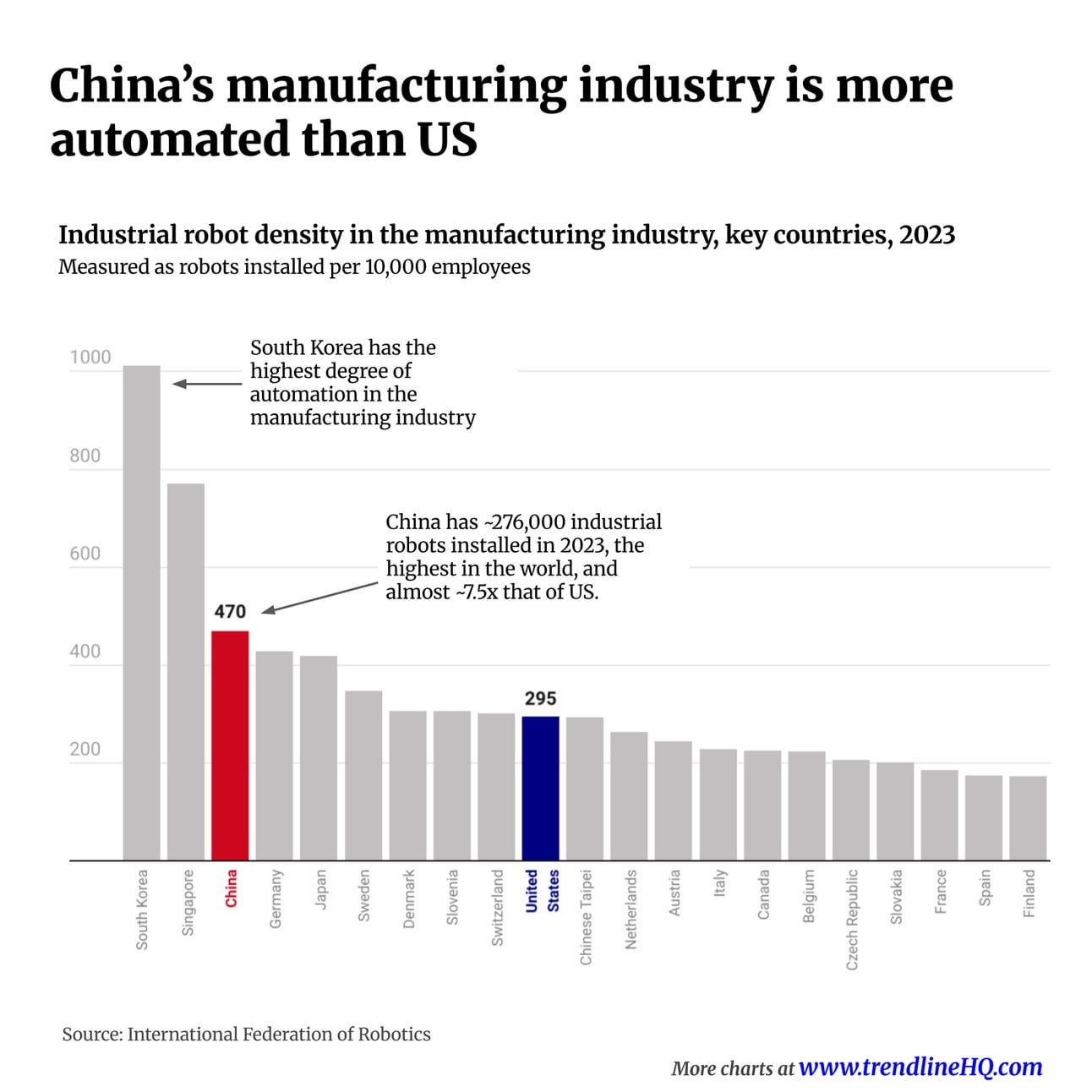
According to international federation of robotics, the Chinese manufacturing industry has much higher degree of automation than US (South Korea is the most automated).
The federation tracks data on installed base of industrial robots for various applications and compares it across countries. Very telling chart below – China’s manufacturing isn’t just competing based on cheap labour but has high degree of automation, 3rd highest in the world and much higher than US.
In this statistic, Industrial robots are defined as: an “automatically controlled, reprogrammable multipurpose manipulator, programmable in three or more axes, which can be either fixed in place or fixed to a mobile platform for use in automation applications in an industrial environment�.
I have to believe there’s a better measure of automation than “how many robots do you have”. Perhaps a measure of the capital intensity vs. labor intensity of goods?
It’s not really that surprising. American manufacturing has for years had more success with smaller batches of high quality goods.
As an example I own two felling axes. One is a cheap one bought at Home Depot in a pinch for storm cleanup as my other axe was in the shed at the woodlot and thus far from home. It’s fine. Does the job, reasonably sturdy, it doesn’t really hold an edge for long but that’s what angle grinders are for. Good value for the cheap price. I’m not unhappy with it so long as I’m not using it all day long for multiple days.
My other axe cost $160 CAD over a decade ago and is American made, it is hand made and is an absolute beauty of an axe. Strong hardwood handle, immaculate grip, holds an edge seemingly forever and cuts through hardwood like its warm butter. I’m also not unhappy with it.
Americans expect to be paid well for their labor and the price point on high end or luxury products are more likely to accommodate that. Outside of the automotive sector American made for many years meant quality products with a good warranty and a company that stands behind their product.
Too bad I won’t be buying anything American made for the foreseeable future.
More updated source:Â https://ifr.org/img/worldrobotics/Press_Conference_2024.pdf
Some questions/observations:Â
US still dominates as country of origin for robotics mfg.Â
US/germany seeing growth, China matches world growth.
Robotics mostly used for handling purposes.Â
Who owns the robots? Some can’t be moved some can be easily by corp.Â
Per employees of same corporation? I ask because China has made amazing advancements in electrical windings, it’s highly automated and skilled, but fewer employees.Â
Good read OP if you click through the pdf has more update information.Â
How do you even quantify number of robots when automation is often multiple machine integrated into a system?
Which get to the question how variable is the output you get from each ‘robot’.
No surprises there, I wholly suspect this is behind the push to repatriate manufacturing to the US, it’s not to bring jobs it’s to use China’s progress in automation to automate our own factories so we can be part of the supply line. Also why he’s so intent on controlling global shipping lanes like Panama and the Arctic. Problem is, he’s going about it the dumbest way possible
China is well past the copying stage. They are now in the innovating stage. China is on track to produce nearly twice as many STEM PhD graduates annually as the United States by 2025. The U.S. is fu*%# with the moronic stooge in charge.
Idk if looking at quantity of robots is really useful here. How big are the factories in China? You can have all the AMRs you want, it ain’t going to help you in giant US warehouses full of racking which are serviced by a smaller fleet of AGVs.
Maybe the robots are the peasants JD Vance was talking about? /s
11 comments
There is a lot of talk about China vs. US right now, esp. when it comes to manufacturing.
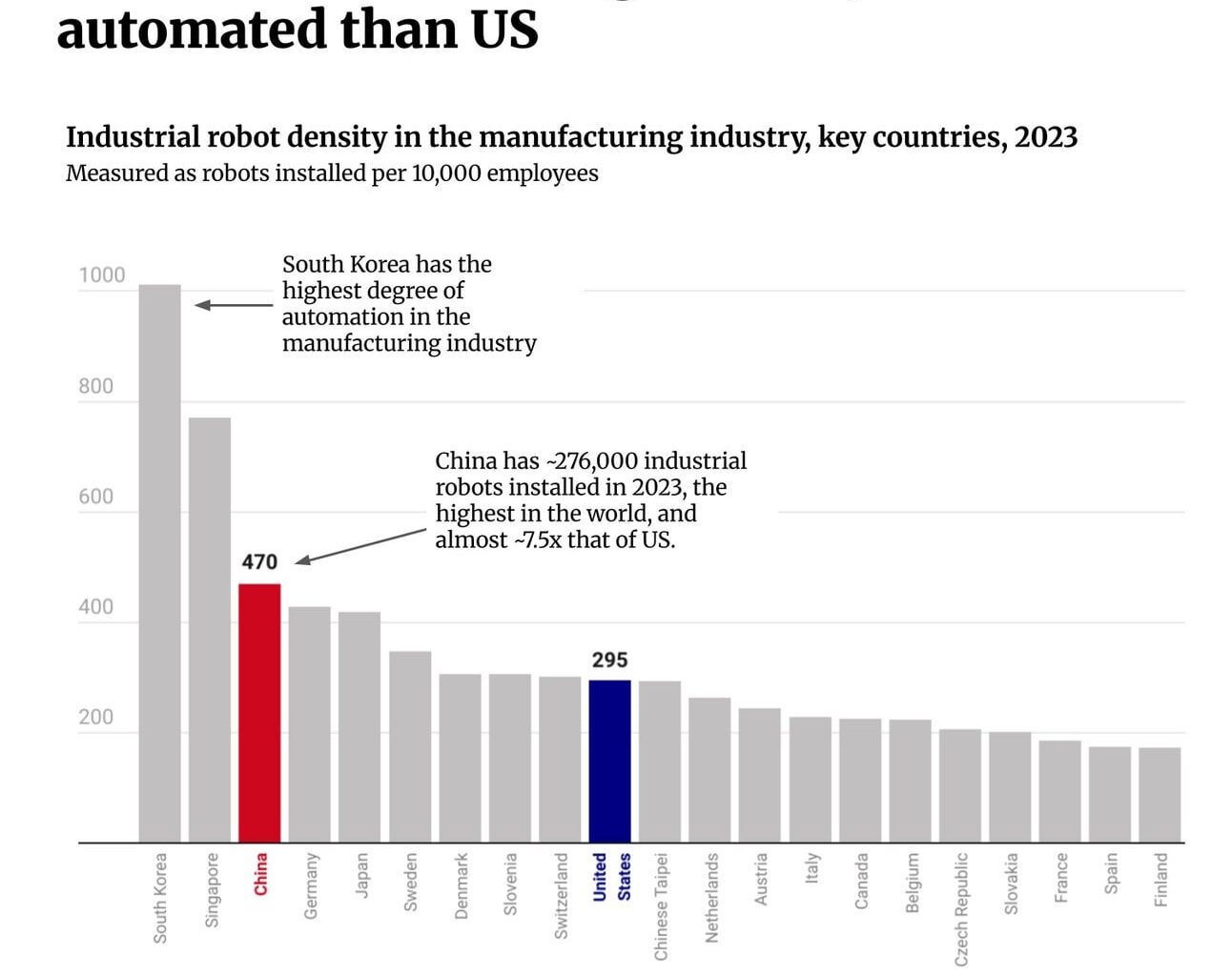
According to international federation of robotics, the Chinese manufacturing industry has much higher degree of automation than US (South Korea is the most automated).
The federation tracks data on installed base of industrial robots for various applications and compares it across countries. Very telling chart below – China’s manufacturing isn’t just competing based on cheap labour but has high degree of automation, 3rd highest in the world and much higher than US.
In this statistic, Industrial robots are defined as: an “automatically controlled, reprogrammable multipurpose manipulator, programmable in three or more axes, which can be either fixed in place or fixed to a mobile platform for use in automation applications in an industrial environment�.
[Chart Source](https://www.trendlinehq.com/p/china-s-automation-edge-over-us)
[deleted]
I have to believe there’s a better measure of automation than “how many robots do you have”. Perhaps a measure of the capital intensity vs. labor intensity of goods?
It’s not really that surprising. American manufacturing has for years had more success with smaller batches of high quality goods.
As an example I own two felling axes. One is a cheap one bought at Home Depot in a pinch for storm cleanup as my other axe was in the shed at the woodlot and thus far from home. It’s fine. Does the job, reasonably sturdy, it doesn’t really hold an edge for long but that’s what angle grinders are for. Good value for the cheap price. I’m not unhappy with it so long as I’m not using it all day long for multiple days.
My other axe cost $160 CAD over a decade ago and is American made, it is hand made and is an absolute beauty of an axe. Strong hardwood handle, immaculate grip, holds an edge seemingly forever and cuts through hardwood like its warm butter. I’m also not unhappy with it.
Americans expect to be paid well for their labor and the price point on high end or luxury products are more likely to accommodate that. Outside of the automotive sector American made for many years meant quality products with a good warranty and a company that stands behind their product.
Too bad I won’t be buying anything American made for the foreseeable future.
https://preview.redd.it/szait02exvte1.png?width=2878&format=png&auto=webp&s=b2c75218f8540413395218d7b6317f4fd27dac27
This should not be news in 2025.
More updated source:Â https://ifr.org/img/worldrobotics/Press_Conference_2024.pdf
Some questions/observations:Â
US still dominates as country of origin for robotics mfg.Â
US/germany seeing growth, China matches world growth.
Robotics mostly used for handling purposes.Â
Who owns the robots? Some can’t be moved some can be easily by corp.Â
Per employees of same corporation? I ask because China has made amazing advancements in electrical windings, it’s highly automated and skilled, but fewer employees.Â
Good read OP if you click through the pdf has more update information.Â
How do you even quantify number of robots when automation is often multiple machine integrated into a system?
Which get to the question how variable is the output you get from each ‘robot’.
No surprises there, I wholly suspect this is behind the push to repatriate manufacturing to the US, it’s not to bring jobs it’s to use China’s progress in automation to automate our own factories so we can be part of the supply line. Also why he’s so intent on controlling global shipping lanes like Panama and the Arctic. Problem is, he’s going about it the dumbest way possible
China is well past the copying stage. They are now in the innovating stage. China is on track to produce nearly twice as many STEM PhD graduates annually as the United States by 2025. The U.S. is fu*%# with the moronic stooge in charge.
Idk if looking at quantity of robots is really useful here. How big are the factories in China? You can have all the AMRs you want, it ain’t going to help you in giant US warehouses full of racking which are serviced by a smaller fleet of AGVs.
Maybe the robots are the peasants JD Vance was talking about? /s
Comments are closed.